
What changed
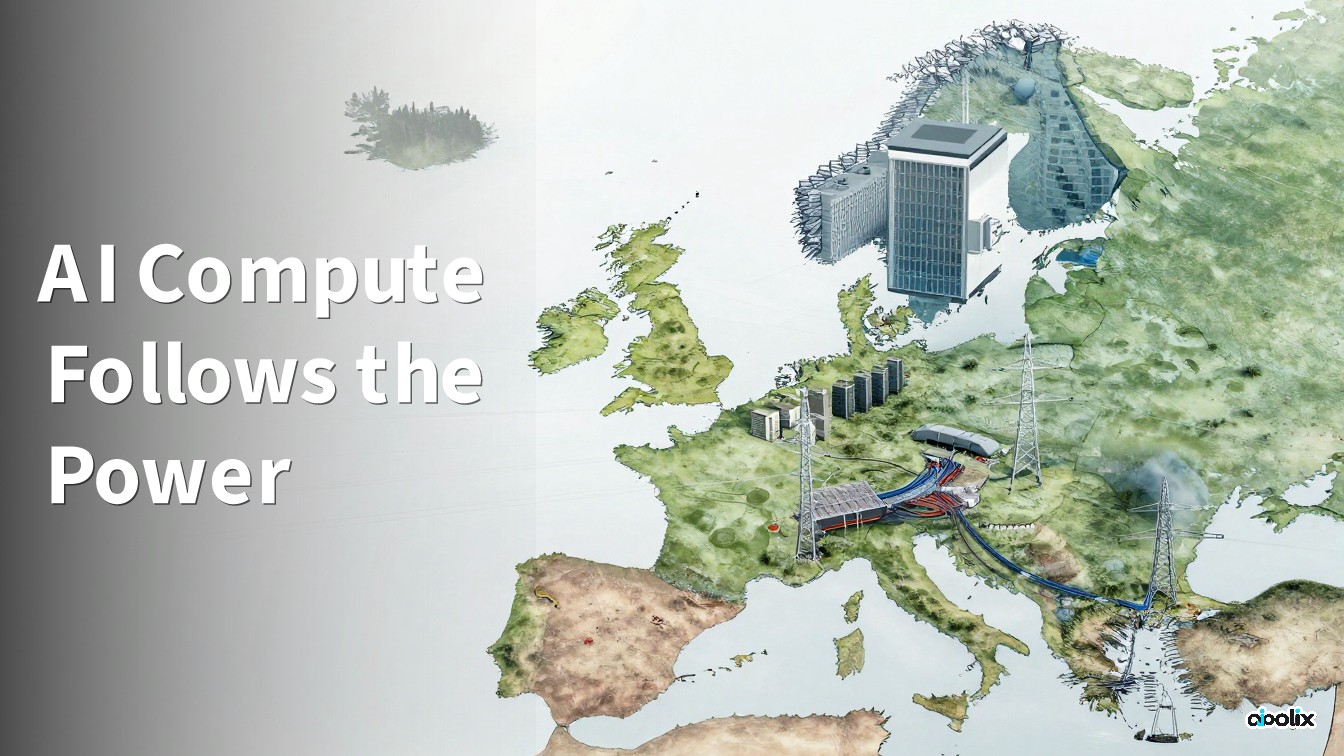
Europe's hyperscale data-center pipeline is moving farther from established metropolitan hubs as AI workloads increase demand for electricity, land and large-scale infrastructure. The change is not that core cloud regions are disappearing. It is that a growing share of incremental capacity is being planned where power can be secured more quickly and at larger scale.
In its Mid-Year 2026 EMEA Data Centre Report, JLL says European hyperscale projects planned for 2026 to 2028 are on average about 175 km from major hubs, compared with roughly 46 km for projects delivered from 2022 to 2025. JLL also reports that greenfield projects account for about 39% of the new pipeline, up from about 8% in the earlier period.
Those figures come from JLL's proprietary dataset. JLL is also a commercial participant in the data-center real-estate market, so the measurements should be treated as JLL's market data rather than independent public statistics. Reuters reporting independently supports the broader direction of travel: developers are increasingly seeking locations with cheaper or faster access to power and land.
Why power is becoming an architecture constraint
AI infrastructure changes the economics of location because large training clusters and high-volume inference fleets can require substantial, predictable power. In constrained metropolitan markets, grid connection queues and limited substation capacity can become schedule risks that are as material as servers, accelerators or networking.
This makes geography part of systems architecture. A model deployment plan can no longer assume that all compute should sit near the largest user population or in a traditional cloud hub. Engineers increasingly have to balance latency, power availability, network transit, data residency, capacity reservations and workload portability.
A two-layer geography may emerge
One useful architectural hypothesis is a two-layer model. Compute-intensive training and other latency-tolerant workloads can move toward power-rich regions, while latency-sensitive inference remains closer to users and enterprise systems. This is an Aipolix interpretation, not a conclusion directly established by the JLL dataset.
If that pattern strengthens, architecture teams will need better workload mobility across regions. Model artifacts, checkpoints, feature pipelines, observability data and serving layers may have to operate across a wider physical footprint without creating unacceptable data-governance or network costs.
What this means for cloud and enterprise strategy
For cloud buyers, regional capacity may become a procurement variable rather than a background assumption. A nominally preferred region may not have the accelerator inventory or power headroom required for a large expansion. Multi-region design can therefore become a capacity strategy as well as a resilience strategy.
For enterprises building private or hybrid AI infrastructure, site selection increasingly links facilities engineering with model strategy. Power contracts, grid timelines, cooling design and network connectivity can shape which workloads are economical to place on-premises, in colocation facilities or in public cloud.
Portugal and Iberia
Portugal and the wider Iberian market could benefit from this redistribution because developers are looking beyond the traditional European hubs. Local reporting has pointed to energy availability, connectivity and land as investment advantages. That case should not be overstated: site economics depend on grid connection certainty, network routes, permitting, water and cooling requirements, and actual customer demand.
A recent Portugal-focused market report illustrates the investment interest, but it is not enough by itself to establish that Portugal will capture a disproportionate share of European AI infrastructure.
Risks and uncertainty
Distance from a major hub is only one variable and does not prove that every new AI facility will move to secondary markets. Core hubs retain advantages in fiber density, interconnection, skilled labor, customer proximity and existing cloud ecosystems. Grid availability can also change quickly as connection queues, new generation and transmission projects evolve.
The 175 km and 39% figures are specific to JLL's dataset and methodology. They are useful directional indicators, but they should not be generalized into a universal rule for all European data-center development.
Aipolix analysis
The architectural consequence is that electricity is becoming a first-order placement constraint for AI. For many large workloads, the question is shifting from 'which region is closest?' to 'which region can actually deliver the required power, accelerators and network capacity on the required schedule?'
That favors architectures that separate workloads by latency sensitivity and make placement more portable. The organizations best positioned for this shift will be those that treat physical infrastructure constraints as part of application and model architecture rather than as a facilities problem handled after the software design is complete.
References
Primary dataset: JLL Mid-Year 2026 EMEA Data Centre Report and JLL's related announcement.
Independent context: Reuters, 19 August 2026.
Global context: JLL Global Data Center Outlook 2026.
Comments
No comments yet. Be the first to comment.
Leave a comment