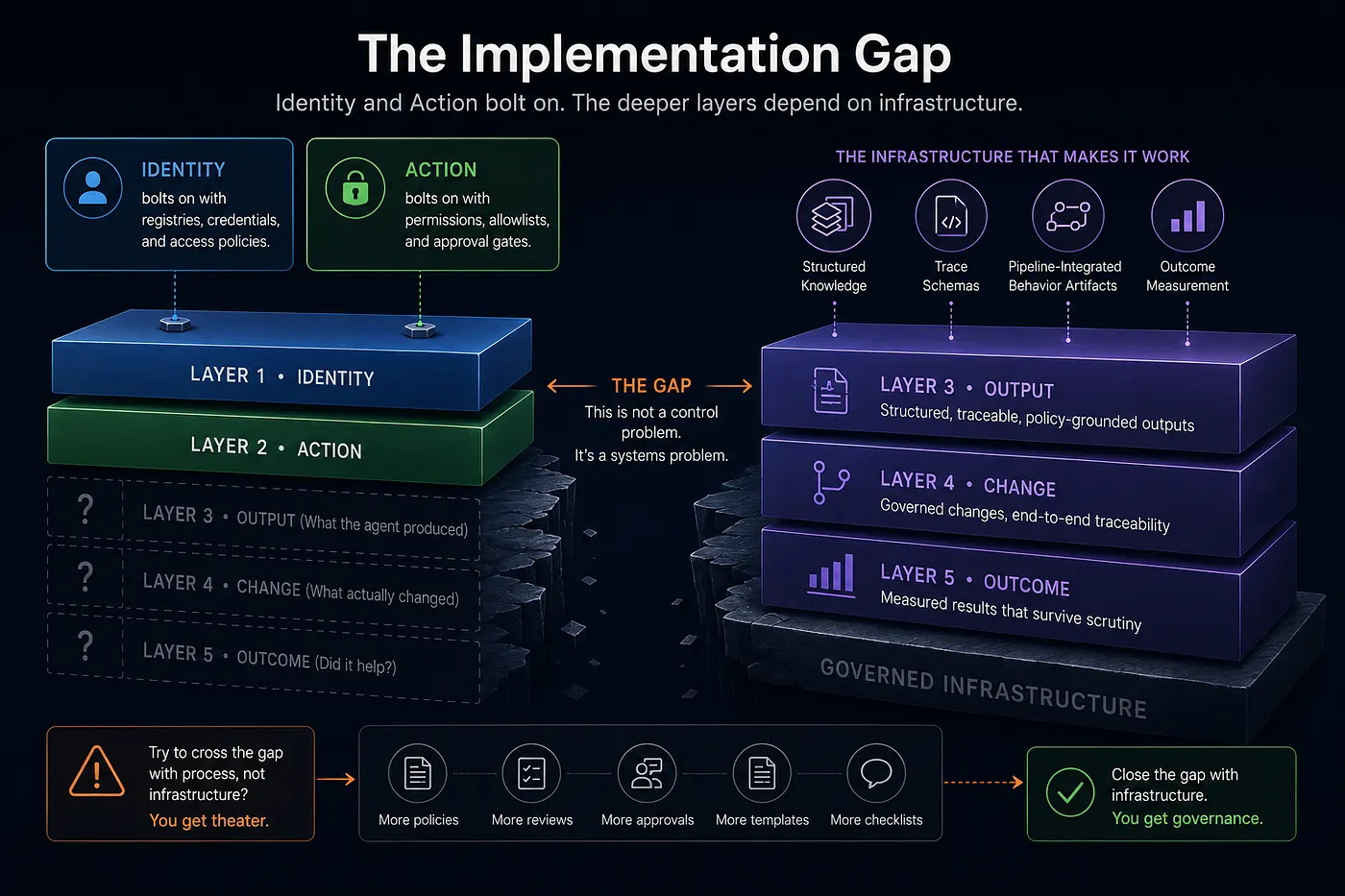
Most teams do not get stuck on agent governance because they are missing one more approval gate. They get stuck because the systems underneath the controls cannot reliably explain what the agent knew, what it changed, or whether the result was actually better.
That is the implementation gap.
This is Part 3 of the ten-part series AI Governance in an AI-Native Software Development Company. Part 2, The Five Layers of Agent Governance, defined five layers: Identity, Action, Output, Change and Outcome. Most organizations can make real progress on the first two because identity and permissions map cleanly onto familiar security and platform controls.
The harder work begins after that.
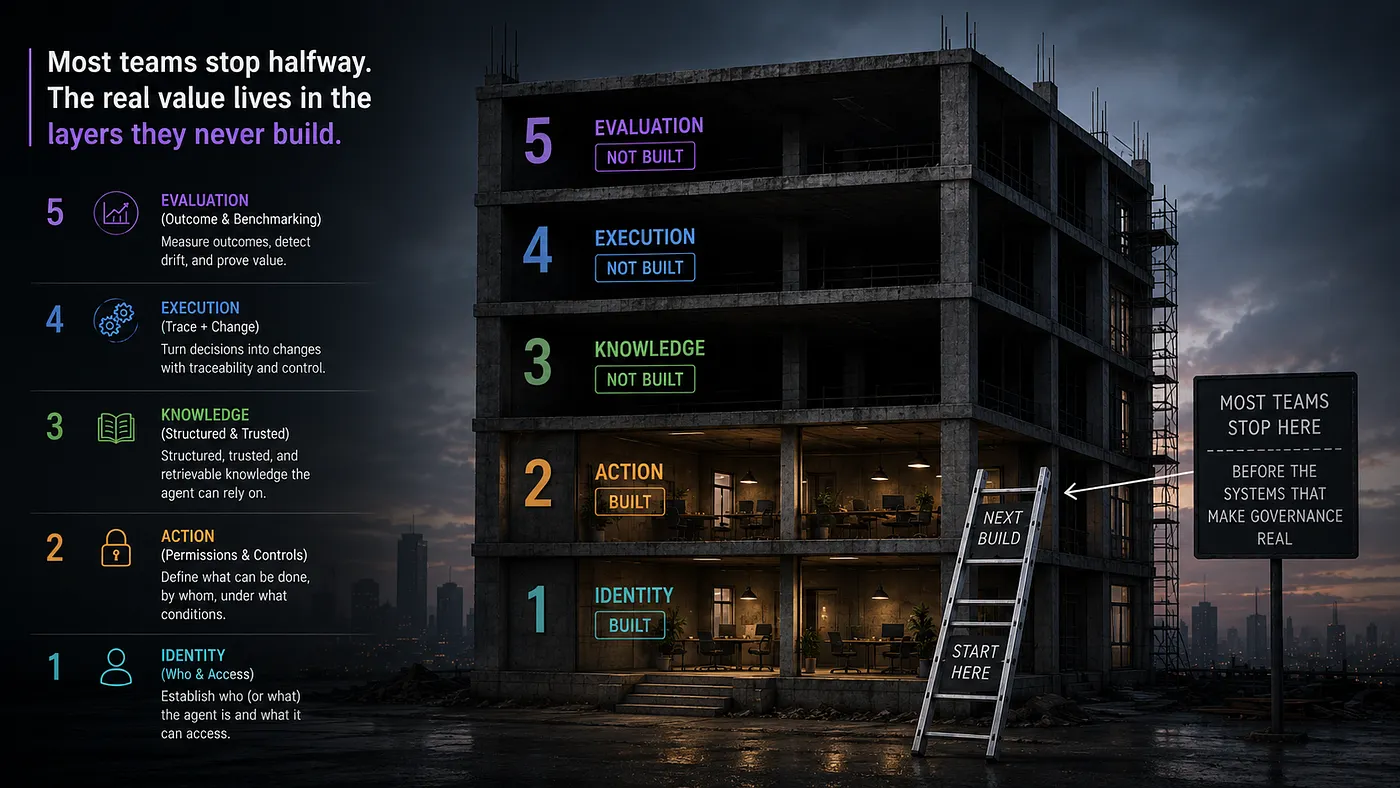
Layers 3, 4 and 5 depend on infrastructure that many companies do not yet have. They require structured knowledge, durable decision traces, behavior-aware delivery pipelines and outcome measurement that can survive technical scrutiny.
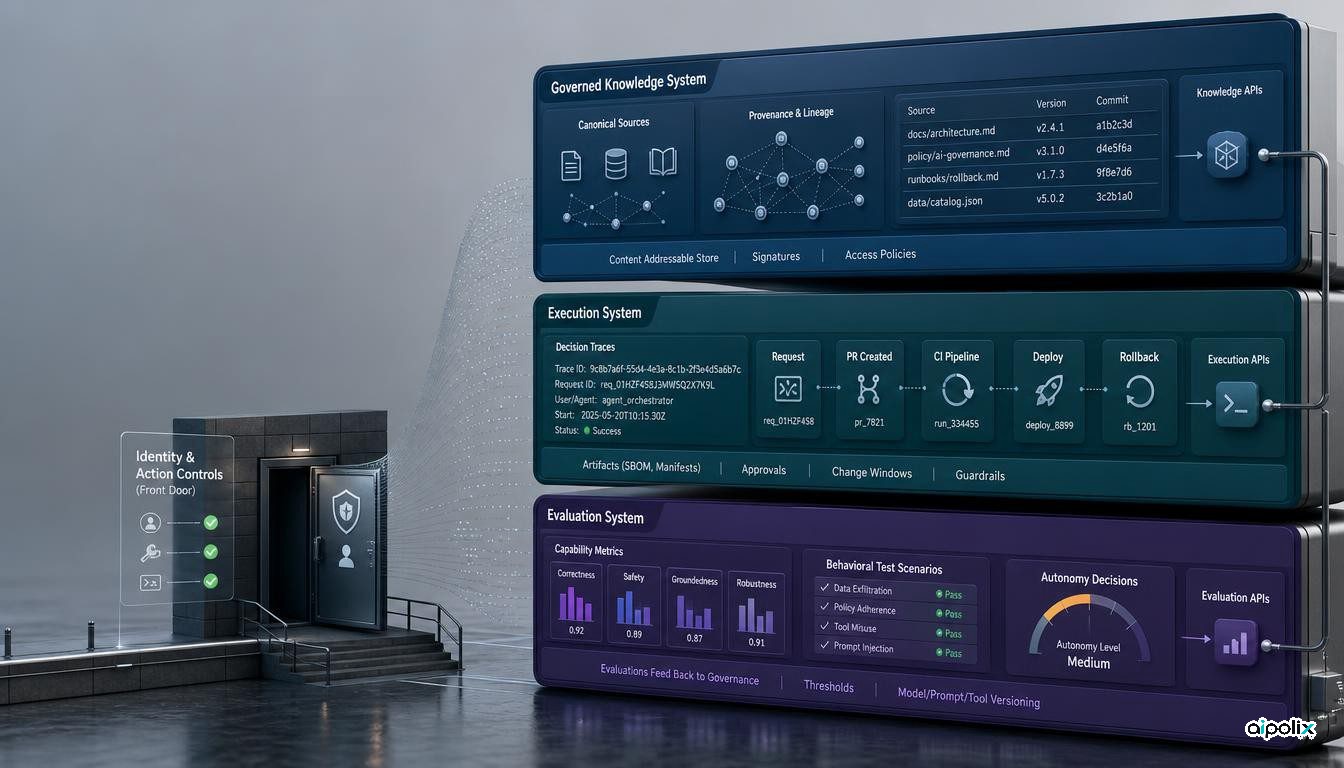
In practice, three hidden systems make the deeper governance layers possible:
- a Knowledge System
- an Execution System
- an Evaluation System
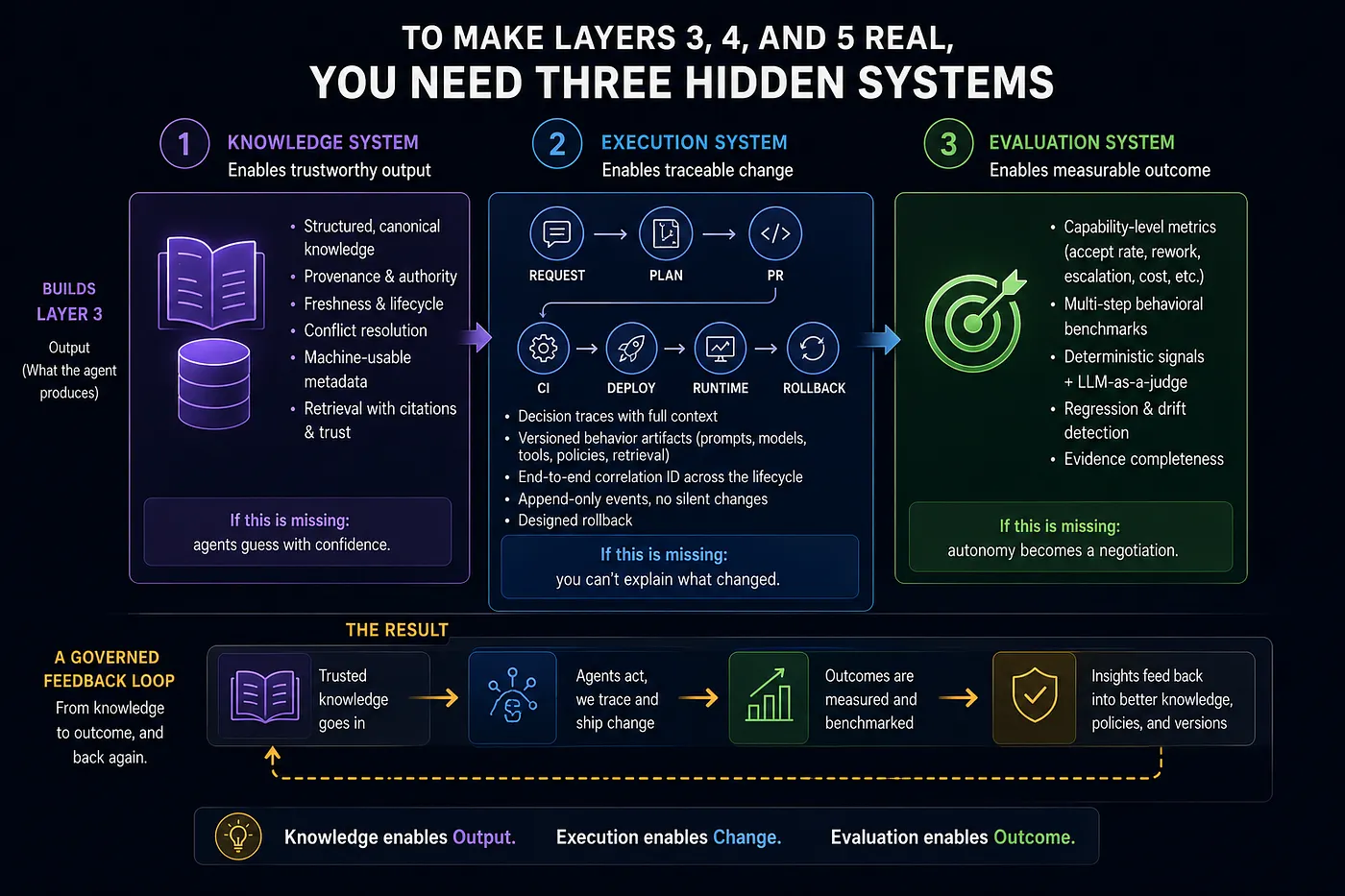
Without them, governance stays visible at the front door while the important behavior behind it remains difficult to inspect.
The missing layer between governance and reality
Identity controls answer who the agent is.
Action controls answer what the agent is allowed to do.
Those are necessary, but they are not enough to establish trust at scale.
Once an agent starts producing plans, code changes, infrastructure changes, policy-sensitive recommendations or production actions, the organization needs to answer more difficult questions:
- What knowledge did the agent rely on?
- Which version of that knowledge was authoritative?
- What decision path produced the output?
- Which prompt, model, tool and policy versions were active?
- How did the output become a production change?
- What happened after deployment?
- Did the capability improve useful outcomes or merely increase activity?
If those questions require manual reconstruction from chat logs, dashboards and human memory, governance is still mostly process.
The deeper layers need an engineering substrate.
Governance without infrastructure becomes theater.
System 1: The Knowledge Layer
Output governance starts before the agent produces an output. It starts with the quality of the knowledge the agent is allowed to consume.
Most organizations still store critical operating knowledge in forms that humans can interpret but machines cannot reliably govern: wiki pages, old tickets, Slack decisions, screenshots, copied runbooks and policy documents that contain no explicit authority or lifecycle metadata.
A human can sometimes resolve contradictions through context. An agent usually cannot do that safely unless the system exposes the structure needed to reason about trust.
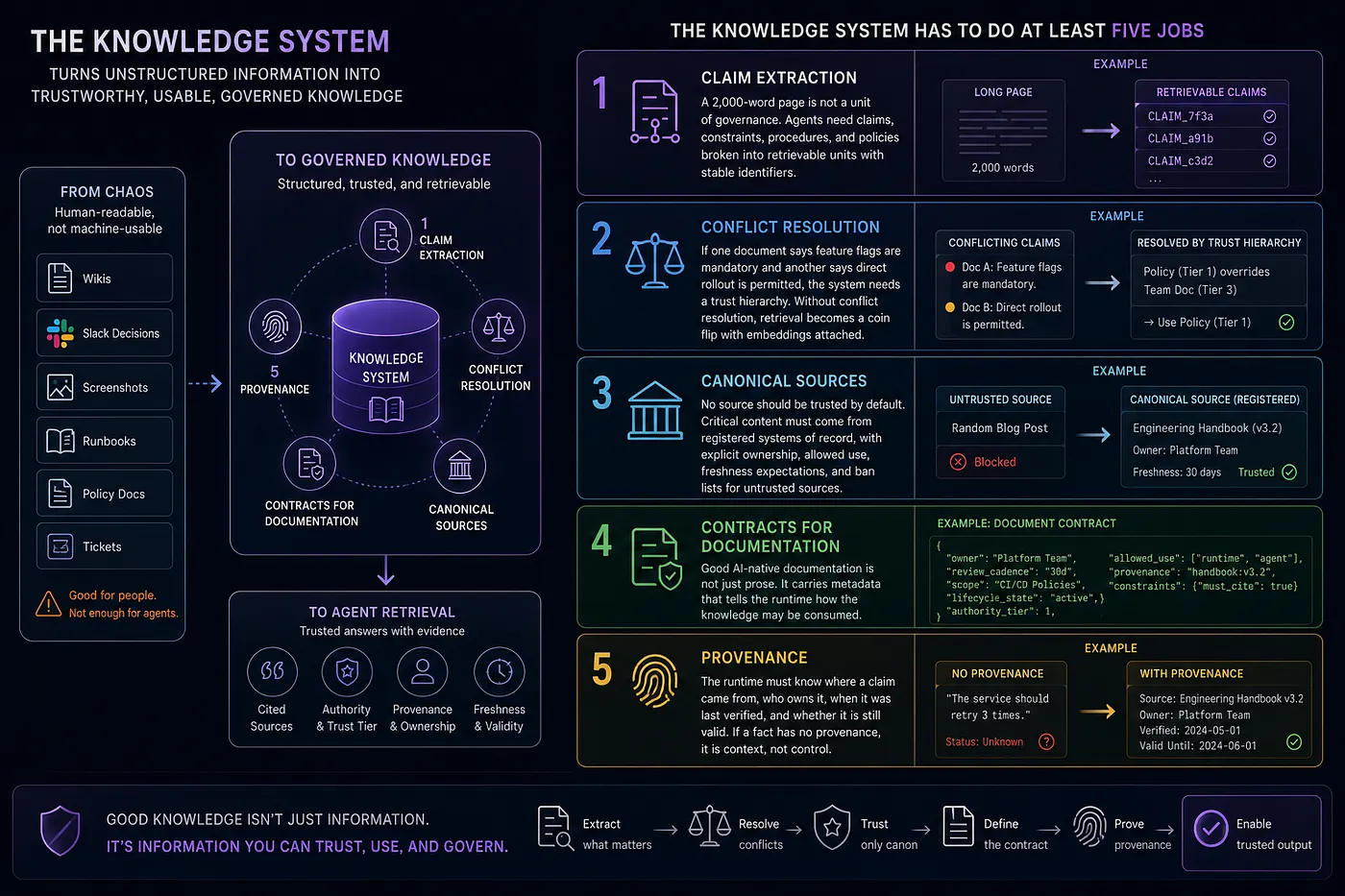
That means a governed knowledge object should carry more than prose.
At minimum, the system should know:
- who owns the information
- which source is canonical
- what scope the content applies to
- when it was last reviewed
- when it expires or needs revalidation
- which authority tier it belongs to
- where the claim came from
- whether another source conflicts with it
- how the runtime is allowed to use it
This changes the role of retrieval.
A retrieval system for governed agents should not return only text that is semantically similar. It should return evidence with provenance, authority and lifecycle context.
Break large documents into governed claims
A long document is not a useful unit of control. Policies, procedures, constraints and facts should be decomposed into stable objects that can be cited and versioned.
Register canonical sources
Critical knowledge should not become authoritative simply because it ranked first in vector search. The system needs a source registry that distinguishes systems of record from drafts, informal notes and untrusted material.
Detect conflict before generation
If two sources disagree about a deployment rule, the agent should not quietly synthesize a compromise. The knowledge layer should expose the conflict and require the runtime to follow an explicit authority rule or escalate.
Preserve provenance
Every material claim used by the agent should be traceable to its source, owner and version. If provenance is missing, the content may still be useful context, but it should not silently become control.
The principle is simple:
If all your knowledge is prose, your governance is prose too.
Layer 3, Output, cannot become trustworthy if the substrate underneath it is ambiguous, stale or unaudited.
System 2: The Execution Layer
Once knowledge is structured, governance has to follow the agent into execution.
Two different records matter here.
The first is the decision trace. It explains how the agent reached a material conclusion.
The second is the change timeline. It explains how that conclusion became a change in the real system.
They are related, but they are not interchangeable.
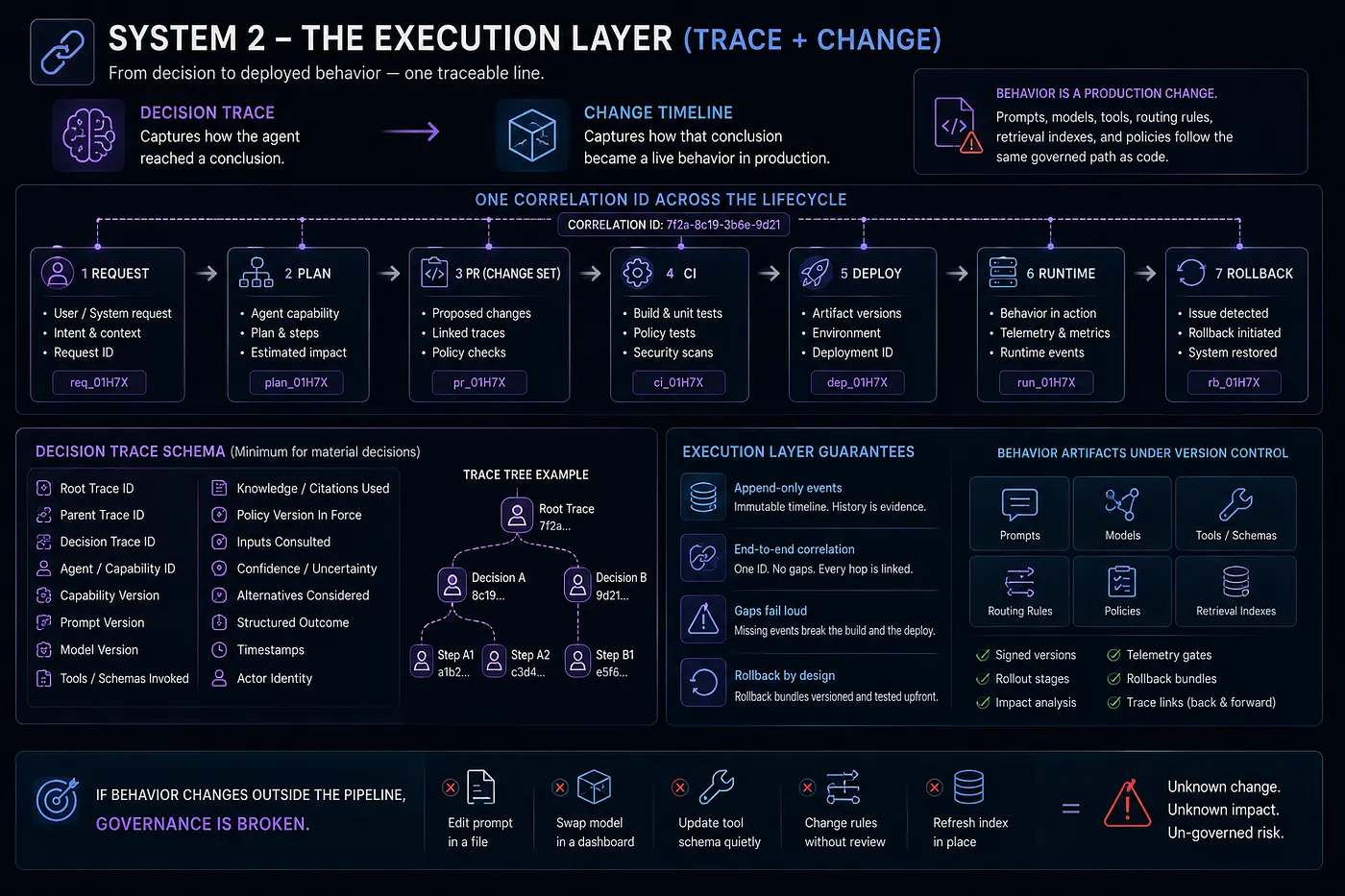
For a material agent decision, a useful decision trace should capture fields such as:
- root trace ID
- parent trace ID
- decision trace ID
- agent or capability ID
- capability version
- prompt version
- model version
- tool versions and schemas
- knowledge objects and citations used
- policy version in force
- important inputs consulted
- uncertainty or confidence signal
- structured outcome
- timestamps and actor identity
This creates the evidence required for Layer 3.
Layer 4 needs more. The organization also needs a durable line from request to production:
request -> plan -> PR -> CI -> deploy -> runtime -> rollback
One correlation ID should survive that path.
That ID should connect work tracking, code review, automated tests, deployment, observability, incidents and rollback. Events should be append-only where possible. Missing links should fail loudly instead of being treated as normal telemetry gaps.
The same principle has to apply to behavior changes that are not source-code commits.
For an agentic system, all of these can change production behavior:
- prompt updates
- model changes
- tool-schema changes
- routing logic
- retrieval configuration
- knowledge-index refreshes
- policy objects
- skill or instruction changes
If code goes through a governed promotion path while prompts and tools can be edited in place, the organization has two different change-control systems.
That is a structural governance failure.
If behavior changes outside the pipeline, governance is broken.
A mature execution system treats behavior-affecting artifacts as versioned production artifacts. They move through controlled promotion stages, carry impact metadata, emit telemetry and have rollback paths.
This is how the organization can answer not just "what code shipped?" but "what behavior was actually active when this decision occurred?"
System 3: The Evaluation Layer
The final hidden system is the one that determines whether autonomy can expand responsibly.
Outcome governance sounds simple until a team tries to prove that an agent actually improved the work.
Usage is not enough.
Token volume is not enough.
PR count is not enough.
Anecdotes from enthusiastic engineers are not enough.
A real evaluation layer works at the capability and version level.
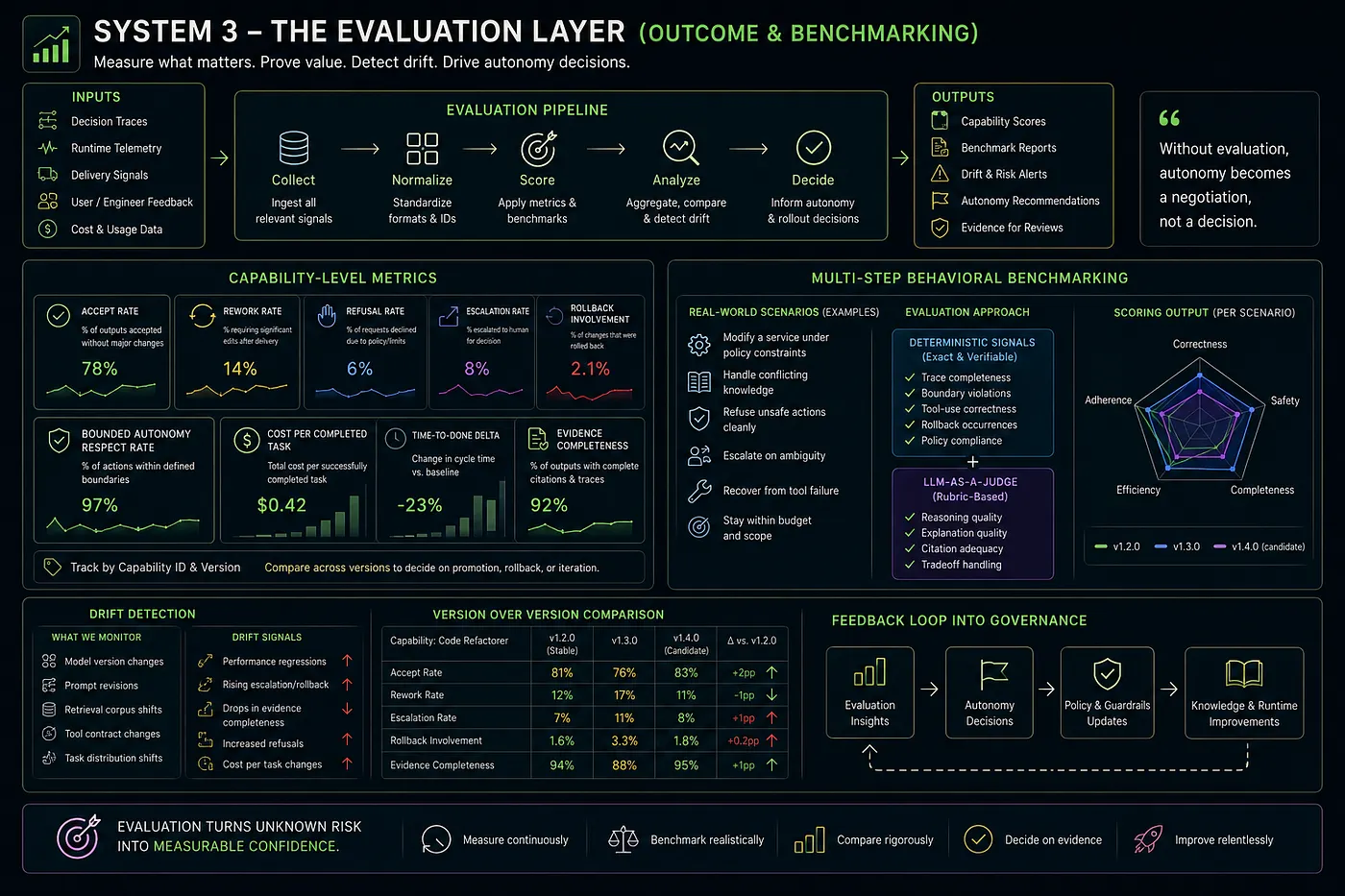
Useful operational metrics include:
- accept rate
- rework rate
- refusal rate
- escalation rate
- rollback involvement
- bounded-autonomy respect rate
- cost per completed task
- time-to-done delta
- evidence completeness
These metrics establish operational visibility. They still do not provide enough evidence for broader autonomy.
For that, teams need behavioral benchmarking.
Single-prompt tests are too weak for many agentic workloads because real agent behavior unfolds over several steps, tools, permissions and context changes. Evaluation scenarios should look more like actual work:
- modify a service while respecting policy constraints
- resolve conflicting knowledge correctly
- refuse a request that crosses an autonomy boundary
- escalate when evidence is ambiguous
- recover from tool failure
- stay inside cost and scope limits during a longer task
- complete the task while preserving trace completeness
Deterministic signals and LLM-based judges both have a role, but they should not be confused.
Deterministic checks are better for things such as policy violations, tool-use correctness, trace completeness, rollback events and explicit boundary breaches.
LLM-as-a-judge can help evaluate qualities that do not reduce cleanly to exact matching, such as explanation quality, completeness, citation adequacy or tradeoff reasoning under a defined rubric.
Good evaluation systems use both.
They also measure drift.
Agent behavior can change even when the application code does not:
- an upstream model version changes
- a prompt is revised
- the retrieval corpus changes
- a tool receives more authority
- task distribution shifts
- a policy object changes
That means evaluation must be tied to capability versions and behavior-affecting releases, not run occasionally as a separate research exercise.
Without this layer, autonomy scaling becomes political.
The team with the strongest demo gets more authority. The vendor with the loudest roadmap wins the argument. A popular tool survives even if version-level evidence shows rising rework or rollback.
Without evaluation, autonomy becomes a negotiation, not a decision.
Putting the real governance stack together
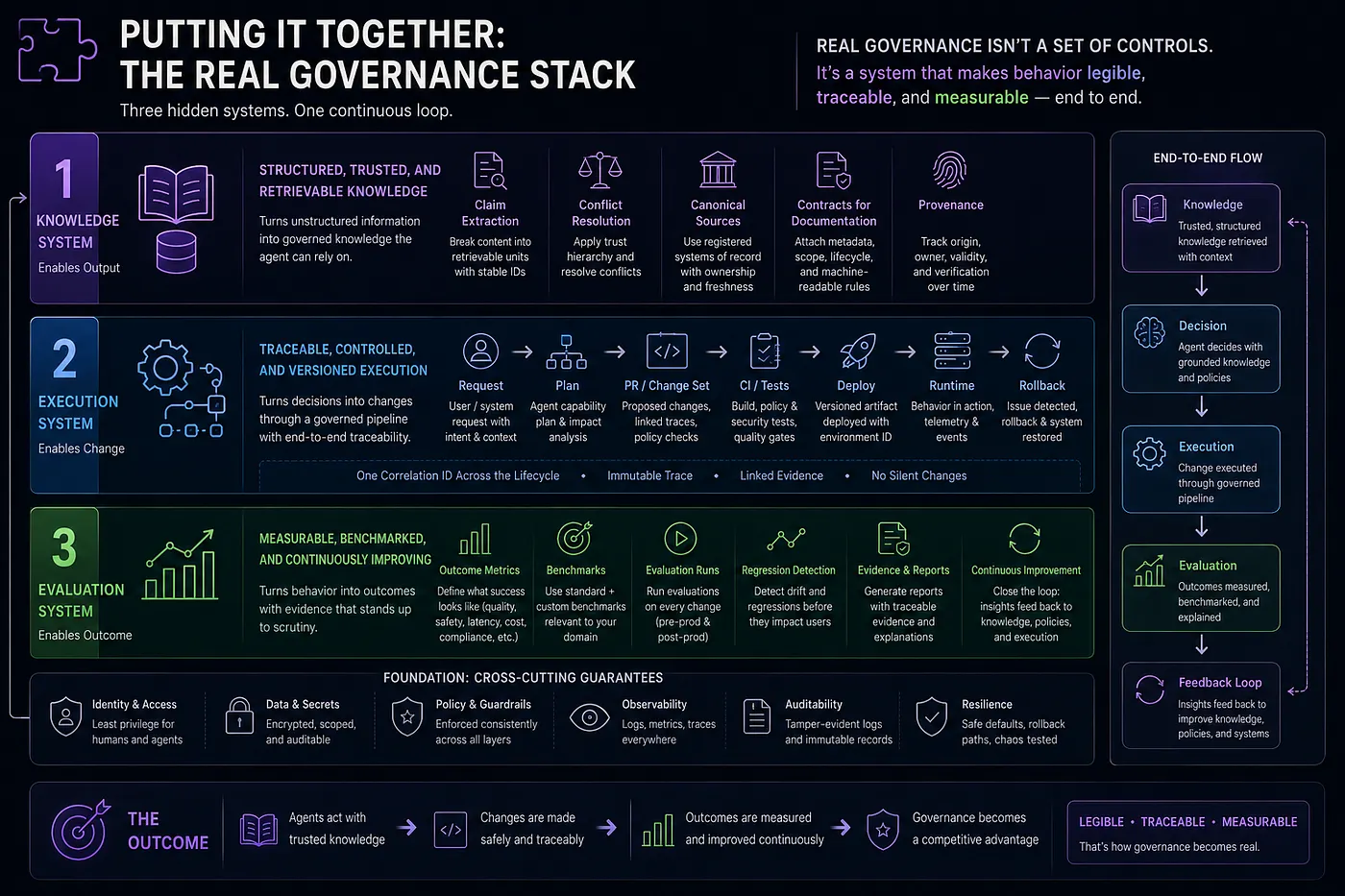
The three systems are mutually reinforcing.
The Knowledge System publishes canonical, validated, machine-usable information with ownership, provenance and explicit authority.
The Execution System consumes that knowledge, records decision evidence, versions behavior-affecting artifacts and preserves a continuous trace from request to production and rollback.
The Evaluation System consumes traces plus delivery and runtime outcomes, compares capability versions, detects regressions and turns evidence into autonomy decisions.
The dependency is straightforward:
Knowledge enables Output. Execution enables Change. Evaluation enables Outcome.
This is the infrastructure behind Layers 3, 4 and 5.
In practical terms, the loop looks like this:
- governed knowledge objects enter retrieval and runtime
- agent runtime emits structured decision traces
- the delivery pipeline versions and promotes every behavior-affecting artifact
- observability and incident systems join through shared correlation IDs
- evaluation scores capability versions using outcomes and behavioral scenarios
- governance decisions feed back into the next capability version
That loop is the operating system for real agent governance.
Not the committee.
Not the policy deck.
Not the approval template.
Practical build order
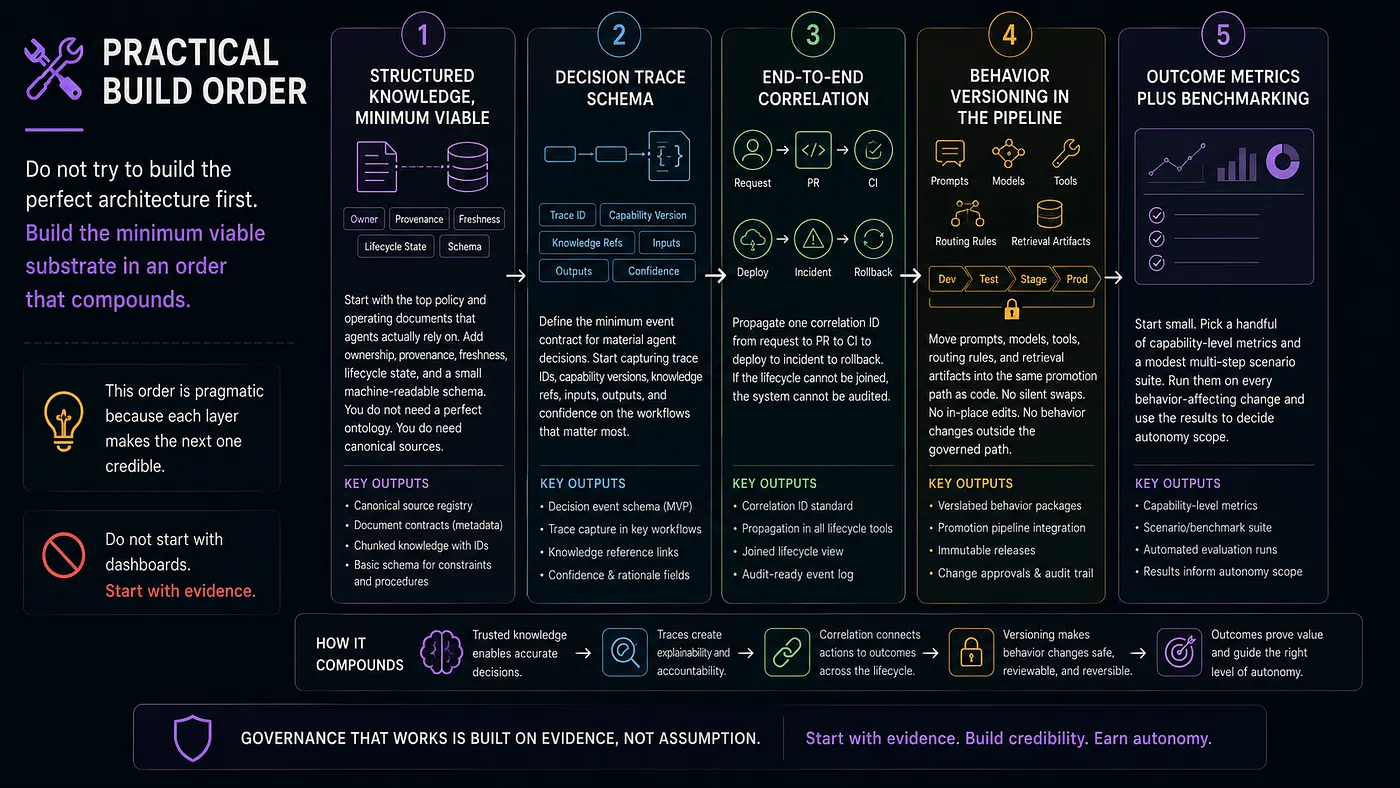
Do not start by building an enterprise-wide governance platform.
Build the minimum substrate in an order where each step makes the next one more credible.
1. Structured knowledge, minimum viable
Start with the policies and operating documents agents actually use. Add ownership, provenance, freshness, lifecycle state and a small machine-readable schema. A perfect ontology can wait. Canonical sources cannot.
2. Decision trace schema
Define the minimum event contract for material agent decisions. Capture trace IDs, capability versions, knowledge references, important inputs, outputs and uncertainty.
3. End-to-end correlation
Propagate one correlation ID across request, plan, PR, CI, deploy, incident and rollback. If the lifecycle cannot be joined, the organization cannot reliably audit it.
4. Behavior versioning in the pipeline
Move prompts, models, tools, routing rules, retrieval artifacts and policy objects into the same governed promotion model as code. No silent swaps and no in-place production behavior changes.
5. Outcome metrics plus benchmarking
Start with a small set of capability-level metrics and a practical multi-step evaluation suite. Run them on behavior-affecting changes and use the results to decide whether autonomy expands, contracts or stays unchanged.
The order matters because each system supplies evidence the next system needs.
Do not start with dashboards. Start with evidence.
Closing
You do not get agent governance by continuously adding controls around the edges.
You get it by making behavior legible, traceable and measurable.
That requires systems.
Teams that stop at identity, permissions and approval gates often believe they are one control away from maturity. Usually they are not. They are missing the infrastructure that makes the deeper layers operational.
So the useful question is not only:
"What control are we missing?"
Ask instead:
- Do agents consume knowledge we can actually trust?
- Can we explain how an agent decision became a production change?
- Can we prove whether a capability improved outcomes?
- Can we connect all three answers with durable evidence?
If not, the governance problem is architectural.
The next article moves into the next implementation boundary: policy can exist on paper and still fail completely if it never reaches runtime.
Next in the series: The Executable Policy Layer: Why Governance Dies Before Runtime.
Originally published by Reza Arani on Medium on May 6, 2026. Adapted for Aipolix as Part 3 of the AI Governance in an AI-Native Software Development Company series.
Comments
No comments yet. Be the first to comment.
Leave a comment