
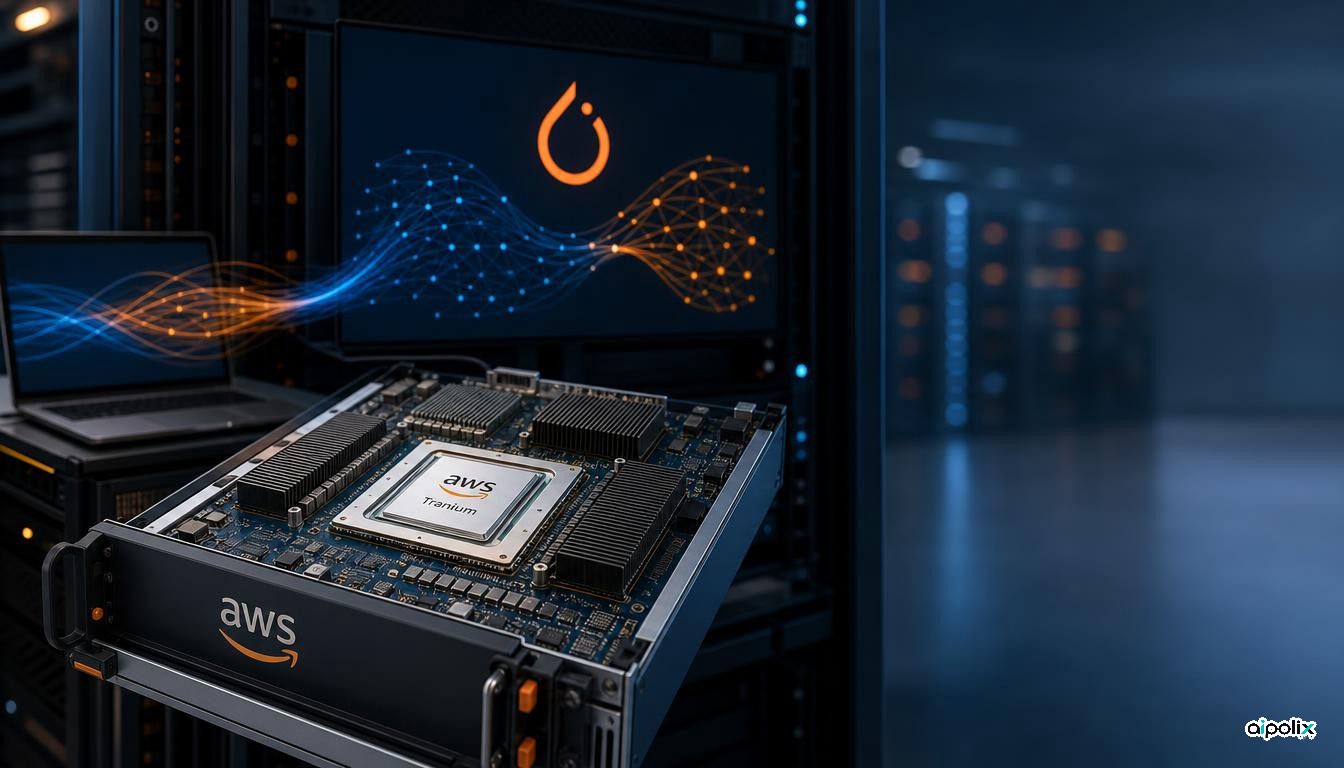
Amazon is trying to remove one of the main reasons developers stick with Nvidia. On Monday, October 19, 2026 the company opened TorchNeuron, a native PyTorch backend for its AWS Trainium chips, to all developers as a public beta, and said it will publish the software as open source under the Apache 2.0 license at PyTorch Conference North America on October 20. Reuters and GeekWire both reported the launch after interviews with Amazon's chip unit.
The pitch is that code written for PyTorch, the most widely used framework for building AI models, should run on Trainium with a single configuration change and no rewrite. Until now, GeekWire reported, developers had to modify their code to call interfaces specific to Amazon's chips. TorchNeuron instead plugs into the standard mechanism PyTorch provides for new hardware to register itself, so the usual tools for testing, debugging and scaling models work without modification, Amazon says. It supports Trainium2 and Trainium3.
Amazon is also working beyond its own backend. It says it is contributing changes upstream to PyTorch to strip out code that ties the framework to particular chips, has open-sourced its complete set of performance kernels and made a large contribution to the vLLM inference project. TorchNeuron integrates with TorchTitan, PyTorch's native distributed training framework, for scaling jobs across Trainium instances with Fully Sharded Data Parallelism. Hugging Face has added native Trainium support to its developer tools, according to Amazon.
The software is not brand new to customers. GeekWire said TorchNeuron has been in private beta since late last year, and Colin Brace, a vice president at Amazon's Annapurna Labs chip unit, told Reuters that more than 30 early customers in robotics, world models and voice AI are using it. Speech AI startup Deepgram says its benchmarks showed Trainium processing about 60% more audio per dollar than its existing GPU setup, and Amazon's Prime Video team used the tool to build a 3D replay system for NBA broadcasts. "If you know PyTorch, then you know Trainium," Brace told GeekWire.
The strategic target is Nvidia's software moat. Much of the industry's AI code was built around Nvidia's CUDA platform, and porting it to other chips can take months, which keeps many companies from switching even as cloud providers build their own accelerators. Google is pursuing a similar effort, TorchTPU, for its TPUs. Trainium's largest users so far are labs with close financial ties to Amazon, including Anthropic and OpenAI, which agreed in February to use 2 gigawatts of Trainium capacity, according to GeekWire.
Quality assurance will decide whether the no-rewrite promise holds up. Amazon says it tests TorchNeuron against hundreds of thousands of models on every build; Brace told GeekWire the nightly test suite covers more than 100,000 models from Hugging Face. Neither figure has been audited, and both describe compatibility rather than performance.
The open questions are practical ones. Customer savings figures such as Deepgram's are self-reported, and Amazon has not published independent performance comparisons with Nvidia hardware for typical training or inference jobs. Custom kernels and model-specific tuning may still matter for peak speed. The open-source release on October 20 will let outside developers check how far unmodified PyTorch workloads really go on Trainium.