Google Cloud is moving its Gemini Enterprise platform deeper into regulated professional work with two new industry packages for legal teams and financial institutions. Gemini Enterprise for Legal and Gemini Enterprise for Financial Services are available in preview from August 25, combining reusable domain skills, governed data connections, specialized agents and centralized controls. The important change is not a new foundation model. It is Google packaging agentic workflows around existing enterprise permissions, data systems and audit requirements so that organizations can deploy agents closer to production work.
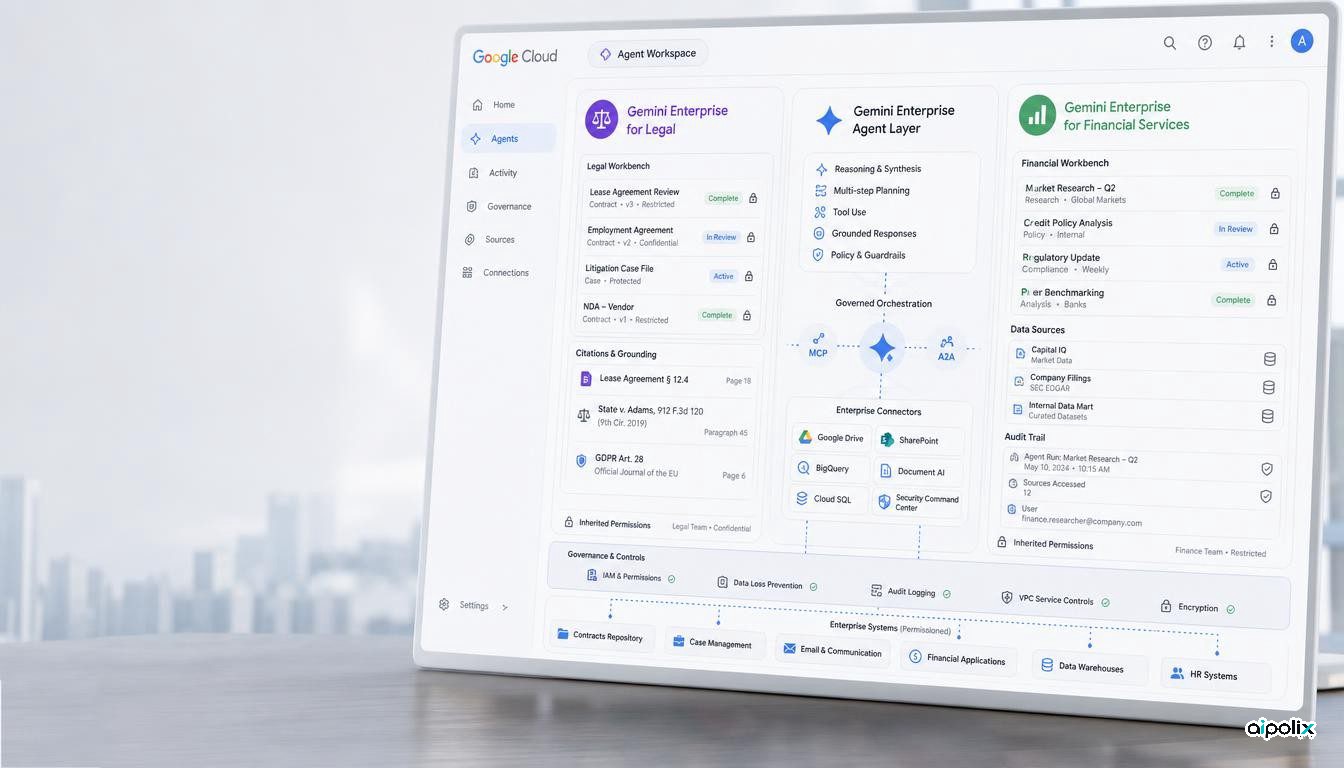
For enterprise architects and technology leaders, the launch is a useful signal about where agent platforms are heading. Google is treating model intelligence as only one layer of the system. The operational product is the combination of skills, connectors, agent execution and governance. In financial services, Google also exposes the Financial Research agent through Agent-to-Agent APIs and connects enterprise data through Model Context Protocol connectors. In legal, MCP connectors are designed to inherit existing permissions from document management, e-discovery and research systems rather than requiring teams to rebuild access control in a separate AI layer.
Legal agents move into permission-bound systems
Gemini Enterprise for Legal is aimed at law firms and corporate legal departments handling privileged and confidential information. Google says the package includes purpose-built skills for tasks such as contract review, redlining, regulatory horizon scanning, legal research and data subject access request workflows.
The architecture matters more than the task list. Google says secure MCP connectors can connect the agents to systems such as iManage, NetDocuments, Docusign, Everlaw, RelativityOne, Thomson Reuters HighQ and CourtListener, along with Google Workspace and Microsoft 365. Those connections are intended to preserve role-based controls, document permissions and other restrictions already maintained in the source systems.
That design addresses one of the hardest practical problems in enterprise agents: an agent may be technically capable of finding and acting on information, but it should not gain broader access than the user who invoked it. Google says Gemini Enterprise for Legal uses a governed control plane and supports controls including VPC and customer-managed encryption keys. It also says customer data, playbooks, intellectual property, custom agents and model outputs remain private to the organization and are not used to train or fine-tune Google's foundation models.
The product is still a preview, so organizations should distinguish the availability of these controls from evidence that every workflow is ready for unsupervised production use. Legal work can carry professional, confidentiality and evidentiary obligations that require human review even when an agent can execute the underlying steps.
Financial services adds a managed research agent
Gemini Enterprise for Financial Services follows the same architecture but adds a Google-built Financial Research agent for capital-markets and corporate-banking workflows. Google says the agent includes more than 50 foundational skills and can produce outputs with methodologies, confidence scores, data snapshots and source citations.
The product connects to licensed and enterprise data through MCP integrations with providers and systems including FactSet, Moody's, MSCI, PitchBook, SEC Edgar and others. Google says those integrations remain bound by existing data entitlements, an important detail for institutions that cannot treat licensed market data as a generic shared corpus.
The Financial Research agent can also be invoked through A2A APIs. That makes the launch relevant beyond the Gemini Enterprise user interface. In principle, teams can place Google's managed agent inside a broader multi-agent workflow while using MCP for data access and A2A for agent-to-agent orchestration. That separation gives architects a clearer way to think about two different integration problems: how an agent reaches tools and data, and how one agent participates in a larger workflow.
Google says Deutsche Bank helped shape the Financial Research agent and that CME Group is among institutions using the new financial-services solution. Those statements show design participation and early use, but they should not be read as independent evidence of productivity gains or broad adoption.
The competitive shift is from models to governed workflow stacks
Reuters reported that Google is expanding Gemini Enterprise for law firms as legal AI investment accelerates and competitors including Anthropic and Thomson Reuters push their own offerings. That context matters because the differentiation in enterprise AI is increasingly moving above the model layer.
For regulated industries, a strong model without governed access, traceable grounding and workflow integration is difficult to operationalize. The new Gemini Enterprise packages bundle those concerns into a single product surface. They also show Google using open integration protocols, especially MCP and A2A, as part of its enterprise strategy rather than requiring every workflow to remain inside a proprietary interface.
This does not eliminate lock-in. The control plane, managed agents, cloud infrastructure and commercial packaging remain Google products. Organizations evaluating the platform should therefore separate protocol-level interoperability from platform-level dependency. MCP can make data and tool connections more portable, and A2A can make agent orchestration more modular, but identity, audit, policy enforcement, billing and operational support still depend on the deployed platform.
What teams should evaluate before production
The launch is most relevant to organizations that already have mature identity, data-governance and application-permission models. The promise of inheriting permissions is valuable only when those permissions are accurate and consistently enforced in the underlying systems.
Technology leaders should test whether access decisions remain correct across connectors, whether citations remain traceable to authorized sources, how agent actions are logged, which actions require approval, and what happens when a connected system changes permissions during a long-running task. They should also verify failure behavior, data-retention settings, regional constraints and how partner agents inherit the same controls.
The broader takeaway is that enterprise agent adoption is becoming an architecture problem, not just a model-selection problem. Google's new legal and financial packages package that reality explicitly: domain instructions, governed context, agent execution and control surfaces are being sold as one operational system. For regulated organizations, that is a more consequential development than another incremental model benchmark, because it targets the boundary between experimental assistants and agents that can participate in real business processes.