
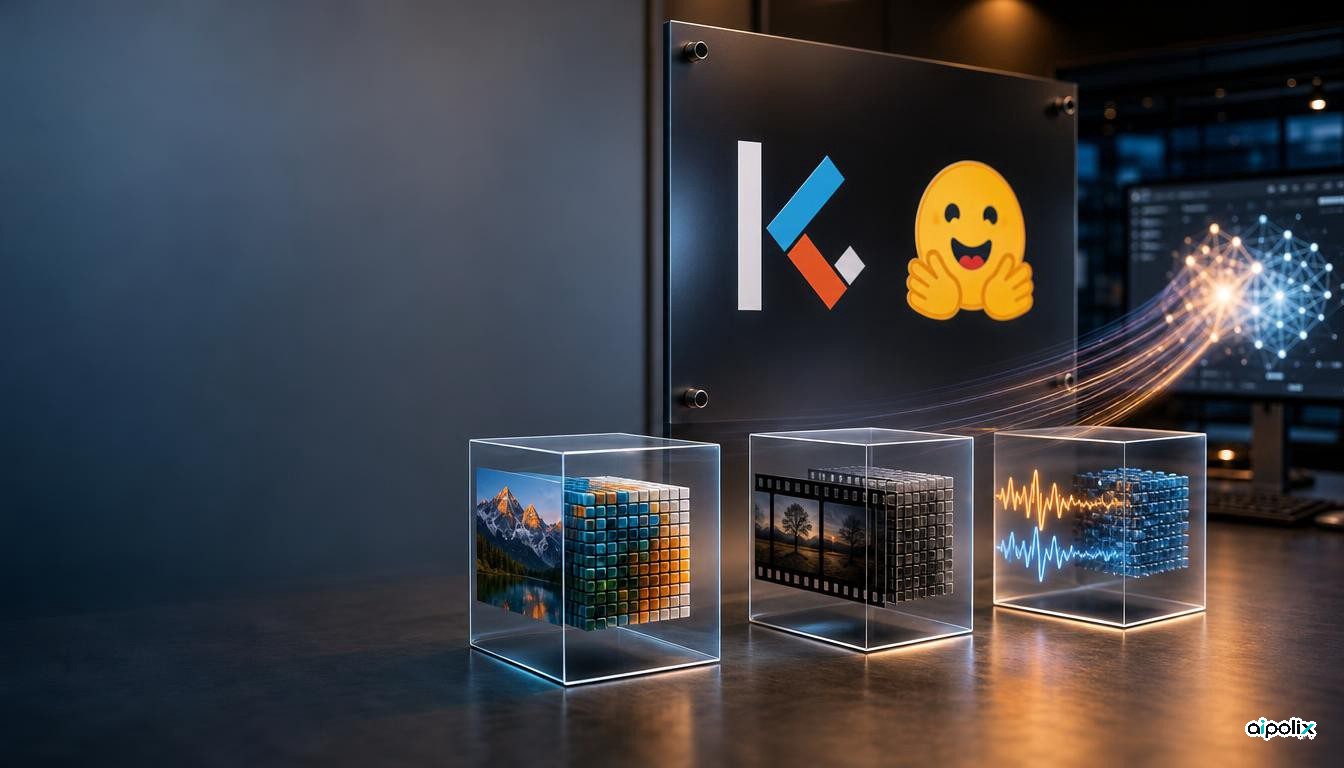
Kandinsky Lab has published a new set of open tokenizers for generative media. KVAE-3.0, announced on the Hugging Face blog on November 27, bundles three variational autoencoders, one each for images, video and stereo audio, with model weights and inference code released under the MIT license.
Tokenizers of this kind sit underneath latent diffusion systems. They squeeze pixels or waveforms into a compact continuous latent, the diffusion model learns to generate in that space, and the decoder turns the result back into media. A tokenizer that reconstructs well but produces a latent space that is hard to learn can still hold back the generator, so the lab trained all three models with an alignment objective: during training, the latents are pushed to stay predictive of features from pretrained encoders.
The image model, KVAE-2D-3.0, downsamples by 8 in each spatial direction into 32 channels. A small eight-block transformer probe learns to predict frozen DINOv2 features from noisy latents, and its loss also trains the encoder; the probe is thrown away once training ends. The lab narrowed the deepest residual stage, added self-attention at the encoder and decoder bottlenecks, and cut the inference model to 85.6 million parameters, about 61% fewer than the 218.4 million of KVAE-2D-2.1. On the 5,000 COCO val2017 images it reports 32.18 dB PSNR and 0.907 SSIM, ahead of FLUX.2 VAE, although FLUX.2 keeps the better LPIPS score. In a matched test where the lab trained a 2B-parameter Kandinsky 5 diffusion transformer on each tokenizer, KVAE-2D-3.0 reached an FD-CLIP of 12.72 after 200,000 steps, against 13.05 for FLUX.2 and 13.30 for the previous KVAE. Human raters split close to even, with KVAE taking between 50.5% and 52.5% depending on the criterion.
KVAE-3D-3.0 is the more aggressive design. It compresses video 32 times along each spatial axis and 4 times in time into 128 channels, twice the overall compression of KVAE-3D-2.0, and aligns its latents with V-JEPA features. It stays causal and fully convolutional, which the lab says avoids spatial tiling even at Full HD. Against MiniMax-H3 on MCL-JCV 720p clips, MiniMax-H3 posts the higher PSNR while KVAE has the lower LPIPS. In generation, raters preferred videos from the KVAE-based model for visual quality (56.6%), semantic quality (52.5%) and prompt following (54.0%), with the comparison run at a 1x1 latent patch for KVAE and 2x2 for MiniMax-H3.
The audio model, KVAE-Audio-Stereo, is a 167-million-parameter waveform VAE built on the Descript Audio Codec architecture. Rather than stacking two mono streams, it encodes left and right channels together at 48 kHz, producing 50 latent frames per second with 128 channels each. In blind listening tests on 148 prompts, a 0.6B diffusion model trained on its latents was preferred over equivalent models built on Stable Audio 3's SAME-L and on the LTX-2.5 audio VAE in every category, with shares from 71% to 98%. On AudioCaps, the lab puts its FAD at 4.27, below the 6.02 it measured for SAME-L and the 5.13 it measured for LTX-2.5.
For builders, the release offers a permissively licensed alternative to tokenizers tied to commercial model families, with a single encode and decode workflow across all three modalities in the GitHub repository and model cards on Hugging Face.
The numbers come with limits. Every comparison was designed and run by Kandinsky Lab, mostly on internal training data, and no outside evaluation has been published. The image preference results are near parity, the SongDescriber benchmark still favors the rival audio VAEs on CLAP and FAD, and the lab's blog and project page give slightly different video reconstruction figures.