
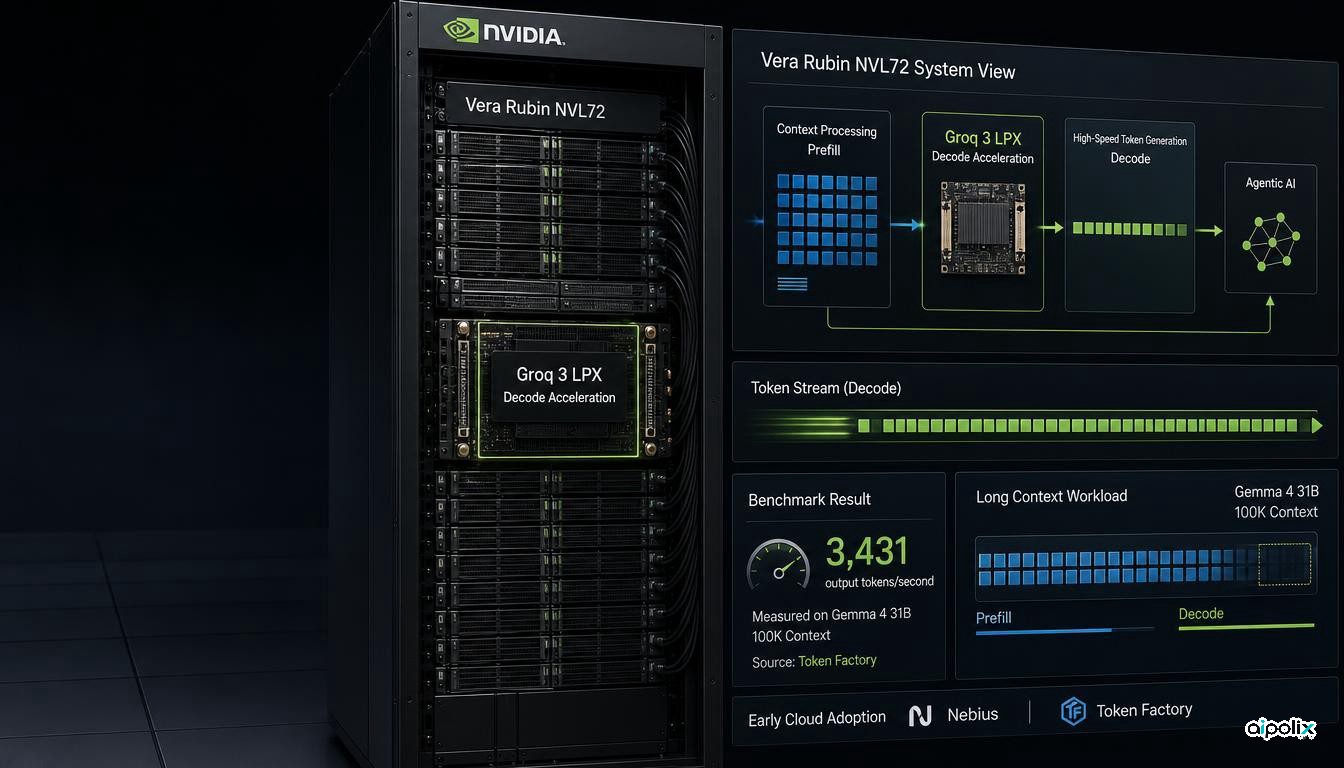
NVIDIA has moved Groq 3 LPX, its specialized interactive AI inference accelerator, into full production as part of the Vera Rubin platform. The August 24 announcement matters less as another chip launch than as a concrete attempt to redesign the decode stage of large-model inference around agent workloads that repeatedly generate tokens, call tools, and continue reasoning across long sequences. NVIDIA says Nebius will be the first AI cloud provider to adopt the system, while Groq has separately said it plans to deploy the hardware with Dell Technologies.
The core engineering claim is that agent systems are increasingly constrained by token-generation latency rather than only by how quickly a model can process its initial context. In the NVIDIA announcement, the company describes Groq 3 LPX as an extension of Vera Rubin NVL72 designed specifically to increase output-token generation rates. Independent reporting from SiliconANGLE confirms the production announcement and Nebius adoption, while correctly treating NVIDIA's benchmark claims as vendor-reported performance rather than broad proof of superiority.
Why decode latency is becoming an agent bottleneck
Traditional model-serving discussions often emphasize total throughput, memory capacity, or time to first token. Agentic systems add a different pressure. A single task can involve planning, tool selection, code execution, retrieval, validation, and repeated model calls. Every step can create more generated tokens, so small per-token delays accumulate across a chain of work.
That is the problem NVIDIA is targeting with Groq 3 LPX. The system is not presented as a replacement for the full Vera Rubin stack. Instead, NVIDIA positions it as a specialized decode accelerator that works alongside Vera Rubin NVL72 so different parts of inference can be optimized separately. In practical terms, the architecture is aimed at workloads where fast generation after context processing is more valuable than maximizing a single general-purpose accelerator's flexibility.
This design direction is significant for infrastructure teams because it suggests that large-model serving may become more heterogeneous. Rather than one accelerator handling prefill, attention, feed-forward computation, and decode in the same way, operators can increasingly separate stages and assign them to hardware optimized for different bottlenecks. NVIDIA's technical material describes configurations such as prefill-decode disaggregation and other forms of co-execution with Vera Rubin.
What the benchmark actually establishes
NVIDIA says an internally hosted Groq 3 LPX system was measured by Artificial Analysis at 3,431 output tokens per second on Gemma 4 31B with 100,000 input tokens of context. The company's technical blog also reports a median 3,382 output tokens per second at 10,000 tokens of context and cites 4,767 median output tokens per second on the coding-oriented SPEED-Bench.
Those figures are useful, but their scope matters. They describe a particular model, benchmark methodology, context regime, serving configuration, and hardware environment. NVIDIA also says Artificial Analysis verified no loss of precision or model quality in the tested configuration. That does not establish that every production model or agent workflow will see the same multiplier, nor does it prove lower end-to-end latency for systems dominated by tool calls, network waits, retrieval, or application logic.
The more defensible conclusion is narrower: the measurements show that specialized decode hardware can produce very high token-generation rates under long-context conditions in the tested setup. For architects, that is enough to justify evaluating decode as its own capacity-planning dimension rather than assuming GPU throughput is a sufficient proxy for agent responsiveness.
Production adoption is the more important milestone
The strongest part of the announcement is not the benchmark chart but the move into full production and the first deployment commitments. NVIDIA says Nebius is the first AI cloud to adopt Groq 3 LPX through its Token Factory offering. Groq also says it will be among the early adopters and is working with Dell Technologies to deploy the hardware in its inference cloud.
That changes the story from a research demonstration into a deployable infrastructure option. For platform teams, the next questions are operational: availability, service-level behavior, model support, capacity allocation, integration with existing inference stacks, and whether the latency improvement survives real multi-tenant traffic. Those details matter more than peak benchmark throughput when an agent product has to serve users continuously.
The production milestone also reinforces a broader shift in AI infrastructure economics. Agents can consume many more generated tokens than a single conversational response because they iterate. If decode becomes a large share of cost and latency, hardware optimized for that stage can change routing and deployment decisions. A system architect may choose different infrastructure for long-running coding agents than for batch summarization or short question answering, even when the same model family is involved.
What engineering teams should evaluate
The first task is to measure where latency actually comes from. Teams should separate prefill time, decode time, tool latency, retrieval latency, networking, and orchestration overhead. If decode is only a small fraction of end-to-end time, faster token generation may not materially improve the user experience. If an agent spends most of its active time generating long plans, code, or intermediate outputs, the impact can be much larger.
The second task is to benchmark representative models and prompts rather than extrapolating from Gemma 4 31B. Model architecture, quantization, batch size, context length, speculative decoding, and serving policy all change performance. The relevant unit is not maximum tokens per second in isolation, but cost and latency per successfully completed task under realistic concurrency.
The third task is resilience. A heterogeneous inference path can create new dependencies between context processing, decode accelerators, networking, and schedulers. Capacity imbalance between stages can waste expensive hardware or create tail-latency problems. Observability therefore needs to expose stage-level saturation and queueing, not just aggregate accelerator utilization.
What remains uncertain
NVIDIA's published numbers are strong enough to make Groq 3 LPX technically interesting, but several practical variables are still unknown for most customers. Public pricing, detailed cloud availability, broad model compatibility, and production behavior across diverse workloads will determine whether the architecture changes mainstream deployment patterns or remains concentrated in latency-sensitive services.
The other uncertainty is how quickly software stacks adapt to stage-specialized hardware. Agent platforms need schedulers and serving layers that can route prefill and decode efficiently without adding enough coordination overhead to erase the hardware advantage. That integration work may be straightforward for tightly controlled AI clouds and harder for enterprises with mixed infrastructure.
For practitioners, the immediate takeaway is therefore not that every agent should move to Groq 3 LPX. It is that decode latency has become important enough for a major infrastructure vendor to productize dedicated acceleration around it. Teams building token-heavy agents should now measure decode separately, compare heterogeneous serving options against conventional GPU-only paths, and judge the result using end-to-end task economics rather than vendor benchmark headlines.