
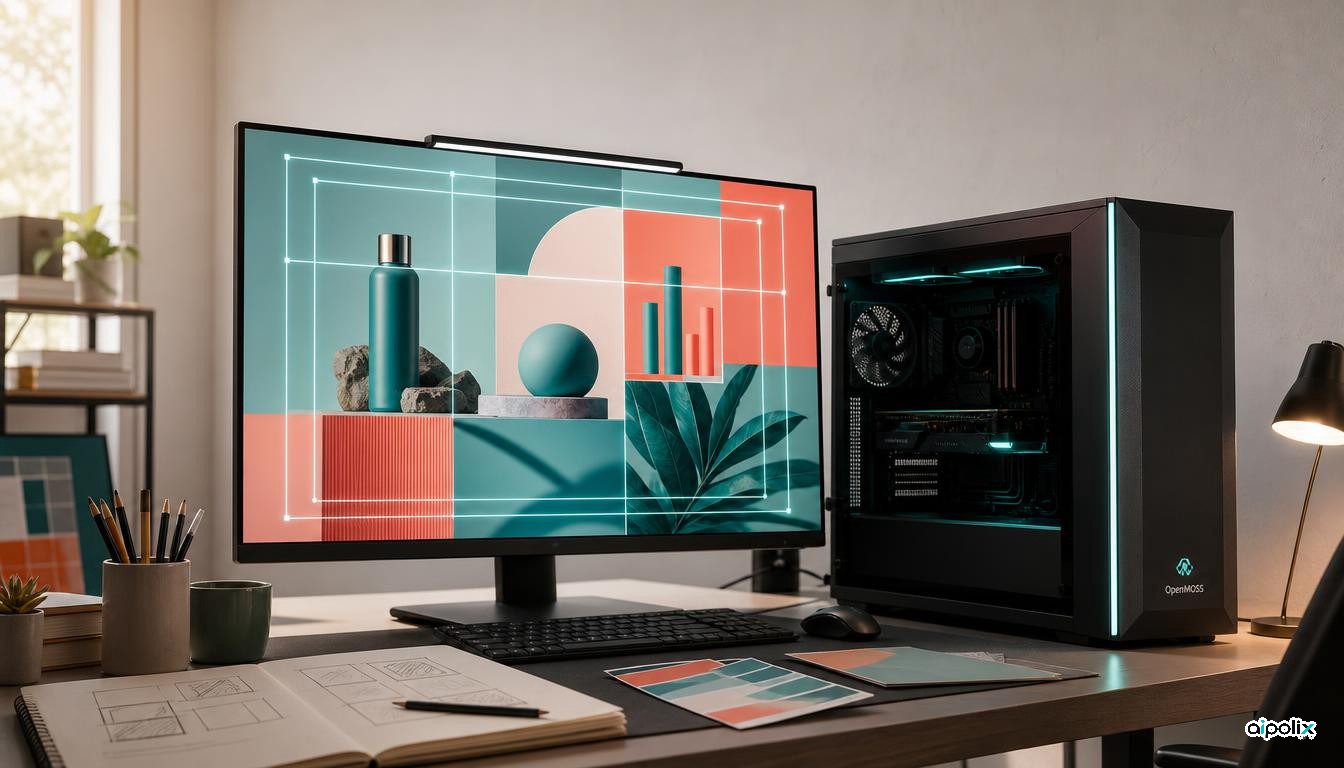
OpenMOSS, the research group behind the MOSS family of models, has released an open-weight image generator designed for the kind of pictures most open models still get wrong: posters, slides and infographics packed with text. MOSS-Image arrived on October 16, 2026 in two checkpoints, MOSS-Image-Base and MOSS-Image-SFT, with code on GitHub and weights on Hugging Face and ModelScope under the Apache 2.0 licence.
Under the hood is a single-stream diffusion transformer with 5 billion parameters, which the team says it pretrained from scratch. The technical report lists MOSI Intelligence, the Shanghai Innovation Institute, Fudan University and Shanghai Jiao Tong University as the institutions involved. According to the project page, the model handles prompts of up to about 4,000 tokens, renders long passages of English and Chinese text, and produces both anime and photorealistic styles. The team also notes that training ran on heterogeneous, non-standard GPU platforms, without naming the hardware.
Layout control is the feature that sets it apart from most open competitors. Besides ordinary prompts, MOSS-Image accepts a JSON description in which each object and each line of text gets its own bounding box, so a user can decide where a headline, a chart or a product shot should sit. To help with short requests, OpenMOSS pairs the model with an agent-style prompt enhancer that expands a few words into a detailed caption or a full layout plan. The enhancer is published as a skill that coding agents can load.
The release came with integration already in place. SGLang and vLLM-Omni, two widely used open serving engines, documented day-zero support, and ComfyUI published a tutorial with ready-made workflows. ComfyUI's documentation says the model runs from single-file checkpoints in int8 and bf16, relying on a Qwen3.5 9B text encoder and the small FLUX.2 VAE, and recommends the SFT checkpoint for cleaner layouts and the Base checkpoint as the starting point for LoRA fine-tuning.
The benchmark claims rest on two tests the team introduced itself. On LongLongTextBench, which measures long-form text rendering in both languages, the report gives MOSS-Image an average coverage score of 96.3, against 64.9 for Qwen Image 2512, the best open-weight result in its comparison. On RealLayoutArena, a human-preference arena for layout-heavy images, the full system scored 1698.70 Elo, second behind GPT Image 2 and ahead of Seedream 5.0 Pro. When every generator received the same enhanced prompts, the MOSS-Image backbone ranked first at 1807.34 Elo.
Early uptake has been quick for a niche model. By October 19 the GitHub repository had about 800 stars, the Base checkpoint showed roughly 1,800 downloads on Hugging Face, and 13 derived models were already listed against it. The technical report, dated October 16, was posted on arXiv and highlighted on Hugging Face's papers page on October 19.
The most important caveat is that both benchmarks were designed by the same team that built the model, and no independent evaluation had been published when this story was checked. The arena ranking also depends on the prompt enhancer, which makes it hard to separate the backbone's quality from the agent that writes its prompts. The report says the training recipe and evaluation framework will be released as well; at the time of checking, the public release covered the model weights, inference code, ComfyUI plugin and prompt-enhancer skill.