
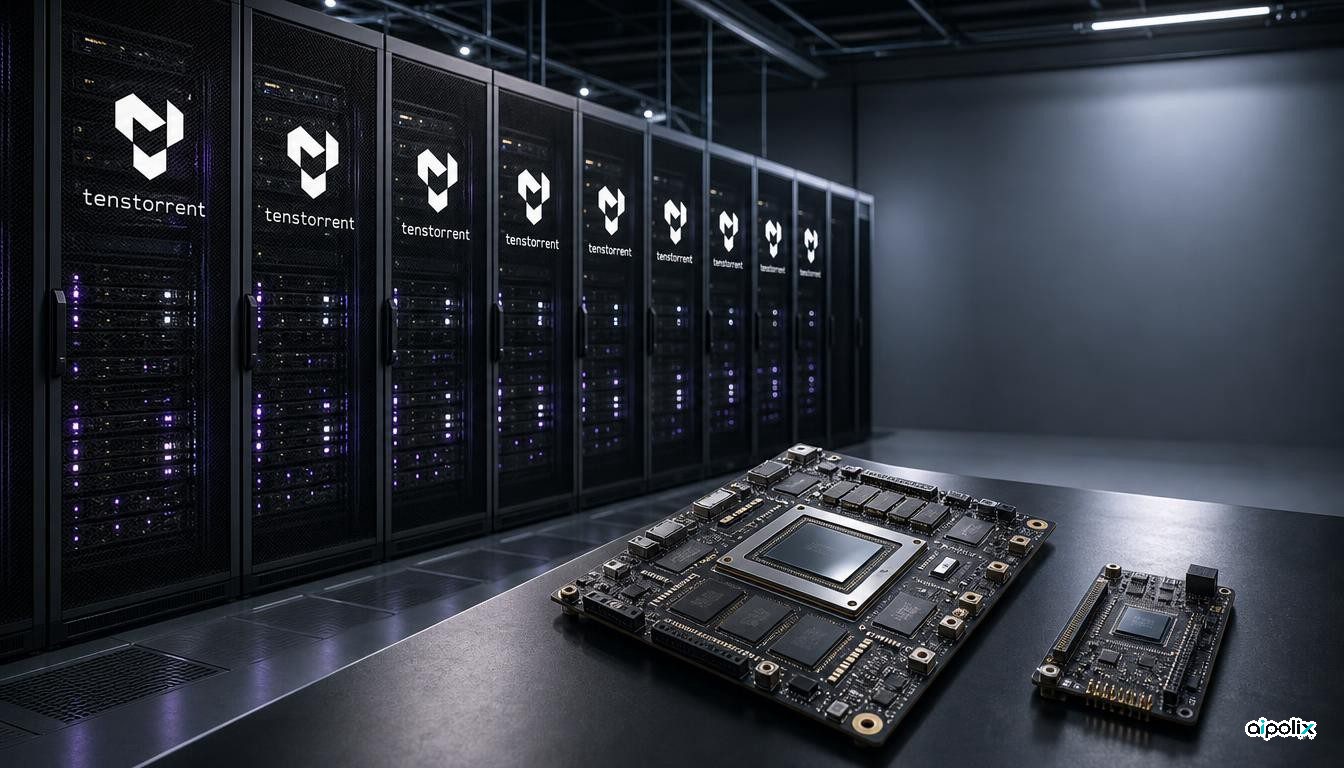
Tenstorrent, the AI chip company led by veteran processor architect Jim Keller, said on Monday, October 19, 2026 that it has closed a $1.5 billion Series E round at a post-money valuation of $6.2 billion. Reuters, which reported the raise the same day, said the valuation is more than double the level set in the company's previous round in December 2024.
Trace Capital and Innovation X led the financing. Tenstorrent lists a long roster of other new and existing investors, including ARK Invest, Fidelity Management & Research Company, Morgan Stanley, T. Rowe Price, Sandisk, Tether Investments, XTX Markets, Virtu Financial, Eclipse and Maverick Silicon. The Globe and Mail noted that Trace Capital was founded by Ben Mahdavi, a former National Football League linebacker turned investor, and that Innovation X is a New York firm.
The company says the money will pay for volume manufacturing and global commercial expansion. In practice that means deploying its Galaxy servers at scale, systems that Reuters describes as combining dozens of Tenstorrent chips to run chatbots, coding assistants and video generators, and continuing to serve open-weight language and video models on them. Tenstorrent also plans to keep developing the AI and CPU designs it licenses to customers that build their own silicon.
That two-sided business is what sets Tenstorrent apart from most Nvidia challengers. It sells hardware at every size, from a single card or workstation up to racks and superclusters, and pairs it with an open-source software stack. It also licenses its TT-Ascalon RISC-V CPU and Tensix AI cores to chip designers, naming Samsung and LG as customers. RISC-V is an open instruction set that lets companies design processors without paying license fees to proprietary architectures such as Arm's. "We built one architecture and sell it at every size," Keller said in the announcement.
The round follows a period of reported takeover interest. According to the Globe and Mail, Intel and Qualcomm were both reported earlier this year to have tried to buy Tenstorrent for upward of $5 billion. The newspaper said the company, founded in Toronto a decade ago and moved to the United States in 2023 after Keller became chief executive, employs about 1,000 people, around 200 of them in Toronto. Its last round, per Reuters, raised more than $693 million at a $2 billion pre-money valuation, led by Samsung Securities and AFW Partners.
The raise also says something about where investors think AI compute demand is heading. Tenstorrent is aiming squarely at inference on open-weight models, a market the Globe and Mail describes as expected to be much larger than training and one where several startups are tailoring hardware to beat general-purpose GPUs on speed. One investor, Protagonist, said Tenstorrent's video generation results beat industry benchmarks, a claim that has not been independently verified.
Important questions remain. Tenstorrent did not disclose revenue, customer volumes or production targets for Galaxy, so the scale of the planned build-out is unclear. Nvidia's software lead and installed base are still the main obstacles for any challenger, and the company's performance claims come from Tenstorrent and its backers. The fresh capital gives it room to prove those claims in large deployments rather than in demonstrations.