
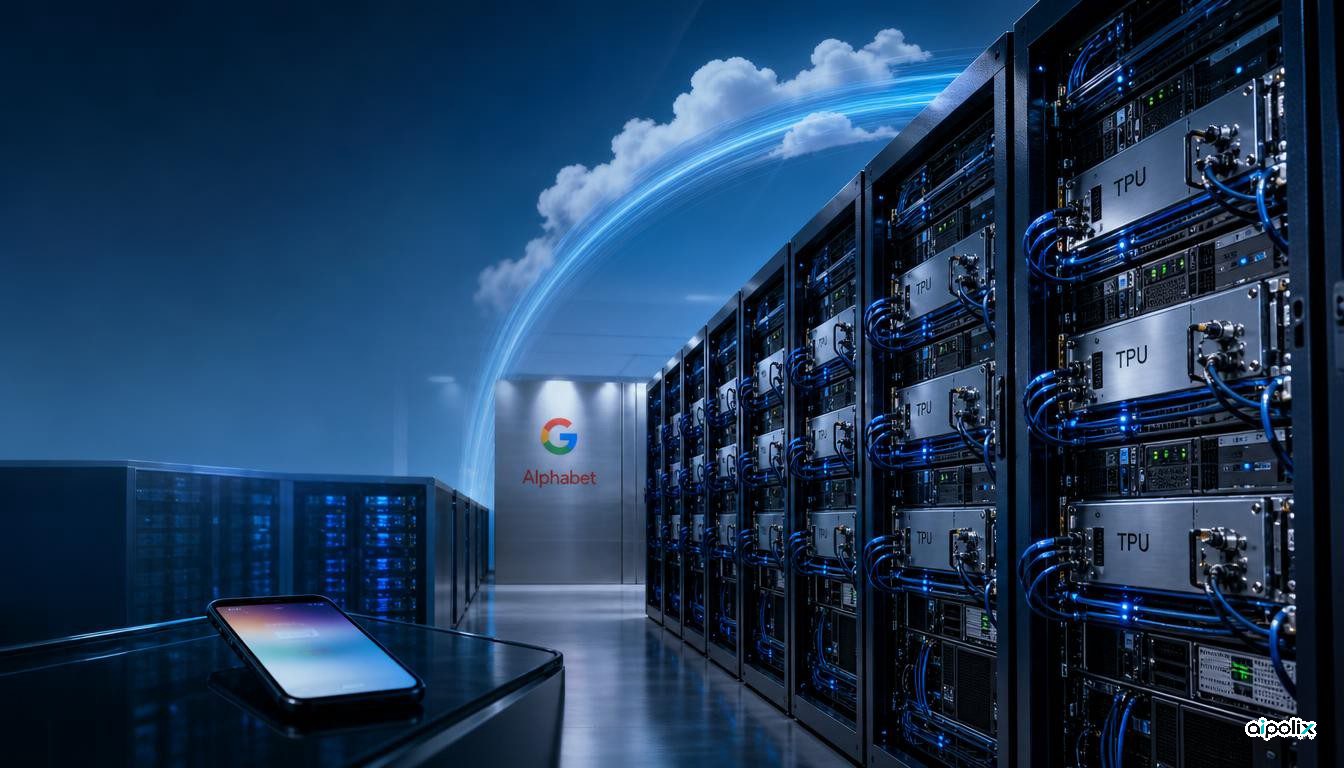
Alphabet's latest quarter put two sides of the AI trade next to each other. Google Cloud, where most of the company's AI infrastructure is sold, more than doubled its revenue, and the Gemini app crossed 1 billion users. Yet the results released on October 28 also showed weaker profit, slower search growth and heavy spending, and investors sold the stock in extended trading.
Sundar Pichai, chief executive of Google and Alphabet, told analysts that group revenue rose 25% from a year earlier, which he described as a half-trillion-dollar annual run rate; TechCrunch put the quarter at $127.6 billion. Google Cloud brought in $30.7 billion, up 103%. CNBC reported that analysts had expected about $28.7 billion. Pichai credited AI infrastructure and AI solutions for most of that growth, said demand for Google's TPU systems is strong across many kinds of customers, and acknowledged that the company is still racing to add capacity.
Usage figures were the other headline. According to Pichai, Google's own model APIs now handle close to 32 billion tokens every minute, up 40% on the previous quarter and over four times the level of a year ago. He called the Gemini app the fastest-growing product Google has ever had, and said that in its first week on developer platforms Gemini 4 Argon ramped usage three and a half times faster than Gemini 3 despite capacity limits. Gemini 4 Carbon, announced the same day for a restricted group of cyber defenders, was presented as stronger than Argon in almost every domain. These are company figures that were not independently audited.
Search is where the pressure shows. Pichai said overall query growth was the fastest in five years and that a typical AI Mode query runs about three times longer than a classic search. Revenue tells a cooler story: revenue from search rose 12%, reaching $63.35 billion and missing the roughly $64.96 billion analysts expected, according to CNBC. TechCrunch noted that the rate had been 17% in the April-June period and 19% in January-March.
Google's answer is to put more advertising inside its AI answers. In a separate post, the company said it is now scaling AI Mode ads across ten countries: Australia and New Zealand, Canada, Kenya and Nigeria, and five Asian markets (India, Pakistan, Malaysia, Singapore and the Philippines). It plans to add Brazil, Mexico and the United Kingdom during the fourth quarter, and is launching multiturn ads in the US so that follow-up questions can also carry ads, each marked as Sponsored. Google says click-through rates on sponsored and organic product listings inside AI Mode are already similar, a claim based on its own data.
The cost side weighed on the reaction. CNBC reported net income of $26.17 billion ($2.12 a share), compared with $34.98 billion a year earlier, the company's first miss on both revenue and earnings in nearly four years. Free cash flow was negative by $9.07 billion. Capital expenditure reached $51.36 billion, below the $55.09 billion analysts had pencilled in, and Alphabet kept its full-year range of $195 billion to $205 billion. Finance chief Anat Ashkenazi said spending should rise significantly in 2027, with details promised on the next call. Long-term debt stood at $125.1 billion, against $21.6 billion a year earlier, and equity holdings, which had delivered a large gain in the second quarter, produced an $8.66 billion loss this time.
Shares fell more than 10% after hours, according to CNBC, while TechCrunch reported a decline of about 8% at the time of its story. The quarter leaves Alphabet with clear evidence that customers want its AI compute and models, and an open question over how quickly AI Mode advertising can make up for slower growth in traditional search while capital spending keeps climbing.