
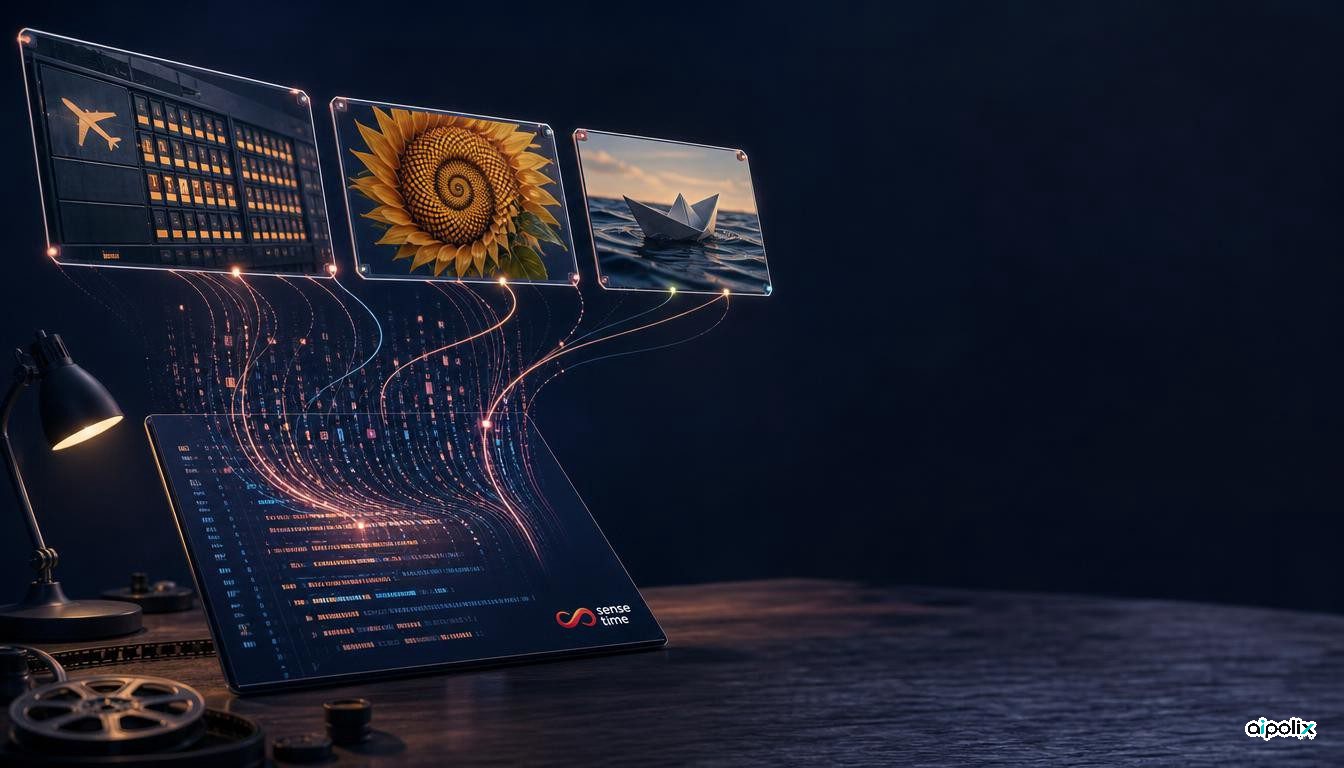
SenseTime has released SenseNova 6.8 Code2Video, an open model that does not paint video frames directly but writes the program that draws them. The weights were uploaded to Hugging Face on October 24, 2026, alongside a GitHub repository under the company's OpenSenseNova organisation, and SenseTime announced the release from its official X account on October 28. The model card publishes the weights under the Apache 2.0 licence.
The model is a 27-billion-parameter fine-tune of Alibaba's Qwen3.8-27B with a context window of 512,000 tokens. Given a brief, it writes code in which every frame is a function of time, renders the result, reviews the frames as images and revises, turn after turn. SenseTime argues that this avoids several weaknesses of video generators that sample pixels: on-screen text, formulas and data are typeset exactly, motion can be computed from equations, and because each element is a named object in the code, a note changes only what it names. The repository shows a retro airport split-flap board that two short rounds of notes turned into a pastel hotel lobby and then filled with a plane and travellers, while the copy, timing and flip mechanics stayed the same.
The scope is deliberately narrow. SenseTime says the model makes videos that can be written as code, such as motion graphics, explainers, stylised 2D and 3D scenes and procedural audio, and that it does not generate photorealistic footage. The repository presents nine showcase films and a 90-second launch film that the company says was produced entirely by the model.
The release goes beyond the weights. SenseTime provides serving commands for LightLLM, vLLM and SGLang that split the BF16 model across four GPUs at the full 524,288-token context; a code-video skill for Claude Code with eight craft guides covering explainers, stylised looks, simulations, characters, 3D scenes, motion graphics, sound and narration, and music sync, plus rendering and checking tools; a prompt-enhancement template; and complete production trajectories. Those logs, in OpenAI messages format, include reasoning, tool calls, retries and 357 review images, with private paths anonymised so the recorded commands cannot be replayed directly.
The intended workflow is agentic and long. SenseTime recommends Anthropic's Claude Code as the harness, pointed at a self-hosted endpoint, and says the model sustains runs of more than 10 hours and more than 2,000 turns, with settings for a 512K context, compaction at 80 percent and 64K of output. It suggests first expanding the user's request with a strong general model, naming Claude Opus 5.5 in its own tests. The model card also warns that a run executes shell commands without asking and should be started in an isolated working environment.
SenseTime is candid about the limits. It reports qualitative examples only, says no systematic benchmark for code-driven video exists yet, and states that the model is clearly behind the strongest proprietary models on visual polish and long-horizon reliability. Early uptake is small: on October 29 the repository had about 108 stars, the model page 47 likes, and the announcement post roughly 1,600 views. Coverage so far, from TSN and Neural Brew, relies on SenseTime's own materials, and no independent evaluation has been published.
For teams building agentic content pipelines, the release is an early open-weight attempt to treat video as a long-horizon coding task rather than a sampling problem, and the published trajectories offer rare material on how such runs unfold. Whether a small open model can narrow the gap with proprietary systems is the question SenseTime itself sets out to answer.