
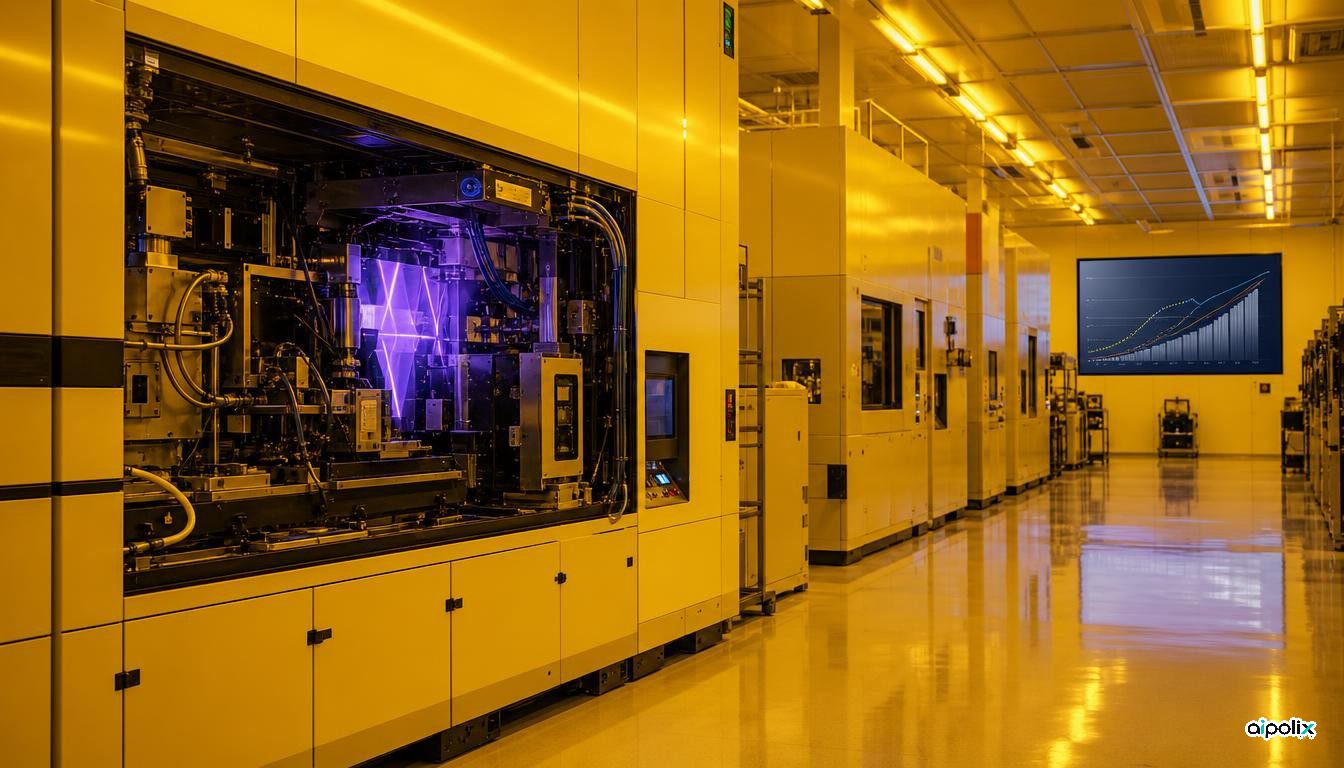
ASML Holding published third-quarter 2026 results on October 14 and raised the tone of its capacity story around artificial-intelligence chip demand. The Dutch lithography supplier reported €11.7 billion in quarterly net sales, a 57.5% gross margin and €5.0 billion in net income. For the fourth quarter it pointed to net sales in a €14.2 billion to €15.2 billion band and roughly 57% gross margin, while trimming the full-year 2026 sales corridor to €44 billion-€45 billion and about 56% gross margin.
CEO Christophe Fouquet said customers keep lifting short- and medium-term equipment forecasts, driven mainly by their view of AI-related investment size and duration. With that visibility, he said some customers are already expressing interest in placing orders for 2029 and even 2030. ASML also said supply as currently planned for 2027 and 2028 will not fully meet customer demand, and that it is investigating ways to raise 2028 capacity beyond the further 30% increase previously flagged. That combination of near-term guidance and longer-dated order interest is what turned a routine earnings print into an AI-infrastructure signal.
The company had said in its second-quarter release that it planned to add 30% to 2026 low-NA EUV and DUV immersion capacity for 2027 and was studying another 30% for 2028. Wednesday's message is that even that path looks short. Fouquet added that productivity upgrades for the installed base remain an important way to add wafer output while new tool capacity catches up. Installed Base Management sales were €3.3 billion in the quarter, above prior guidance.
Investors watch ASML because it is the sole high-volume producer of extreme ultraviolet lithography tools used for the most advanced logic and memory nodes. CNBC reported early European trading gains after the outlook and noted that Samsung and TSMC committed during the quarter to using High NA EUV tools. ASML also reiterated that China is expected to account for about 20% of sales, unchanged from prior commentary under export-control limits.
This producer run treated ASML's company results text, available via an official press-release mirror, as the source of record for figures and CEO wording. CNBC supplied independent market context. The Reuters Tech sitemap carried the discovery headline; reuters.com article pages returned HTTP 401, so wire wording was cross-checked through licensed syndications that match the sitemap item.
The AI-relevant core is not a new model launch but a capacity signal: leading chipmakers' AI plans are stretching lithography lead times into the next decade. Open questions include how fast ASML can actually expand 2028 output, whether customer interest for 2029-30 converts into firm orders, and how export rules continue to shape the China mix. Those execution risks sit beside an unusually explicit multi-year demand narrative from the industry's bottleneck toolmaker. For AI builders, the practical takeaway is that model ambition still depends on a physical tool chain whose lead times are stretching, not shrinking.