
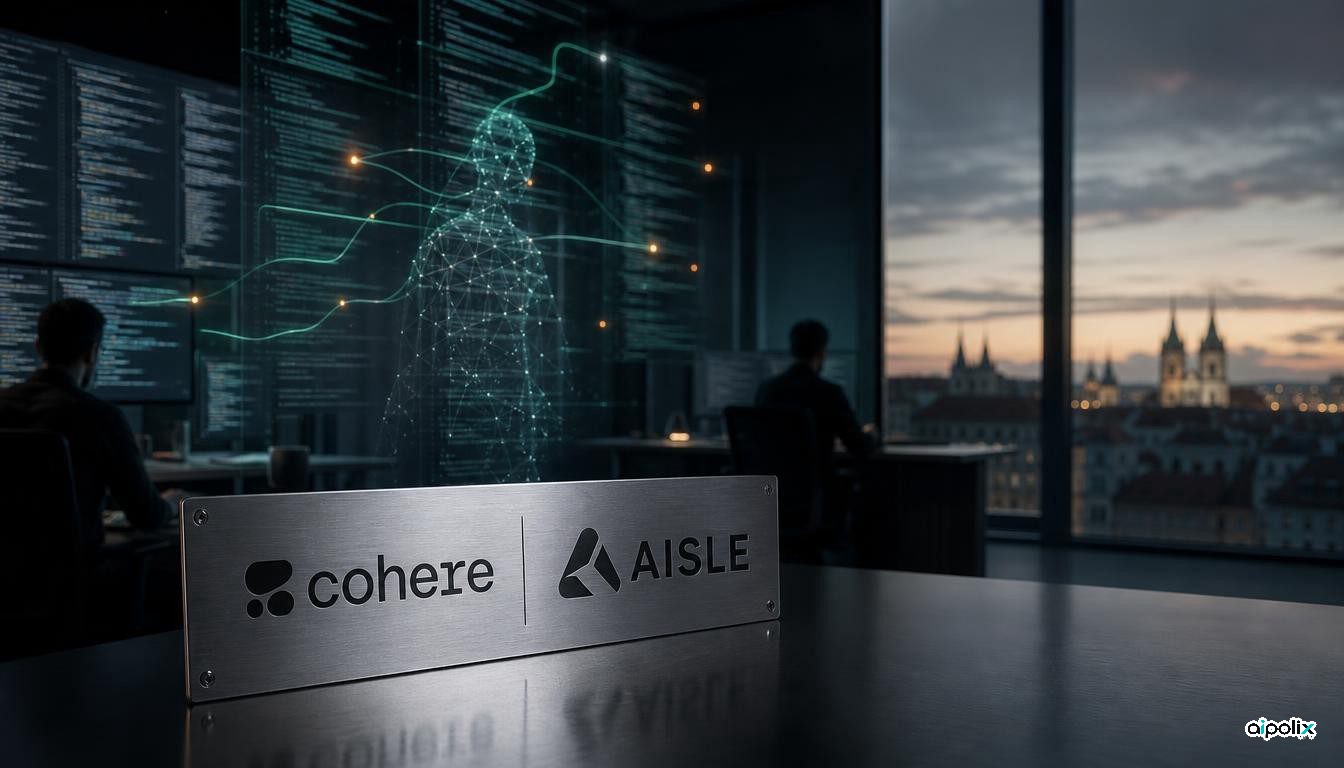
Canadian AI developer Cohere has signed a letter of intent to acquire AISLE, a cybersecurity startup that builds autonomous systems for finding and fixing previously unknown flaws in production software. Both companies announced the proposed deal on October 15, 2026. Neither disclosed a price, and a letter of intent marks an agreed direction rather than a closed transaction: AISLE said it would share more details as the deal moves forward.
AISLE was founded in 2025 and emerged from stealth roughly a year ago. Reuters describes it as based in San Francisco with an engineering hub in Prague, while AISLE itself calls Prague its headquarters and says that office would become Cohere's base in the Czech capital once the purchase completes. Chief executive Ondrej Vlcek previously led the Czech antivirus company Avast, and Reuters reports that the founding team also includes people who came from Google DeepMind and Anthropic.
The startup's pitch rests on a public track record. According to AISLE and Cohere, its systems were behind more than 500 vulnerabilities that received CVE identifiers across over 100 codebases during its first year. Two widely used open-source projects stand out in the companies' account: AISLE says it found every flaw patched in OpenSSL's January update, twelve in total, plus 18 of the 24 CVEs that the newest curl version addressed. The totals are self-reported, but CVE assignments and fixes go through each project's own maintainers, which leaves an external paper trail that a benchmark score would not.
The deal is designed to keep AISLE's leadership in charge inside Cohere. Vlcek is slated to become Senior Vice President of Cohere Cyber, a new unit that will bring security products to Cohere customers. Co-founder Jaya Baloo would take over as Cohere's global chief information security officer. Stanislav Fort, AISLE's chief technology officer and chief scientist, would become Vice President of AI Security and partner with Ivan Zhang, Cohere's co-founder and chief technology officer, on tying security research to the way Cohere develops and trains its models.
For Cohere, the purchase fits a strategy built around what it calls sovereign AI: models and agent software that governments and regulated companies can run in private clouds, on their own premises or in fully air-gapped settings. Cohere presents AISLE as a way to add threat detection, stronger protection for sensitive data and closer monitoring of AI agents to that offering. It also frames the move as part of a wider European push, following its purchase of Reliant AI and its tie-up with Germany's Aleph Alpha, which Reuters characterises as a merger reported to value the combined business at about $20 billion.
There is a research argument too. Both companies say a security system and the foundation model underneath it improve each other: the surrounding software decides how a model explores large codebases, discards false alarms and turns findings into patches that maintainers will accept, while a stronger model raises the ceiling on what the whole system can uncover. Cohere says difficult, checkable security problems could help it evaluate and improve future models, giving its model team a steady supply of tasks with clear right and wrong answers.
The announcement adds to a broader push to point AI agents at defensive security work. AISLE has told its customers to expect continuity. Still unknown are the price, the expected closing date and whether AISLE's tools will remain available on their own or be sold mainly through Cohere's platform.