
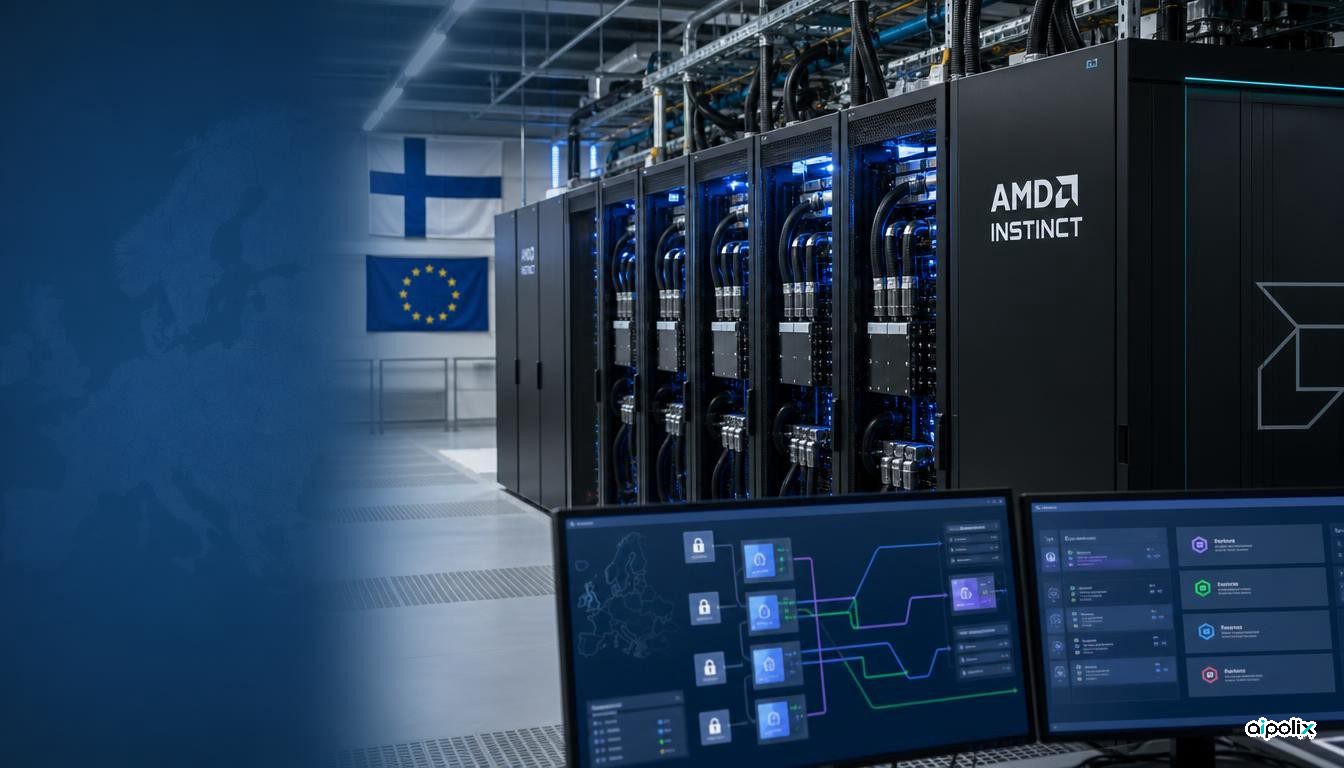
EuroHPC has signed a EUR 387.8 million procurement contract with Bull to deploy LUMI-AI, a new AI-optimised supercomputer in Kajaani, Finland. The system will become the computing backbone of the LUMI AI Factory and is scheduled to be available in the second half of 2027. The important change is not only another large public compute purchase. The contract fixes a specific architecture, access model and operating role for one of Europe's largest shared AI-compute systems, giving startups, SMEs and researchers a public alternative to commercial hyperscaler capacity.
The EuroHPC announcement says LUMI-AI will use AMD Instinct MI430X GPUs and sixth-generation AMD EPYC 256-core processors, with a tenfold increase in AI capacity compared with the current LUMI system. AMD's implementation note adds that the design will be multi-tenant, expose extensive API-based access and nearly double the HPC capability of the current machine. Reuters independently reported the contract and the wider pressure behind it: demand for European AI-compute capacity is already exceeding available supply.
The contract turns AI Factory policy into committed capacity
Europe's AI Factories programme has often been discussed as industrial policy, but this procurement is a concrete capacity commitment. EuroHPC says the EUR 387.8 million budget covers acquisition, delivery, installation and maintenance, with half funded by the EuroHPC Joint Undertaking through the Digital Europe Programme and half by the LUMI AI Factory consortium. The machine will be hosted at CSC's data centre in Kajaani and used by a consortium led by Finland with Czechia, Denmark, Estonia, Norway and Poland.
That matters because the availability problem is operational, not rhetorical. EuroHPC says its AI Factory network is intended to provide free, customised support to startups and SMEs, while Reuters reported that demand for AI compute has already exceeded supply and some access requests have been rejected. A signed procurement does not solve today's shortage, but it converts a policy objective into scheduled infrastructure with a defined delivery path.
The architecture is deliberately closer to a shared AI cloud
LUMI-AI is not being positioned only as a traditional batch-oriented supercomputer. AMD says the system will use a multi-tenant architecture, additional compute and storage resources, and extensive API-based access designed to support modern development environments. EuroHPC says the machine is intended for large-scale AI workflows that may involve dynamic and confidential datasets, as well as scientific simulation and data-intensive applications.
This changes the practical relevance for developers and smaller companies. A public supercomputer that can only be accessed through specialist HPC workflows is useful to a narrower community. API access and multi-tenancy move the system closer to the interaction model teams already expect from cloud AI infrastructure, even if allocation, scheduling and governance remain different. The design therefore reduces part of the migration gap between commercial AI platforms and publicly funded European compute.
LUMI-AI also diversifies Europe's accelerator dependency
A second consequence is hardware concentration. Much of the global AI infrastructure expansion has been built around Nvidia accelerators. LUMI-AI will instead use AMD's MI430X GPUs, which are designed for both AI and high-precision HPC workloads. AMD says the system should deliver roughly ten times the AI capacity and nearly twice the HPC capability of the current LUMI platform, although those are vendor and project projections that cannot be treated as independently demonstrated performance before deployment.
The architectural significance is still real without accepting the performance claims. A EUR 387.8 million public procurement creates a large production target for an alternative accelerator ecosystem and requires software, orchestration and user tooling to work at meaningful scale outside the dominant Nvidia path. For European infrastructure policy, diversification at this layer can reduce single-vendor dependency, but it also transfers risk into software maturity, workload portability and operational support. Those are the areas users should watch when the system approaches service in 2027.
Public capacity does not automatically mean easy capacity
The strongest reason to follow LUMI-AI is access, not headline FLOPS. EuroHPC says AI Factory resources are aimed at startups, SMEs and research users and that access is allocated through EuroHPC and consortium mechanisms. The current LUMI AI Factory has already been supporting sectors including manufacturing, health, life sciences and communications using existing infrastructure.
The constraint is that public capacity can still be scarce, scheduled and policy-governed. A team deciding between EuroHPC and commercial cloud therefore needs to evaluate more than raw compute cost. Eligibility, queue time, data-governance requirements, deployment tooling, model-serving support, portability and the ability to move workloads between local, public and commercial infrastructure may matter more than peak theoretical capacity.
This is where LUMI-AI's API-oriented design becomes strategically important. If EuroHPC can make the new system operationally accessible to ordinary AI engineering teams, the AI Factory model can become a practical compute option rather than a programme used mainly by organisations with dedicated HPC expertise.
What to watch before 2027
The contract is a material infrastructure milestone, but it is not deployed capacity yet. Installation and user availability are expected in the second half of 2027. The claimed performance improvements remain projections, and the final user experience will depend on software maturity, allocation policy, operational reliability and the ability of the AI Factory network to absorb demand.
For practitioners, the useful checkpoints are concrete: whether API access is broad enough for modern training and inference workflows, whether AMD software support reduces portability friction, whether confidential-data workloads receive usable secure environments, and whether startups and SMEs can obtain capacity without long delays. Those factors will determine whether LUMI-AI becomes merely a large sovereign-compute asset or a genuinely usable European AI platform.