
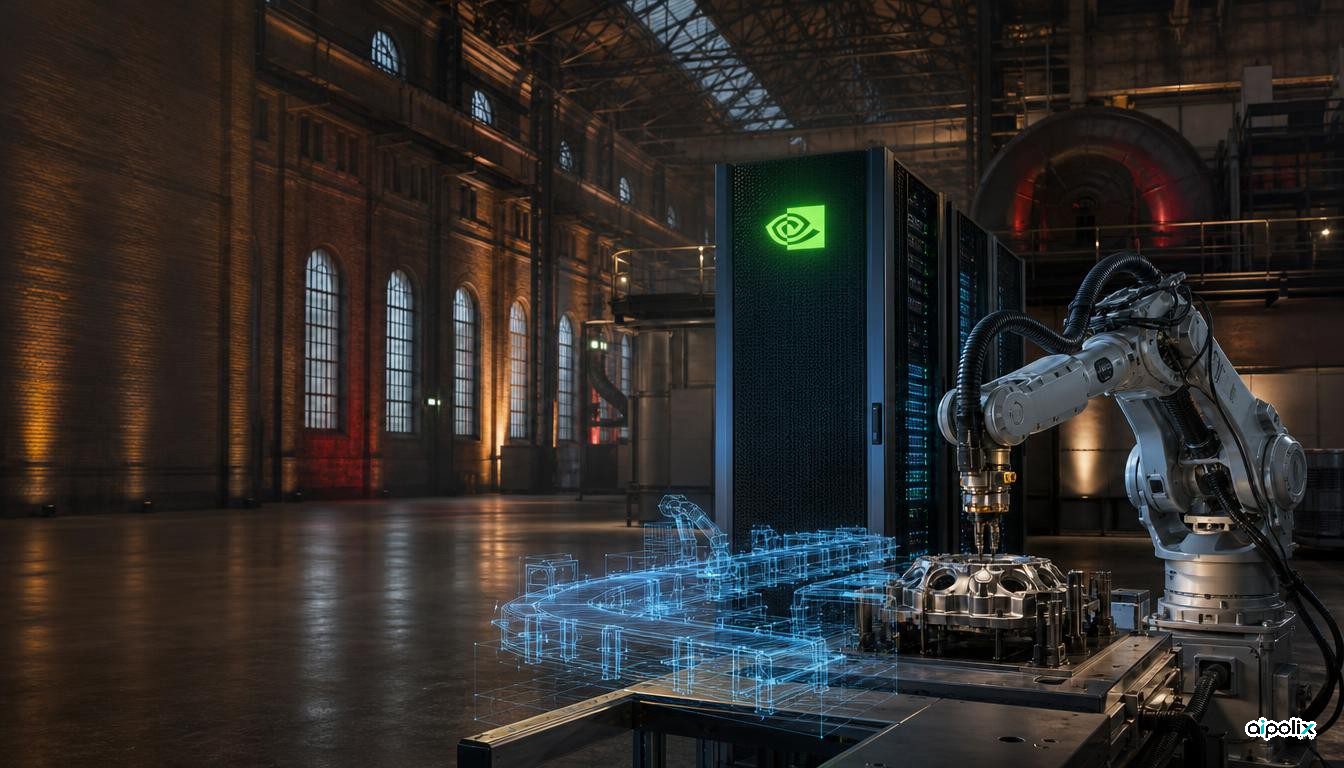
Germany has put its industrial AI ambitions in writing with NVIDIA. On Monday, October 19, 2026, at the first Invest in Germany summit in Berlin, the Federal Ministry for Economic Affairs and Energy and the Federal Ministry for Research, Technology and Space signed a joint declaration of intent with the chipmaker. Its stated aim is an initiative to develop advanced AI models for physical AI, meaning systems such as robots, autonomous machines and production lines that sense and act in the real world, drawing on German industrial data, manufacturing know-how and engineering expertise.
NVIDIA announced the agreement on its corporate blog, and the federal government confirmed it in a statement quoted by tagesschau and by AFP. According to those accounts, NVIDIA will widen its work with German partners to develop specialized, open models for industrial AI, and will make its models available to small and medium-sized firms and research institutions as well as to large manufacturers. The government framed the goal as bringing industrial AI into broad use and building a state-of-the-art industrial AI ecosystem in Europe.
The organizing vehicle is the existing Plattform Industrie 4.0, the network of government, industry, research and trade-association representatives that Berlin has used to coordinate factory digitization. Handelsblatt, which says it has seen the declaration, reports that the document names the platform the central strategy and implementation network for industrial AI in Germany and plans a task force with three focus areas. The paper had reported on October 15 that the cooperation would center on physical AI for training robots and autonomous vehicles, and on models capable of simulating individual production steps or entire factory workflows.
Money is the open question. The government gave no figures for its own contribution when it announced the deal, tagesschau noted. Citing a media report, the broadcaster said Berlin intends to back the project with a sum in the hundreds of millions of euros, partly to rent computing capacity in Deutsche Telekom's AI cloud. That figure has not been confirmed by the government or NVIDIA.
The signing was paired with a public conversation between Chancellor Friedrich Merz and NVIDIA chief executive Jensen Huang at the Kraftwerk, a former power station in Berlin. Merz urged the Mittelstand, Germany's base of family-owned and mid-sized manufacturers, to open their data to AI, and said he wants Germany to become one of the leading countries in spreading AI across its companies. Huang told the audience that AI would augment rather than replace German engineering knowledge and, according to tagesschau, said NVIDIA invested almost one billion dollars in Germany last year.
Huang also used the stage to name planned investments in four German startups: Munich robotics maker Agile Robots, Munich hospital-software company Avelios Medical, AI audio developer Mirelo and Berlin satellite builder Reflex Aerospace. NVIDIA did not disclose amounts and presented the deals as part of a commitment of nearly $10 billion to companies, universities and research institutions across Europe. Earlier the same day, Siemens announced a partnership with NVIDIA on AI-driven autonomous factories; Siemens says fully virtual production ramp-up at its Erlangen plant cuts engineering effort by up to 85% and agent-based production planning saves up to 20% in costs, figures that come from the company and have not been independently tested.
A declaration of intent sets a political framework rather than a delivery plan. No model names, release dates, licenses, compute volumes or budgets were published, and the dts news agency notes that its practical effect will depend on which German partners take part and how quickly the planned models turn into tools companies can use. For manufacturers, the test will be whether open, specialized models trained on German industrial data actually appear, and on what terms smaller firms can adapt them to their own production lines.