
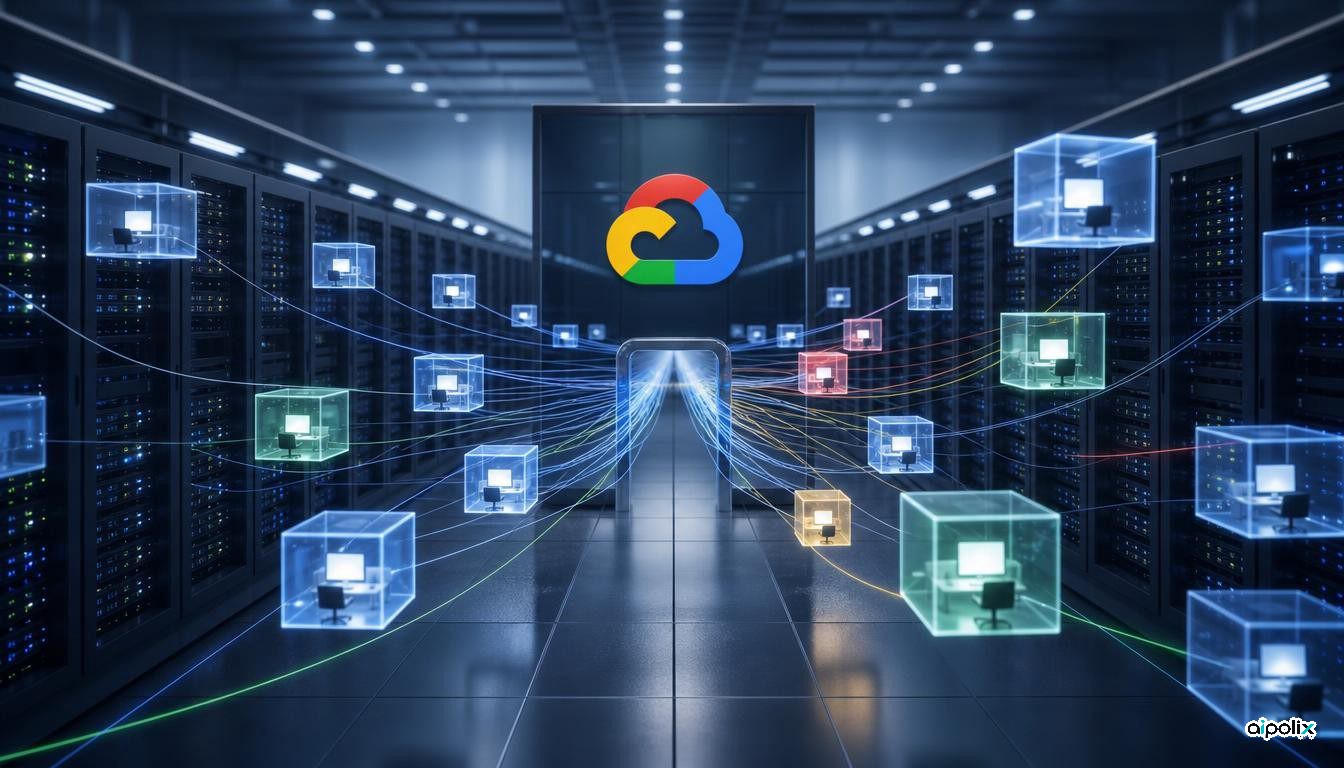
Google Cloud is turning the infrastructure that runs its own Gemini agents into a product. At AGNTCon + MCPCon on October 22, the company announced Agent Compute Engine, a compute service that hands every AI agent a dedicated microVM: a small virtual machine that runs a separate guest kernel and grants root access. Google says the service already supports Gemini acting as a work agent, and that customers will be able to run their own agents on it once a preview opens in the coming months. No pricing or firm date was given.
The pitch rests on how agents behave. An agent loop alternates between bursts of activity, when it runs code, calls tools or drives a browser, and long pauses while the model reasons or a person replies. Google says ordinary VMs take seconds to minutes to start or resume, which is too slow for that rhythm. Agent Compute Engine instead boots microVMs quickly, shares memory pages across agents cloned from one operating-system template, and checkpoints idle machines so they can be restored from snapshots when work picks up again. Each microVM gets its own Hyperdisk volume, so files and context survive long sessions.
Security gets similar emphasis. The service runs on Titanium, Google's offload processor, with a Cloud Hypervisor boundary around each guest. According to Google's technical deep dive, the microVMs have no standard network interface; traffic passes over a vsock channel to proxies outside the guest that enforce outbound policy. Every microVM carries a cryptographically verified identity and short-lived credentials, and service secrets are added on egress so code inside the sandbox never holds them. Google lists coding workspaces that persist for days, large evaluation and reinforcement-learning sweeps, and internal Google services among the workloads it was designed for.
For teams that prefer Kubernetes, Google pointed to Agent Substrate, an open-source runtime for GKE that it first announced in May. Google claims Substrate delivers up to ten times the density of traditional compute and, in a test with 200,000 agents, sustained 500 activations per second with suspend and resume under half a second. Nous Research says it relies on the architecture for Hermes Enterprise deployments. These figures come from Google and its partner and have not been measured independently.
The second half of the announcement concerns control. Google is extending the governance tools in Gemini for business (Agent Gateway, Agent Registry, SPIFFE-based Agent Identity and OpenTelemetry tracing) beyond its own runtimes. Policy enforcement built on Envoy proxies is due to reach other clouds and on-premises setups, and an OS-level sandbox will bring the same rules to coding agents such as Claude Code and Antigravity CLI on managed laptops; both are described as coming to preview soon. Token budgets, model-routing policies and identity links with Ping Identity, SailPoint and Saviynt are slated for preview this quarter.
Google is not alone in selling isolated computers for agents. The New Stack points out that E2B and Daytona already offer microVM sandboxes and that AWS gives each Bedrock AgentCore session its own microVM. Google's argument is that its version has already been run at Gemini scale and that it binds compute, identity and policy into a single stack.
For now, much of this is a roadmap. Agent Compute Engine has no public pricing or general-availability date, several governance features are still listed as coming soon, and the performance and density numbers rest on Google's own benchmarks.