
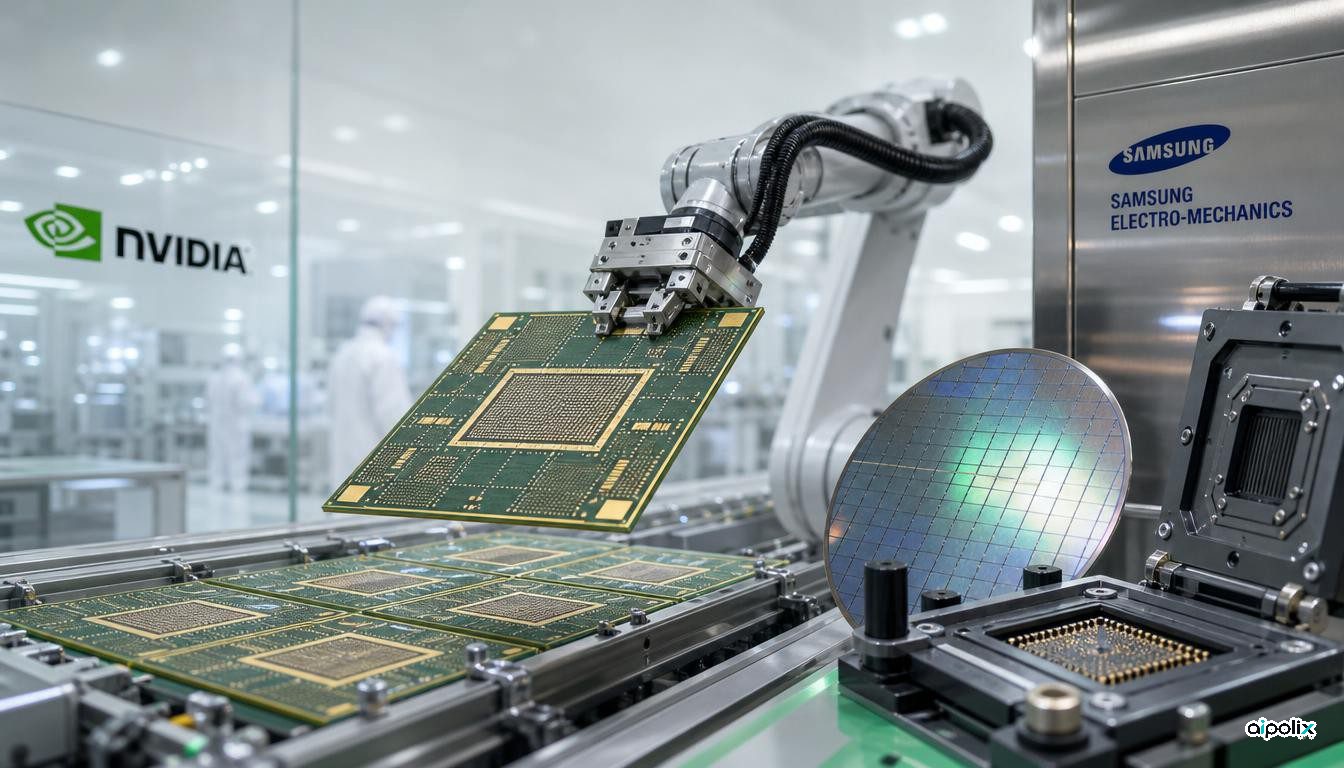
NVIDIA is spending to unblock the parts of its supply chain that sit around the GPU itself. At GTC Berlin on October 21, the company announced capacity agreements with six manufacturing partners, Amkor Technology, IBIDEN, King Yuan Electronics (KYEC), Samsung Electro-Mechanics, Siliconware Precision Industries (SPIL) and Unimicron, covering package substrates, advanced packaging, chip testing and the optical engines used in co-packaged optics. "Demand is extraordinary. Capacity is the constraint," chief executive Jensen Huang said in the release.
Substrates are the largest piece. NVIDIA says it plans to raise substrate capacity for its products by 2.5 times over the next three years, with the IBIDEN, Samsung Electro-Mechanics and Unimicron deals contributing and more agreements underway. IBIDEN, under a deal announced earlier this year, receives a multibillion-dollar capacity reservation advance for its Ono plant in Japan, which is meant to reach three times its current capacity, with new output starting to ramp in the first quarter of 2028. Unimicron's KF substrate expansion in Taiwan, backed by a capacity reservation agreement, should start adding capacity in the second quarter of 2027 and be fully online by mid-2028.
Samsung Electro-Mechanics is the new name in that group. In its own announcement, the Korean company described a strategic partnership in which the two firms will jointly invest in dedicated ABF package substrate lines at its Sejong and Busan sites. Supply starts in 2026 from existing Korean operations and covers substrates for NVIDIA compute chips as well as for high-speed networking switches used inside data centers. Samsung Electro-Mechanics expects volumes to grow at a double-digit annual rate, and both companies say NVIDIA's allocation will be a significant share of its total package substrate capacity by 2028.
Neither company published financial terms. Maeil Business Newspaper reported on October 22, citing industry sources, that NVIDIA will contribute about 2.6 trillion won and Tesla about 1.1 trillion won toward Samsung Electro-Mechanics' FC-BGA expansion, roughly $2.8 billion combined according to Reuters, which relayed the report. The paper says Tesla's money comes with a five-year supply contract running from 2029 to 2033, with substrates intended for chips in its self-driving cars and Optimus humanoid robot. Samsung Electro-Mechanics had disclosed in September a 4.27 trillion won Sejong investment, running to May 2028, that it said would rely partly on funding support from global customers.
The other deals target later stages of production. Amkor and NVIDIA plan to lift interposer wafer capacity in South Korea by more than 300% by the end of 2028. NVIDIA is giving KYEC a $1.1 billion capacity reservation advance for new US testing facilities, with high-volume production targeted for April 2027, and says its total testing capacity should double from 2026 to 2027 across the US, Taiwan and Singapore. SPIL aims to raise its optical-engine output for co-packaged optics in Taiwan 15-fold by mid-2027, then double it again by the end of 2028.
The pattern is notable. Rather than simply placing orders, NVIDIA is prepaying or co-investing to reserve capacity at suppliers in Japan, Korea, Taiwan and the US. High-end substrates are made by only a handful of firms; Maeil Business cites industry estimates that IBIDEN alone holds more than 70% of the market, which helps explain why NVIDIA wants a third major supplier.
Most of the new capacity lands in 2027 and 2028, so it does little for current shortages, and the timelines are company projections that depend on construction and equipment schedules. The won figures and the Tesla contract come from a single newspaper's sources and have not been confirmed by the companies.