
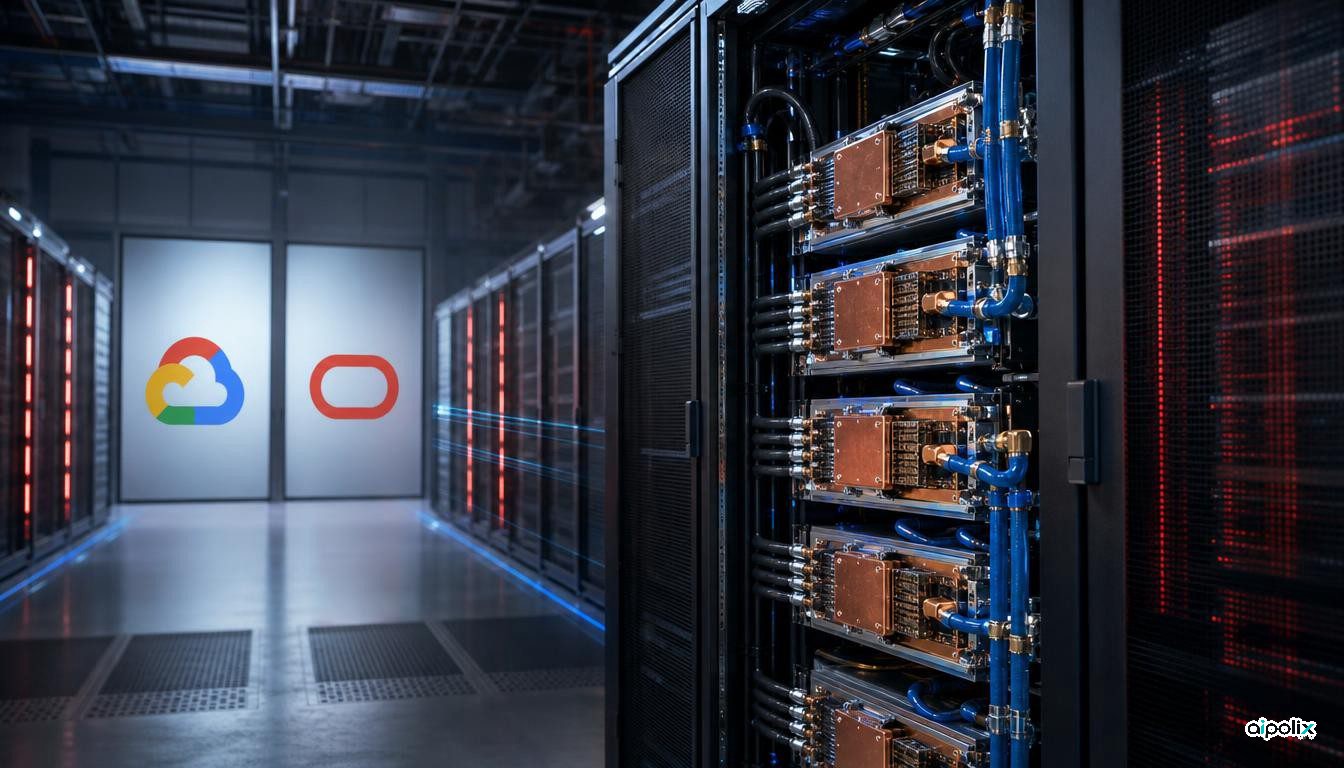
Google's custom AI chips are leaving Google's own cloud. Oracle and Google announced on October 27, during the Oracle AI World conference in Las Vegas, that Tensor Processing Units will be available through Oracle Cloud Infrastructure, with deployments starting in calendar year 2027 and capacity growing over several years. Both companies describe OCI as the first hyperscale cloud other than Google Cloud to offer TPUs.
Under the arrangement, Oracle supplies the data centers, power, liquid cooling and networking, and Google supplies the TPU systems. The joint release names Google's eighth generation, which comes as two separate chips: TPU 8t handles training and TPU 8i handles inference. Google says the training part delivers close to three times the compute per pod of the previous generation, while the inference part is tuned for workloads in which many specialized agents call models over and over. Customers will be able to use the chips for dense and mixture-of-experts training, post-training and production inference.
In its own blog post, Google pitches TPUs on system-level economics rather than raw chip speed. It cites goodput above 97% on large training runs thanks to optical circuit switching that routes around faults, and, for the newest chips, as much as 80% more serving performance per dollar when latency is tight. Those figures are Google's. Oracle's Acceleron networking will connect TPU clusters to the rest of OCI, and Google argues that running fine-tuning and inference next to Oracle databases spares customers costly transfers between clouds.
Oracle executives framed the move as part of a broader effort to stock many kinds of accelerators. CNBC reported that Oracle also plans to host Cerebras hardware and OpenAI's in-house Jalapeño chip on OCI, and that OCI president Mahesh Thiagarajan rejected the idea that the company is turning away from NVIDIA, whose GPUs he called the most fungible option. The Next Platform said the Cerebras systems are also due in 2027. On the same day, Oracle and NVIDIA announced wider availability of Vera Rubin systems on OCI.
Oracle has not said how much TPU capacity it will install. Karan Batta, a senior vice president at OCI, told DatacenterDynamics the deal is a multi-year partnership measured in gigawatts and that Oracle expects to offer each new TPU generation as soon as Google launches it. DCD noted that Google began offering TPUs to selected outside customers in April 2026 and is also working with Blackstone on a separate US cloud built on the chips, so OCI may or may not be the first to switch them on.
For AI developers, the practical effect is more places to rent TPUs and less dependence on a single GPU supplier. Google has been lowering the switching cost on the software side, recently open-sourcing TorchTPU, a native PyTorch backend, and listing support in serving stacks such as vLLM and SGLang. That matters for labs and enterprises that already store data in Oracle systems and want to pick an accelerator per workload without rewriting code.
Important details are missing. Neither company disclosed pricing, regions, the size of the first deployment or how customers will reserve capacity, and availability is more than a year away for most buyers. The performance and efficiency figures come from Google and Oracle and have not been independently measured on OCI.