
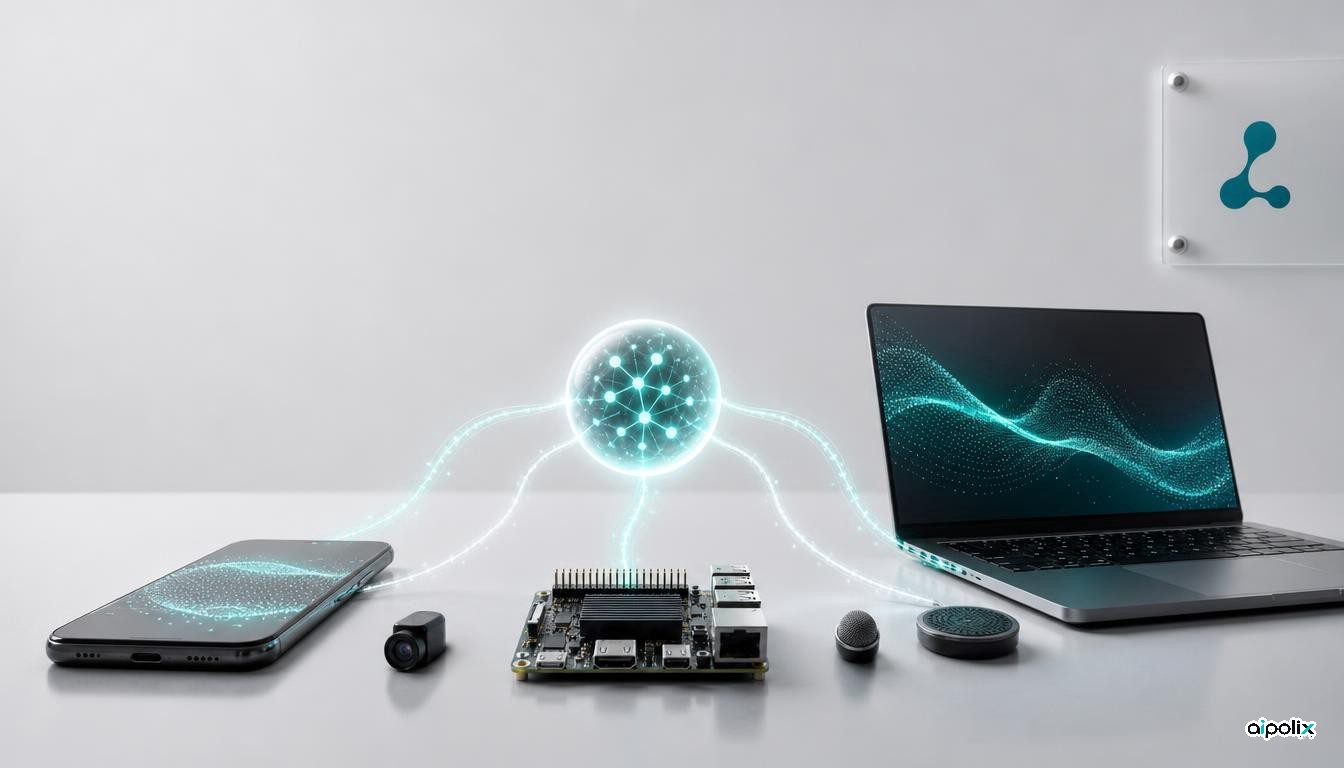
Liquid AI, a startup that builds small foundation models for devices, released LFM3 on October 27. Instead of a single flagship, the first LFM3 release is a set of six models of roughly 2 billion parameters, all derived from the same LFM3-1.7B-Base. The weights for both the base and post-trained versions are published on Hugging Face, and the models are also offered through Liquid's playground and API.
The lineup splits by input type. LFM3-1.7B handles text and is post-trained for local agents, tool calling and structured output. LFM3-VL-2B reads images and, for the first time in an LFM vision model, video. LFM3-Audio-2B covers voice chat, speech recognition, speech synthesis and translation in 18 languages. LFM3-Omni-2B, Liquid's first omni model, takes text, images, video and audio and can reply in text or speech. Two decision models, d1-2B and d1-omni-2B, answer a list of questions about an input in one forward pass, each with a calibrated probability, rather than generating free text.
The architecture is a revision of the hybrid design used in LFM2. Liquid says it searched layouts with hardware in the loop across 14 device and backend combinations, from phones to a Raspberry Pi 5, and settled on a mix of 13 gated short-convolution layers, five sliding-window attention layers and six global attention layers. The base was pre-trained on 22 trillion tokens, with the last 3.5 trillion weighted toward agent traces and tool calls, which also stretched the text model's context window to 256K tokens. At 4-bit precision the text model needs about 1 GB.
Liquid's benchmark claims are large. It says LFM3-1.7B outperforms the earlier LFM2.5-2.6B despite having about a third fewer parameters, and that on the WebArena-Verified agent benchmark it scores 38.42 against 3.02 for the older model, even topping Qwen3.5-9B on long browser and business-app tasks. For vision, Liquid reports a jump from 57.6 to 71.4 in the mean score over a suite of 62 tests relative to LFM2.5-VL-3B, which it says matches Gemma 4 12B, a far bigger model. New in-house vision and audio encoders are meant to cut compute, with time to first audio token as low as 50 milliseconds.
Fine-tuning is central to the pitch. Liquid argues that a capable small model customized for one task is more useful at the edge than a large general model, and says every LFM3 variant can be fine-tuned on a single GPU, with notebooks provided for each modality. The models load in Hugging Face transformers, and Liquid lists availability at launch across platforms from Ambarella, AMD, Arm, Intel, NVIDIA, Qualcomm, OpenRouter and Vercel, with Mercedes-Benz and Shopify credited for pre-release testing.
LFM3 lands in a busy segment for small models, where Alibaba's Qwen team and Google's Gemma group also compete, and Liquid explicitly benchmarks against both.
All performance figures come from Liquid's own announcement and model cards; no independent evaluation had been published when this article was written. Small models also trade breadth for speed, and Liquid's comparisons focus on chosen benchmarks and on-device scenarios rather than general-purpose use. Developers should also review the license terms on each model card before commercial deployment.