
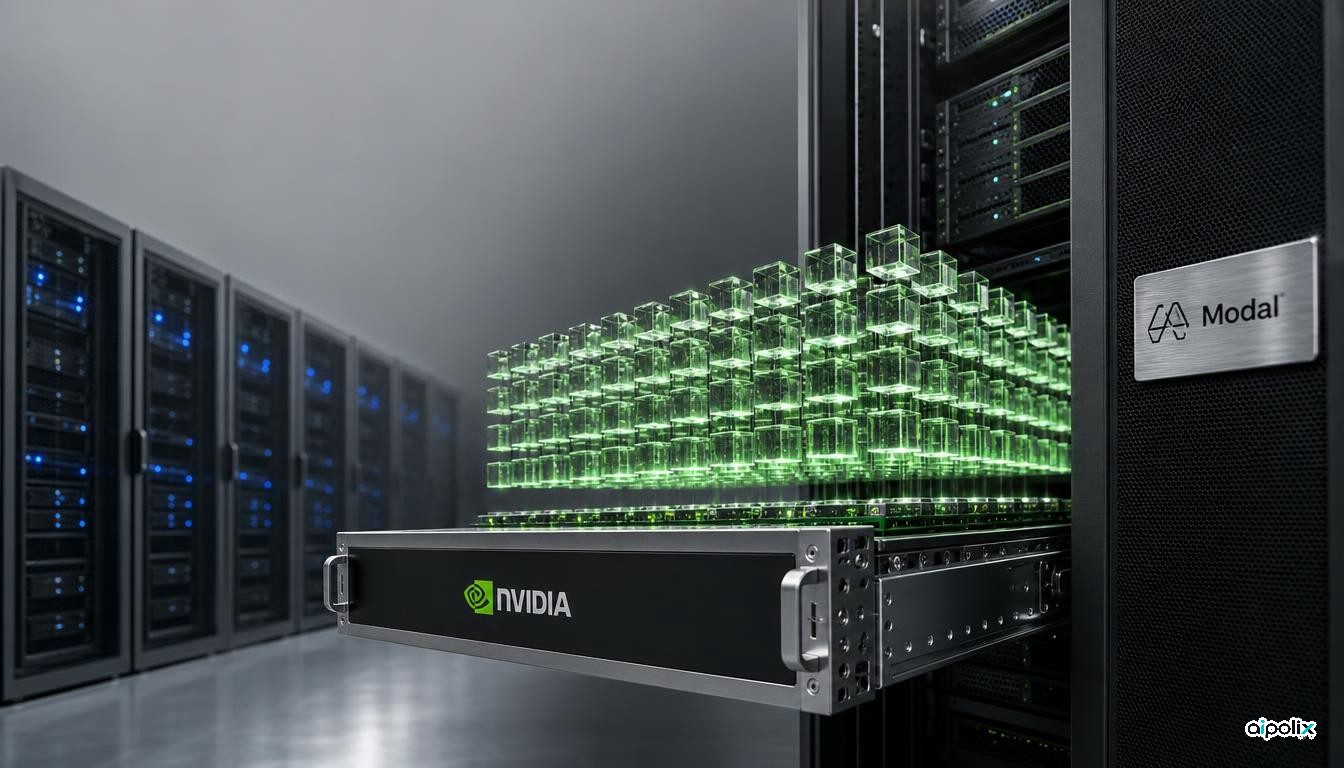
NVIDIA has picked up another customer for its push into general-purpose processors. Modal, the cloud company that rents computing power to AI developers, said on Monday, October 19, 2026 that it will start using NVIDIA's new Vera CPU to host its Sandboxes, the isolated environments where AI agents run the code they write. Until now Modal has run that work only on x86 chips from Intel and AMD. Reuters described the decision as an early sign that NVIDIA's entry into a market long controlled by those two rivals is gaining traction.
Modal explained its reasoning in a detailed engineering post. Sandbox workloads are awkward to schedule: a container can sit almost idle while it waits for a language model to respond, then spike to roughly ten times its baseline CPU use during a package install or a large file search. Hundreds of these containers share each host, so one tenant's burst can slow down its neighbors. Modal lets customers reserve capacity for typical rather than peak usage and absorbs spikes with headroom on each machine, an approach it says has saved users money but increases exposure to that contention.
To test Vera, Modal built what it calls Agentless Agent Bench: 50 Terminal-Bench oracle solutions and verifiers, stripped of network calls and prewarmed in concurrent Docker containers, so that only the CPU work an agent or a reinforcement-learning rollout actually performs remains. That includes compiling, grepping files, git operations and device emulation. Run one task at a time on an idle machine, Vera was often faster than the other processors but not always, and not by a wide margin. TNW reports the serial comparison covered chips from Intel, AMD and Amazon.
The picture changed under load. As Modal packed more concurrent containers onto the machine, it says Vera delivered up to double the task throughput of an equivalent x86 Granite Rapids server while individual task latency stayed the same or fell slightly, because Vera did not slow down as jobs accumulated. Modal attributes this to the chip's high memory bandwidth, which lets more container workloads share each core without throttling. NVIDIA's Vera team told Modal the results were expected; neither company has released the raw data, and the benchmark has not been checked independently.
Throughput matters in two places Modal sees most often. Background coding agents finish faster, which shortens response times and reduces CPU cost. In reinforcement learning, expensive GPUs often wait while sandboxed rollouts complete, so CPU time saved is GPU time saved. NVIDIA designed Vera for its Vera Rubin GPU platform but also sells it as a standalone CPU server; TNW notes the chip was unveiled in March with 88 cores. Reuters reports NVIDIA has told investors it expects at least $20 billion in Vera sales this fiscal year, in a CPU market it values at about $200 billion, and has named OpenAI, Anthropic, Oracle and Perplexity among planned users.
The change is not trivial for Modal. Vera uses an Arm-compatible design, so the company must adapt its infrastructure and its container image build system to a second CPU architecture. Chief executive Erik Bernhardsson told Reuters that Modal is not dropping its current suppliers: Vera will run in a mixed fleet alongside Intel and AMD, with each job placed on the hardware that suits it. He added that the tests used Intel and AMD chips already on the market and that Modal will test the rivals' newer designs when they become available.
The timing follows a large funding round. Modal raised $750 million last week in a round led by Accel at a $15.75 billion valuation and said it is on track for $1 billion in sales over the next year, according to Reuters; TNW reports Modal put Sandboxes revenue at $300 million a year. The open questions are practical. All performance figures come from Modal's own early testing on a single node, the comparison is against current-generation x86 parts, and Modal has not said when customers will be able to run Sandboxes on Vera.