
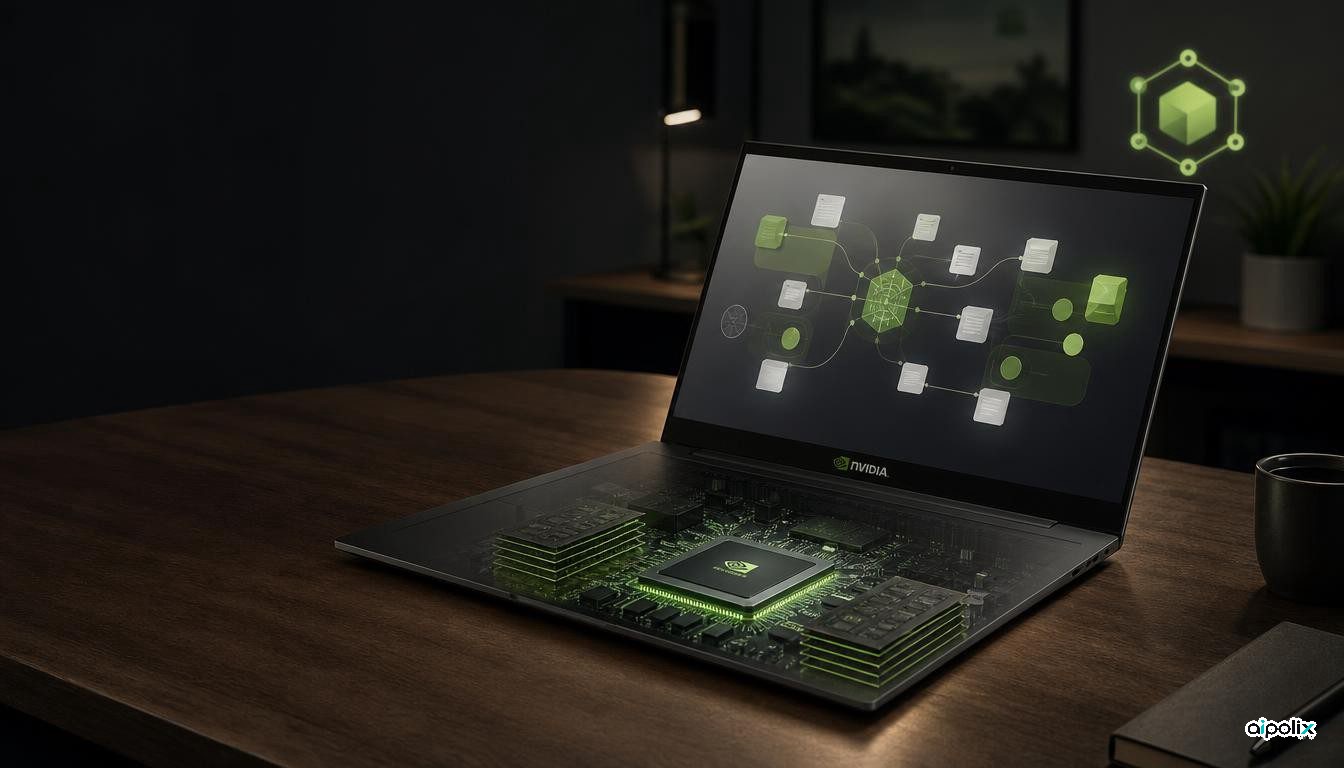
NVIDIA has announced Nemotron 3.5 Bolt 74B, an open language model built to run AI agents locally on its new RTX Spark laptops, as part of a batch of software updates published on October 13, 2026 ahead of the hardware's retail launch. The company says the model will be released on Thursday, October 15, one day before RTX Spark laptops go on sale on October 16.
The model is a mixture-of-experts design with 74 billion total parameters, of which about 9 billion are active for each token, and NVIDIA lists its full name as Nemotron 3.5 Bolt 74B-A9B 24GB. To fit that into 24 GB of memory, NVIDIA quantised it to 2 bits and says it used quantisation-aware training to keep quality close to the full-precision model. The company positions it as quicker than most popular dense models and more capable than most MoE models with a similar memory footprint, claims it did not back with published benchmark numbers in the announcement.
Openness is a central part of the pitch. NVIDIA says Bolt 74B, like its other Nemotron models, will ship with weights, training data and training recipes, so developers can fine-tune it for their own agents. At launch it is expected to work with Ollama, LM Studio, llama.cpp, vLLM and Unsloth, and to be available directly inside agent apps such as Hermes Agent and OpenClaw.
The model arrives with tooling meant to make local agents easier to set up and safer to run. NVIDIA PAIR, a free open-source tool that pools AI compute across PCs on a home or office network, left beta with llama.cpp support and direct downloads from Hugging Face. Six agent apps (Hermes, OpenClaw, GitHub Copilot, Pi, Perplexity and WorkBuddy) are adding one-click local model setup, and NVIDIA says its OpenShell layer and Microsoft Execution Containers will sandbox agents at the operating system level. An open-source routing library, NVIDIA Switchyard, lets agents split queries between local and cloud models.
RTX Spark itself was announced by NVIDIA and Microsoft the previous week. NVIDIA describes it as a single superchip pairing up to 128 GB of shared memory with a petaflop of AI processing, which is what makes a 24 GB model plus agent tooling practical on a laptop. Other updates in the same post include NVIDIA Broadcast 2.3, which adds an MCP server so local agents can control the app, and a smaller Nemotron 3.5 Bolt E4B model for in-game characters due on October 23.
For developers, the release is a bet that capable agents can run on personal hardware rather than in the cloud. An open model with published training data is also easier to audit and adapt than most commercial alternatives, which matters for teams that want to keep code or documents on their own machines.
Several points are still unproven. Bolt 74B was not yet downloadable when it was announced, NVIDIA's speed and quality comparisons are its own, and real-world performance of a 2-bit model on long agent tasks will need outside testing. Licensing terms were not detailed in the post.