
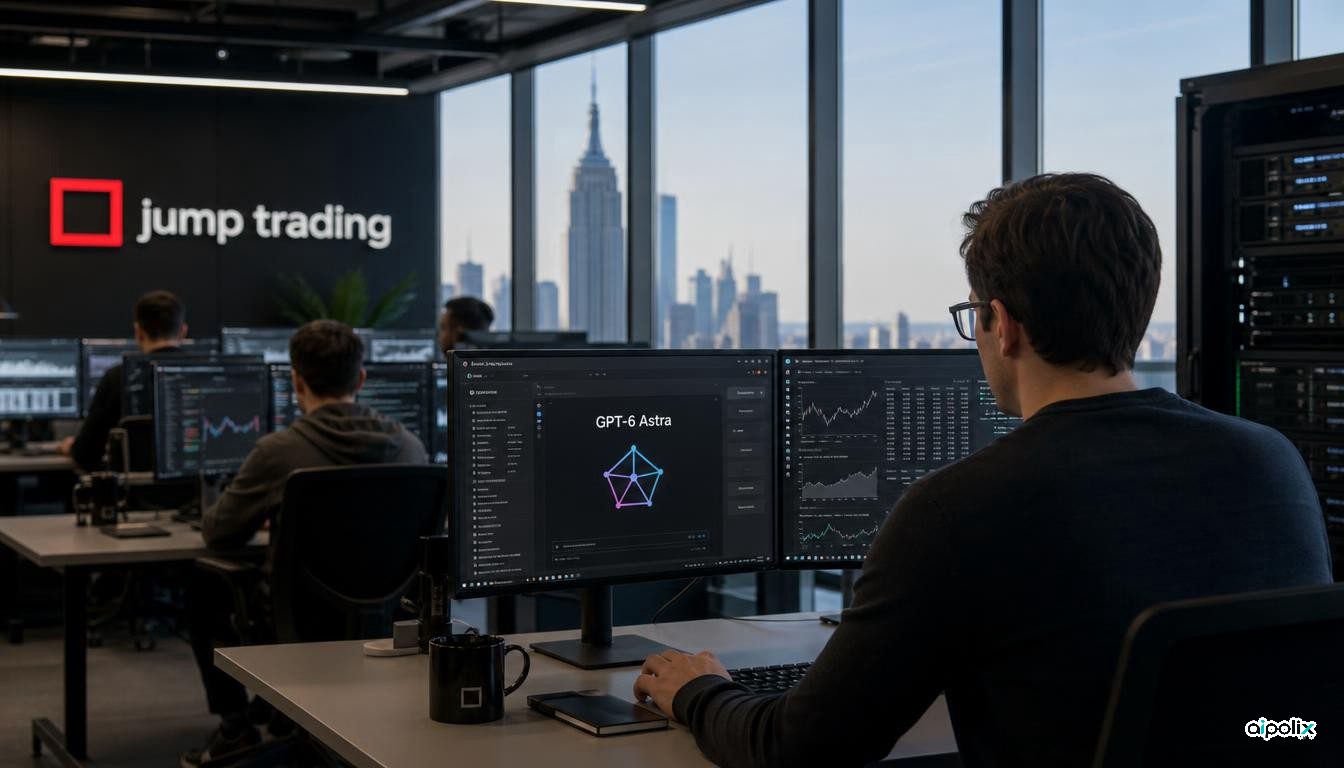
OpenAI has published a case study on Jump Trading's use of GPT-6 Astra for quantitative research. Jump's LLM R&D team says newer agent systems can take on longer and more ambiguous research tasks, ranging from coding to quantitative studies that pull from multiple data sources and iteratively evaluate findings.
The workflow described by Jump is not autonomous trading. Researchers define the problem, environment, evaluation criteria and constraints, while agents explore ideas and can redirect their work based on intermediate results. Human review remains a required boundary before critical outputs are accepted. Jump says a trading signal produced by an agent is treated as potentially wrong and enters the same controlled review environment as other signals.
The case study emphasizes long-horizon agent coordination and recursive improvement rather than a specific benchmark. Jump's Lucas Baker says GPT-6 Astra can run research processes for days with periodic human check-ins, connecting findings and deciding where to allocate further analysis. These are customer and vendor descriptions, not independently audited measurements of trading performance.
The story is relevant to finance because it shows how a highly regulated quantitative firm is structuring agentic research around observability, constrained environments and human acceptance rather than handing agents direct control over execution. The strongest conclusion supported by the source is adoption and workflow design, not evidence that AI improves investment returns.