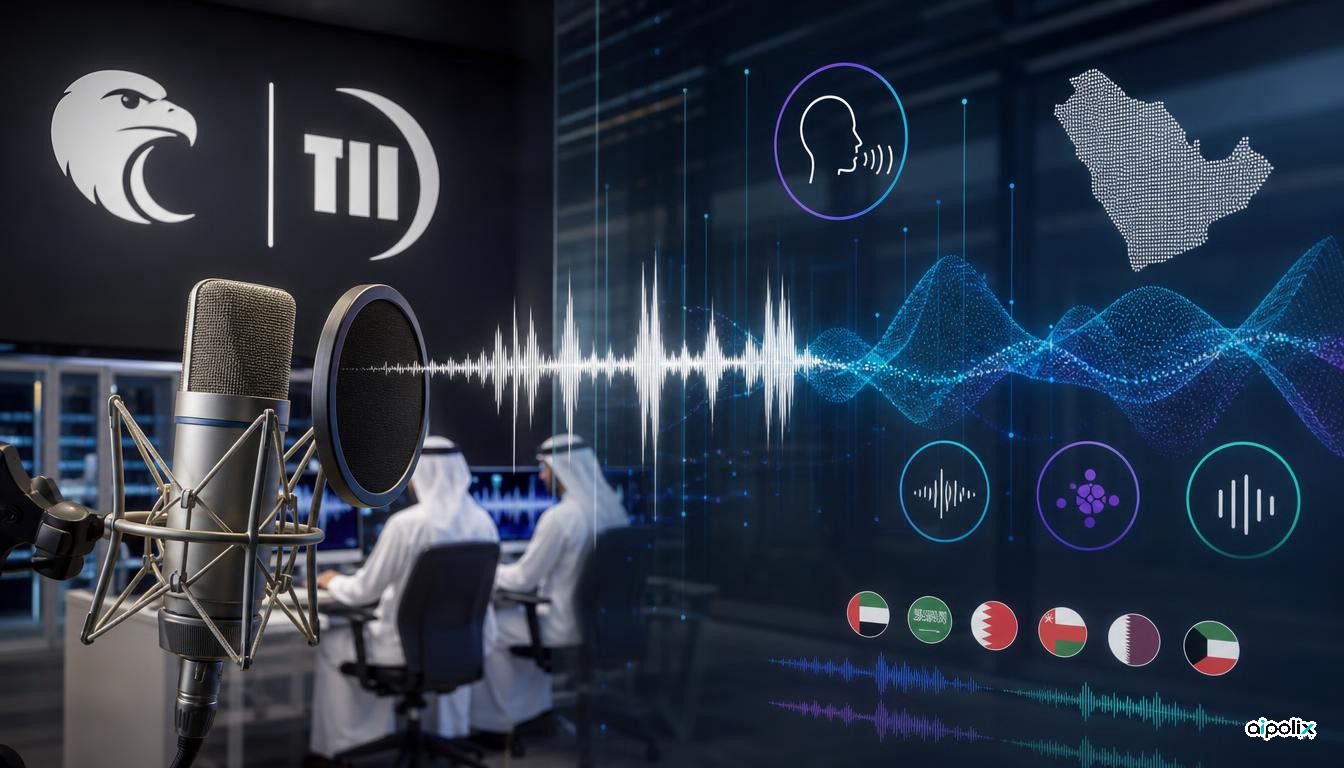
Technology Innovation Institute has released Falcon-ASR, a 1.6-billion-parameter automatic speech-recognition model built with particular emphasis on Emirati Arabic while also covering Modern Standard Arabic, other Arabic dialects, English, French, Spanish and Portuguese. The technical release appeared on Hugging Face on October 7 after TII announced Falcon-ASR alongside Falcon-Emirati and Falcon-OCR-Arabic on October 6. A public demo is available, while API access and native applications are planned rather than generally available today.
TII says Falcon-ASR was trained to handle speech conditions that commonly degrade transcription systems, including background noise, overlapping speakers, music, reverberation, telephone-quality audio and changes in speaking speed and pitch. The same model weights handle all supported languages without requiring a language flag, and the system can emit word-level timestamps so applications can align individual words with their positions in an audio recording.
On six Arabic test sets used by the Open Universal Arabic ASR Leaderboard protocol, TII reports an average word error rate of 20.92% and character error rate of 8.79%. Lower values are better. The next-best published average in the leaderboard snapshot TII says it checked on September 30 was 23.17% WER for Audar-ASR-V1-Turbo. TII also reports 22.73% WER on an internal Emirati evaluation, compared with 26.80% for Qwen3-Omni-30B-A3B-Instruct in the same comparison. These are meaningful reported results, but the internal Emirati benchmark is controlled by TII and should not be treated as an independently established universal ranking.
The model also recorded a TII-reported mean WER of 5.74% across seven public English test sets. Its architecture builds on the institute's earlier Falcon3-Audio work. The release is especially relevant because dialectal Arabic has fewer transcribed resources than Modern Standard Arabic, making everyday regional speech a harder target for general-purpose transcription systems. Falcon-ASR is therefore positioned less as a generic speech model and more as a compact multilingual system with a specific regional strength.
Independent coverage from RuntimeWire confirms the model release and accurately distinguishes the public Arabic benchmark from TII's internal Emirati evaluation, while warning that broader testing is still needed. That caveat is central: the public leaderboard comparison is more inspectable, but the strongest Emirati claim remains vendor-evaluated. Real production value will depend on performance across speakers, dialect variation, code-switching and recording conditions beyond the test sets, as well as on the deployment options TII ultimately makes available.