
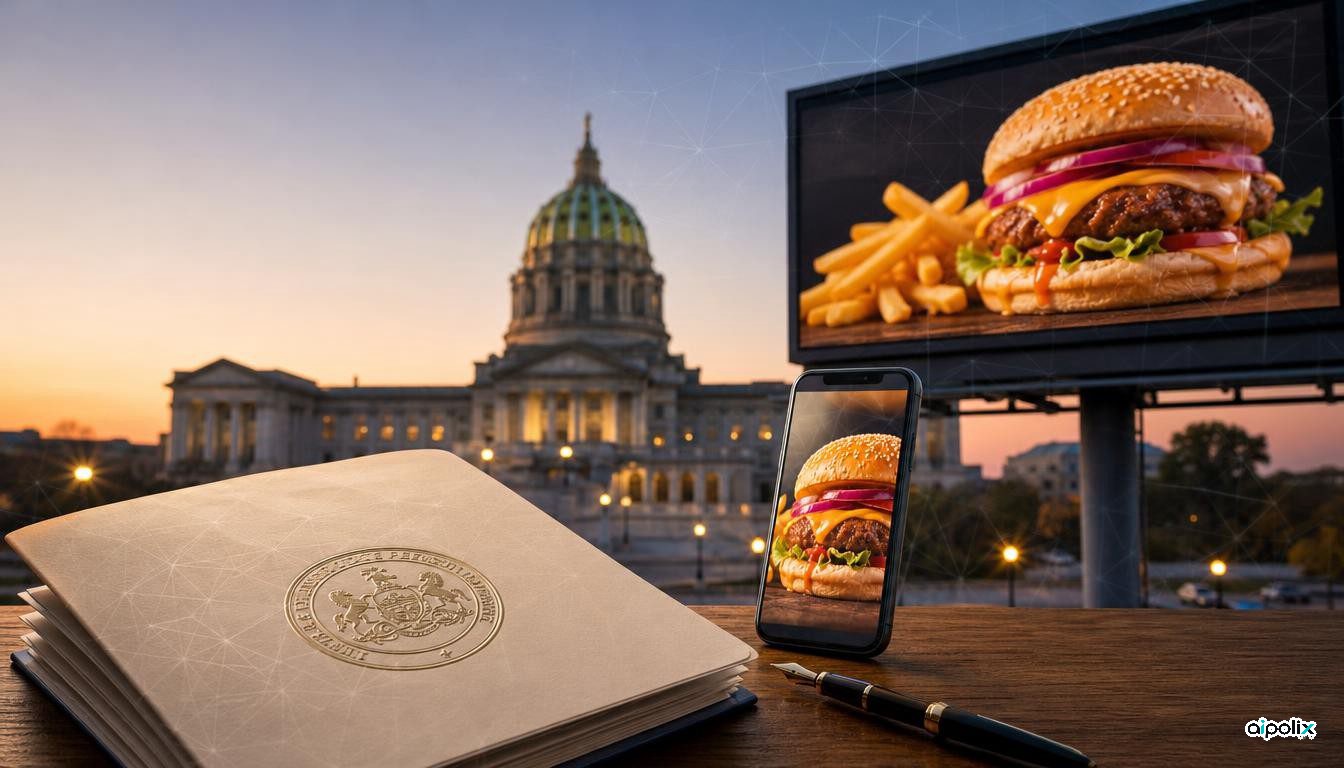
Pennsylvania has turned a growing complaint about AI-made marketing into a legal duty. Governor Josh Shapiro signed Senate Bill 806, titled the Artificial Intelligence Deceptive Advertising Act, on Thursday, October 22, as part of a batch of 58 bills, and the legislature's records list it as Act 99 of 2026. The law obliges advertisers to tell consumers when synthetic content in an ad could mislead them about what is being sold. It takes effect 60 days after signing, which places the start date around December 21.
The core obligation is narrower than a blanket label on every AI image. Under the enacted text, an advertiser who knowingly, recklessly or willfully produces and runs an ad in which AI-made material misleads people about what a product or service is, where it comes from or whether it is genuine must attach a clear and conspicuous notice. That notice must state that the ad contains content modified or generated using artificial intelligence. It has to appear the first time the synthetic material is shown, use the same medium as that material, and, where technically feasible, be permanent or very hard to strip out.
The definitions do much of the work. Synthetic content covers images, video, audio clips and text that AI has produced or substantially altered, and the act's definition of AI explicitly includes generative systems. A disclosure only counts as clear and conspicuous if its size, contrast, placement, duration or volume make it easy to notice and understand, and it must be given in the language the consumer is using. Three categories are carved out: material that is evidently fictional, parody, satire, commentary or criticism, and content limited to text.
Enforcement sits with the state Attorney General and county district attorneys, who can seek injunctions and bring civil actions. A court may impose a civil fine of no more than $3,000 and award attorney fees and court costs. The bill was introduced in June 2025 by state Senator Nick Pisciottano, a Democrat from Allegheny County, with Republican and Democratic co-sponsors. It cleared the Senate 48 to 2 on June 10, 2026, and the House 163 to 40 on October 7.
In an interview with CBS Pittsburgh, Pisciottano said consumer groups representing older residents had described people being scammed by fake AI advertising, and he argued that the technology will soon make real and fabricated images hard to tell apart. He said only a few other states have similar requirements, and that political ads are not affected. Shapiro, quoted by WPXI, called the law an important step but said Pennsylvania still needs stronger AI guardrails, pointing to worries about jobs, children's safety and elections.
The reach could extend beyond the state's borders. The Verge noted that the labeling duty applies regardless of where an ad was produced, so campaigns made elsewhere but shown in Pennsylvania may need disclosures too. It also flagged gaps: what counts as significantly modified is open to interpretation, the fictional and satire exemptions are loosely bounded, and a label is required only when synthetic material creates a false consumer perception, which leaves the question of who decides what is false.
Some early descriptions of the law do not match the signed text. Coverage said text was covered, yet the act exempts content limited to text, and Pisciottano's remarks about possible jail time and liability falling on AI companies rather than users are not reflected in the enforcement section, which targets advertisers and caps fines at $3,000. How the Attorney General interprets these terms, and whether other states copy the model, will decide how much the labels change what Pennsylvanians see in their feeds.