
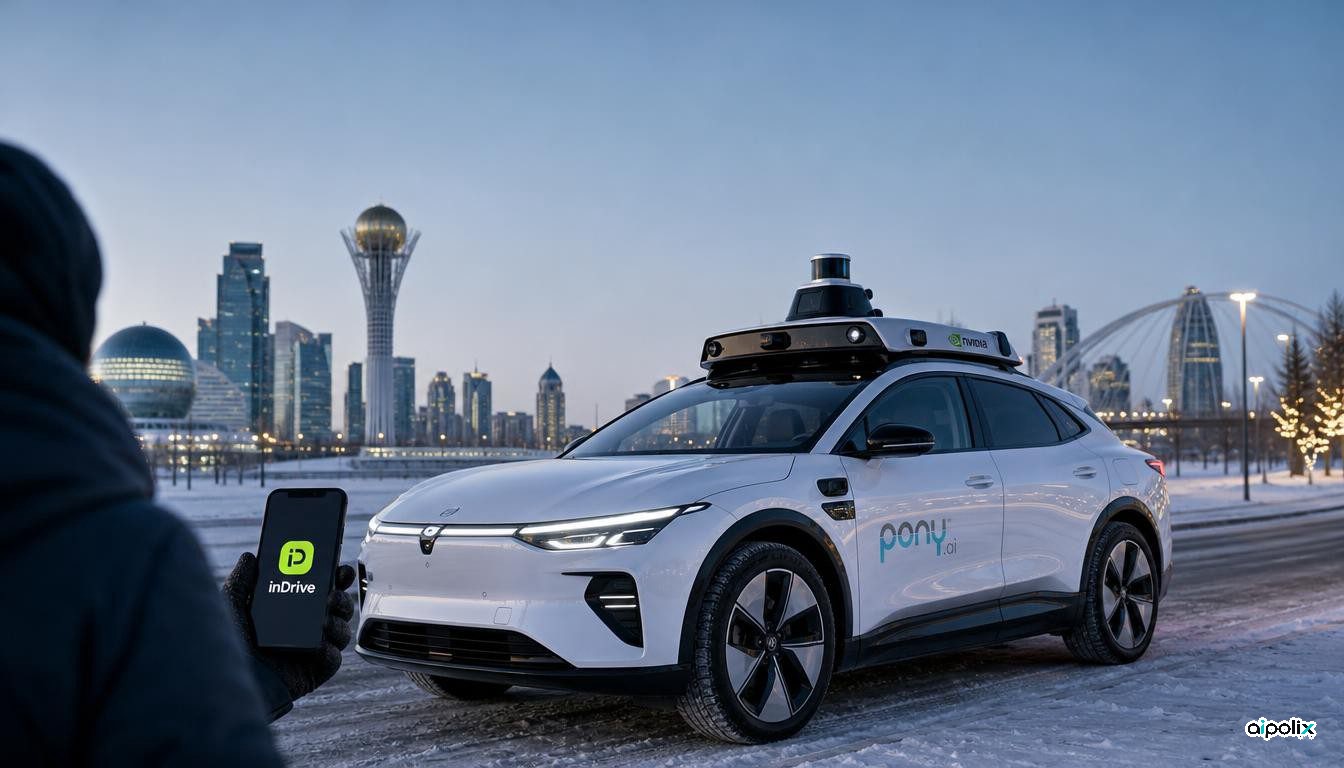
Kazakhstan could become an early proving ground for robotaxis outside the US and China. Pony.ai said on October 23 that it had signed a memorandum of understanding with inDrive, the ride-hailing platform known for letting riders and drivers negotiate fares, and with NVIDIA to examine whether driverless ride-hailing can work in the country. Astana, the capital, would be the first city.
The roles are clearly split. Pony.ai would supply its seventh-generation robotaxis, inDrive would offer the rides in its app and operate the service, and NVIDIA would provide the AI platform. That platform centers on NVIDIA Hyperion, a reference design of sensors and computers for Level 4 vehicles, paired with the Alpamayo software stack and the Halos safety system. Under the memorandum, the partners will test whether putting Level 4-ready vehicles in front of riders makes sense on technical, operational, regulatory and commercial grounds.
Timing is less settled than some headlines suggest. Pony.ai's release gives no date, and MarketWatch noted that the companies disclosed no launch date, investment or fleet size. Kursiv, a Kazakh business outlet, likewise reported that no timeline had been announced and that the partners first plan to draw up a roadmap. inDrive's chief technology officer, Yuri Misnik, told TechCrunch that testing should begin in Astana in the first half of 2027, initially with a safety operator on board and with fully driverless rides as the longer-term aim. Any launch still depends on reaching an agreement with Kazakhstan's government.
Regulation is the main reason Kazakhstan came first. Pony.ai pointed to the country's first structured legal framework for driverless transport, adopted during a national push branded the Year of Digitalization and Artificial Intelligence. TechCrunch reported that Kazakhstan announced last month it wants autonomous taxis on the road in 2027, starting with trials in Astana and two other cities. Astana's long, icy winters also make it a tough test environment, a point inDrive founder Arsen Tomsky raised when he said the city could show how the technology copes with harsh conditions.
Cost is the other thread. NVIDIA's automotive vice president, Ali Kani, told TechCrunch that a ready-made sensor and compute base matters most in emerging markets, where conventional ride-hailing is already cheap and robotaxis must compete on price. The announcement came as NVIDIA chief executive Jensen Huang made his first visit to Kazakhstan.
For Pony.ai, the deal adds to a fast international expansion. TechCrunch reports the company wants a fleet above 3,500 robotaxis spread across more than 20 cities by late 2026, against 1,975 cars in late June, and Uber said earlier this month it would test Pony.ai vehicles in London. inDrive, whose service runs in 47 countries and over 1,200 cities, signed a separate deal in December to explore WeRide-powered autonomous rides in Riyadh with Saudi Arabia's AI Driver; TechCrunch says it is unclear whether that pilot has started.
A memorandum of understanding is not a binding commitment to launch. The companies will assess other Kazakh cities and inDrive markets only after Astana, and fleet size, pricing and safety targets remain unpublished.