
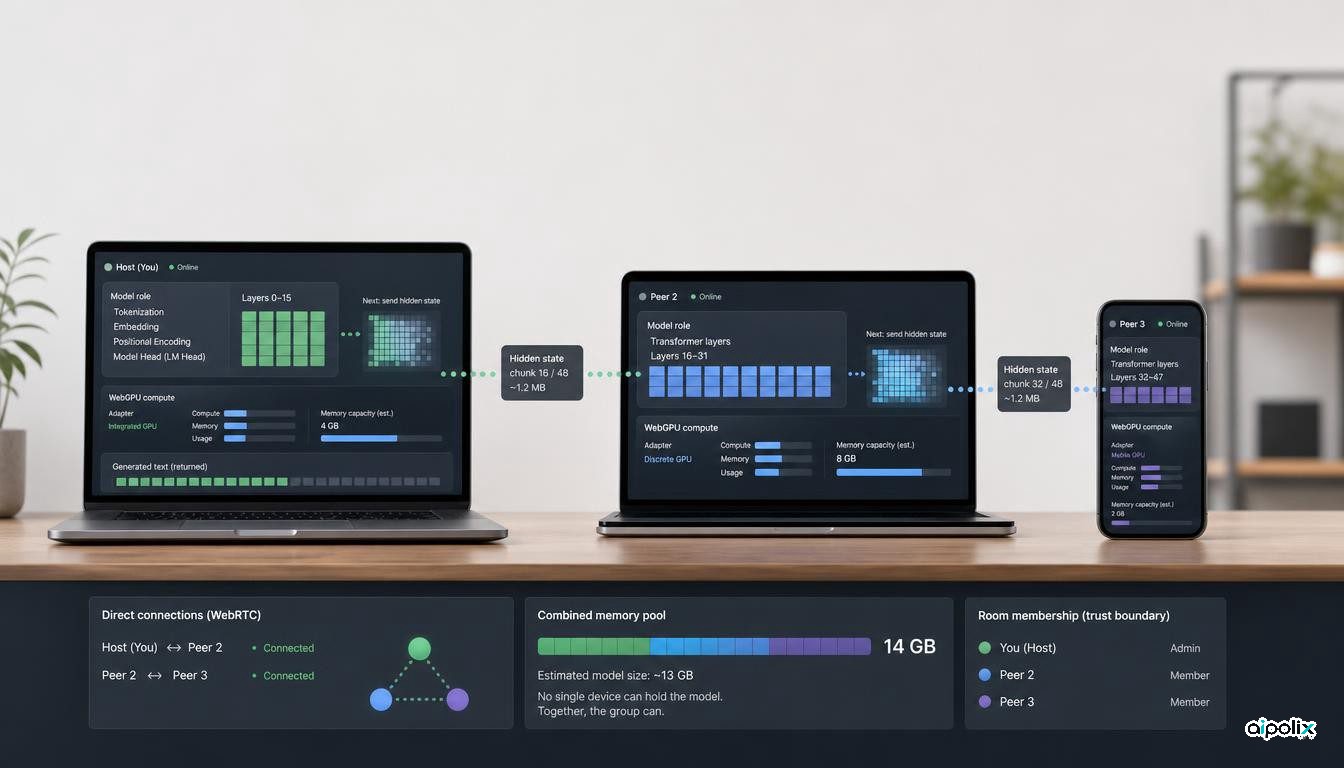
SwarmLLM has released version 0.2.0, an early open-source system that splits one large language model across browser tabs on multiple devices. The release includes a September 7 demonstration of Qwen 3.8 27B divided between a MacBook and an iPhone, plus a WebGPU inference engine, WebRTC transport, benchmark logs, tests and an explicit threat model.
The noteworthy part is not the project's self-reported speed. Those measurements have not been independently reproduced. The architectural change is more concrete: devices can contribute only a contiguous slice of model layers, download only those weights, and pass intermediate activations directly to the next browser. That turns spare memory and GPU capacity in nearby machines into a shared inference pool without installing a native runtime on every participant.
A model can be larger than any one browser can hold
SwarmLLM's architecture keeps tokenization, embeddings, the final language-model head and sampling on the host. The model's transformer blocks are divided into contiguous layer ranges. After one device finishes its range, it serializes the hidden state as f16 and sends it over a WebRTC data channel to the next participant.
For Qwen 3.8 27B, the project documents a 5,120-element hidden state, or roughly 10 KB per token hop. Each participant downloads only the tensors for its assigned layers and caches them in the browser. In practical terms, the system is pooling memory capacity, not pretending that several devices become one GPU.
Version 0.2.0 packages this into a browser room rather than a cluster that needs Python, an RPC daemon or a native binary on every node. That lowers deployment friction enough to make ad-hoc local inference a plausible workflow for labs, classrooms and small teams that already have heterogeneous hardware.
The performance claim needs a narrower reading
The project reports 9.0 tokens per second for plain decoding and 16.1 with speculative decoding on an NVIDIA GB10, compared with 8.0 tokens per second for a particular llama.cpp CUDA build on the same GGUF and machine. It also reports 7.7 tokens per second when the 27B model is split between a MacBook and an iPhone on the same Wi-Fi, while the attached v0.2.0 demo reports 10.7 tokens per second for a 400-token run.
These are project measurements, not independent benchmarks, and they should not be generalized into a claim that browser inference is faster than native inference. The same benchmark log shows a major counterweight: on the GB10, llama.cpp prefill was measured at 377 tokens per second while SwarmLLM reported 44. The authors also document large drops as more browser hops are added.
The useful conclusion is therefore about deployability and memory distribution, not universal speed. SwarmLLM can make a model fit where one device could not hold it, while network and per-hop overhead remain first-order constraints.
Speculation is used to amortize network round trips
Distributed autoregressive inference has an obvious problem: if every generated token must traverse several devices, network latency can dominate. SwarmLLM addresses this with the model's multi-token-prediction draft head. The host proposes several tokens, then the distributed trunk verifies them in a batched pass.
According to the architecture document, accepted drafts are kept only when the trunk agrees; after the first mismatch the system uses the trunk's token and restores recurrent state from snapshots. The project says its tests require the speculative path to produce the same output stream as plain decoding for the same sampler.
This is an important design choice because it targets the network bottleneck directly. Faster kernels help a single device, but a distributed browser runtime also needs to make each network lap carry more useful work.
The privacy boundary is the room, not the server
The project's security document is unusually clear about what peer-to-peer does not solve. The signaling service does not carry model traffic, and WebRTC encrypts transport between browsers. However, everyone in a room can see the shared conversation, and the project warns that intermediate activations are not a privacy mechanism.
More importantly, SwarmLLM currently has no verification that a remote participant actually performed its assigned computation correctly. A malicious peer could return manipulated activations. The project lists auditing as future work and explicitly rejects the idea that an open swarm of strangers is safe today.
That changes how the architecture should be evaluated. Removing a central inference provider reduces one dependency, but it replaces that boundary with trust in every participating browser. For sensitive prompts, the relevant question is not only where the model runs but who is allowed into the computation.
The operational opportunity is ephemeral local pooling
Aipolix's analysis is that SwarmLLM is most interesting as an ephemeral local-compute layer, not as a decentralized cloud replacement. A team can assemble a temporary inference pool from devices already in a room, use browser delivery to avoid per-node installation, and disband it when the task is finished.
That makes three controls operationally important: pin the exact model artifact, restrict room membership to trusted participants, and record the topology and benchmark conditions when performance matters. Version 0.2.0 does not yet provide remote-compute verification or model-file content hashing, so those limitations should be treated as design constraints rather than future details.
The release is early and the project is small. Its benchmark results need outside reproduction. But the shipped code demonstrates a concrete alternative deployment shape: local inference can be distributed at the browser layer, with the trade-off shifting from single-device memory limits toward network latency and peer trust.