
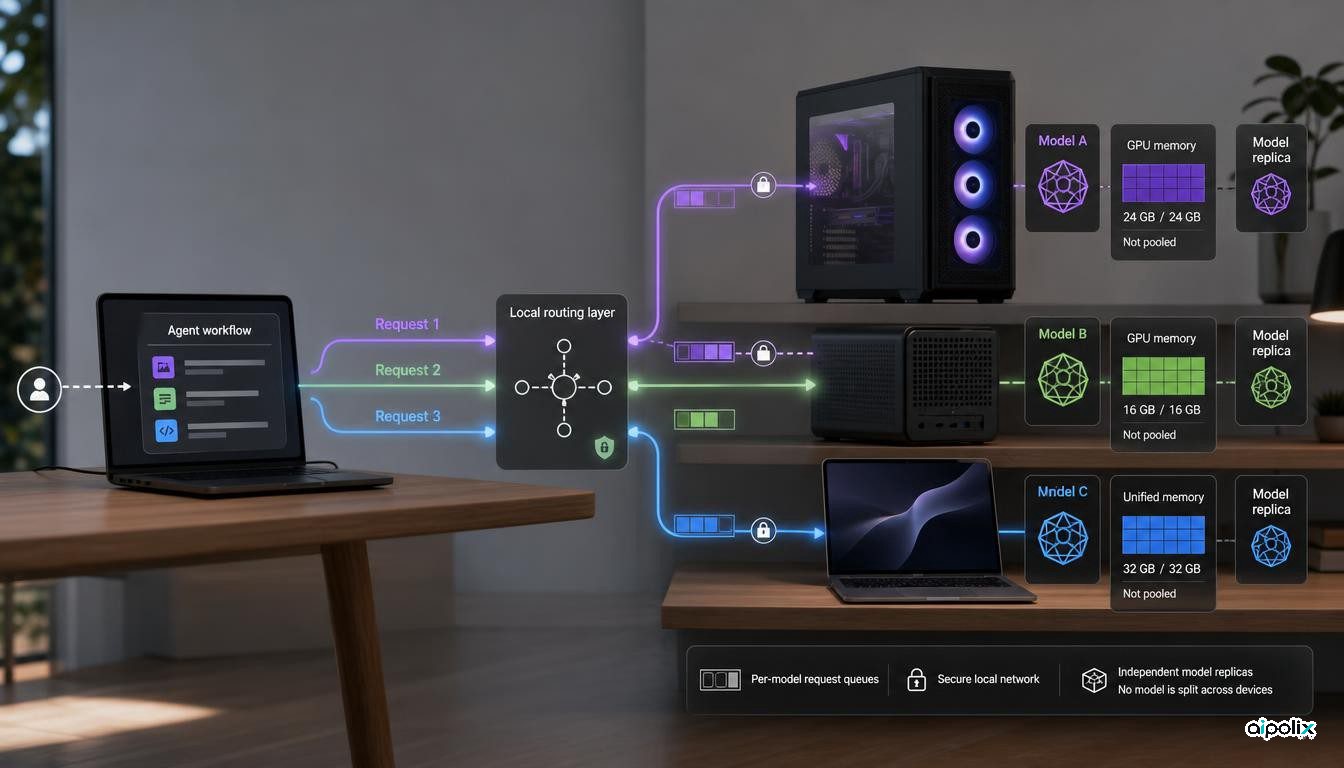
NVIDIA has released the beta of Personal AI Router (PAIR), an open-source local inference router that lets compatible computers on the same network share independent AI requests behind one endpoint. The useful part is not that PAIR creates a bigger virtual GPU. It does not. Instead, it gives local multi-agent and concurrent AI workloads a way to use otherwise idle machines without changing the agent harness.
PAIR currently works with Ollama and LM Studio and supports Windows, Linux and macOS nodes, including RTX systems, DGX Spark and Apple M4-or-newer Macs. NVIDIA says participating machines can join and leave the available pool as their state changes, while the router decides where each new request should run.
That architecture makes PAIR potentially important for developers who want more local throughput without moving inference to the cloud. It also creates a clear planning constraint: PAIR scales request capacity, not model memory.
One endpoint hides a request scheduler, not a distributed model
PAIR sits in front of local inference engines as a proxy. An application can continue sending an Ollama-compatible or OpenAI-compatible request to a familiar local endpoint. PAIR inspects the requested engine and model, filters the paired machines that are ready to serve it, selects one eligible node and keeps that request on the selected machine until completion.
The project documentation is explicit about what does not happen. GPU memory is not pooled. A model is not sharded across the network. One inference request is not split between machines. A node must already be able to load and run the requested model before PAIR can send work to it.
That distinction is easy to miss because “cluster” can imply aggregate memory or distributed execution. PAIR is closer to a local traffic scheduler for inference. Its advantage appears when several independent calls are available at the same time.
For agent systems, that can be a natural fit. A coordinator that launches several research, coding or verification subagents may generate many model requests that do not depend on each other. Instead of queueing all of them behind one local engine, PAIR can place different calls on different ready computers.
The performance claim is promising but configuration-specific
NVIDIA demonstrates PAIR with a five-subagent Hermes Desktop workload running through Ollama with Qwen 3.6 35B A3B. The company reports an average completion time of 18 minutes on one RTX Spark laptop and 8 minutes 48 seconds on a three-device setup containing the RTX Spark laptop, a DGX Spark and an RTX 5090.
That is roughly a 51% reduction in elapsed time for this demonstration, or about 2.05 times the completion rate. It should not be treated as a general benchmark. NVIDIA labels the result unofficial and configuration-specific, and the comparison changes the available hardware as well as introducing PAIR. Workload parallelism, model placement, engine settings, network conditions and node availability can all change the result.
Independent reporting from The Verge confirms the beta launch, open-source release and focus on using idle local systems for parallel inference, but it does not independently reproduce NVIDIA's timing result.
The more defensible claim is therefore architectural: PAIR can reduce queueing when a workload exposes enough independent requests and more than one eligible machine has the required model.
Local-first does not mean every deployment is automatically private
PAIR uses local-network discovery, a six-digit pairing flow and mutual TLS for communication between paired nodes. NVIDIA says prompts, files and agent context can remain on the local network when the application, model source, inference engine and participating nodes are all local.
That last condition matters. PAIR cannot make a workflow local if another component still calls an external service. Teams should treat “local” as an end-to-end property of the application path, not a property inherited merely because PAIR is installed.
The repository also makes the trust boundary concrete. It exposes local HTTP endpoints, performs LAN discovery and creates cluster identity and certificates. On a trusted home or studio network that may be a reasonable trade-off. On a shared or hostile network, the service should be evaluated like any other network-accessible control plane rather than assumed safe because inference happens on-premises.
The real scaling unit is replicated model availability
The practical Aipolix implication is that PAIR changes how small local AI deployments should think about capacity.
If the same model is installed on three capable machines, PAIR can have a wider pool for concurrent calls to that model. If the model exists on only one machine, requests for it still converge on that node. If a model is too large for every individual machine, adding more PAIR nodes does not make the model fit because their memory is not combined.
That means the useful capacity metric is not simply total GPU memory across the house or office. It is the number of eligible replicas for each model, multiplied by the amount of independent work the application can expose.
For agent builders, this creates a design incentive. Parallel subagent work can benefit from routing; a long sequential chain dominated by one model call cannot. Model placement also becomes part of scheduling strategy. Frequently requested models may need copies on several nodes, while specialist models can live on fewer machines if their traffic is sparse.
This is a more modest claim than turning a group of PCs into one giant accelerator, but it is also more operationally credible. PAIR moves a familiar data-center idea, request routing, into local inference while preserving existing Ollama and LM Studio interfaces.
A useful beta for throughput, not a shortcut around hardware limits
PAIR is most interesting where developers already own several compatible machines and want to run multiple local agents or AI applications at once. The proxy design lowers integration cost because an existing harness can keep using its current local API shape, while the router handles placement behind it.
Its limitations are equally important to the product story. PAIR does not solve oversized-model memory requirements, does not accelerate inherently sequential workloads by itself and is still a beta. NVIDIA's scheduler currently uses a relatively coarse combination of queued work and smoothed GPU utilization, and the repository says it does not yet account for factors such as GPU model, available memory, model warmness or estimated request cost.
For teams evaluating it, the right test is therefore an end-to-end workload test, not a synthetic “cluster size” comparison. Measure queueing, completion time, output quality and observed routing on the actual mix of nodes and models.
PAIR matters because it offers a low-friction way to widen local inference throughput for parallel workloads. Its value is strongest precisely when its boundary is understood: it distributes requests across machines; it does not turn those machines into one larger GPU.