
Most governance programs fail in the same place.
They write the policy. They approve the policy. They publish the policy. Then the runtime makes a decision without ever consulting it.
That is the handoff governance never makes.
A policy can be perfectly written, legally reviewed and technically sensible, and still govern nothing if the execution path cannot evaluate it before an agent acts.
This is Part 4 of the ten-part series AI Governance in an AI-Native Software Development Company. Part 3, Why Most Teams Stall at Action Controls, described the Knowledge, Execution and Evaluation systems that make the deeper governance layers operational. This article moves to the next boundary: turning policy into runtime behavior.
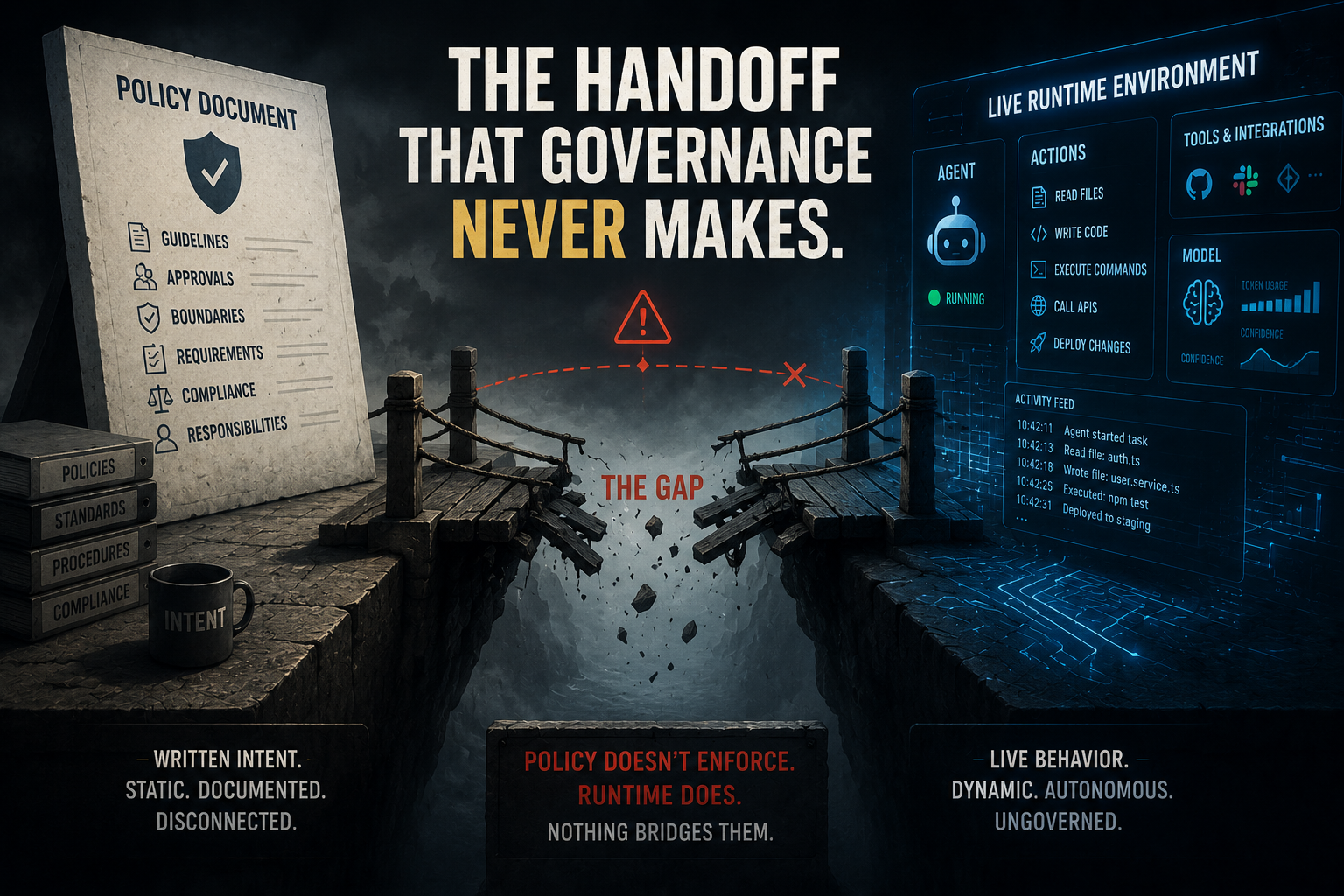
If policy stops at documentation, you do not have AI governance. You have formatting.
The manual enforcement gap
Most organizations already have policies.
They have acceptable-use rules, data-handling requirements, approval matrices, production access controls, security standards and escalation procedures. The problem is not the absence of intent.
The problem is translation.
A human can read a policy such as "production changes affecting customer data require approval from the service owner" and interpret it in context. An agent cannot safely be expected to reproduce that interpretation from prose every time it acts.
The same rule may depend on runtime facts:
- which agent is acting
- which capability version is active
- which user delegated the request
- which tool is being called
- whether the action is read-only or state-changing
- which environment is targeted
- what data classification is involved
- what blast radius is possible
- how much budget remains
- whether an exception is active
- which policy version is in force
Those facts change from request to request.
A wiki page does not evaluate them.
A system prompt does not enforce them.
A human approval queue cannot scale to every low-risk action once agents operate continuously.
This is why governance dies before runtime. The organization has policy intent, but no executable decision boundary between intent and side effect.
What executable policy actually means
Executable policy does not mean converting every governance document into code.
It means identifying the rules that must affect machine behavior and representing them in a form the runtime can evaluate consistently.
A useful executable policy has seven properties.
External to the model. The model can propose an action, but it should not be the final authority on whether the action is permitted.
Structured. The decision should operate on explicit attributes and typed intent, not on a paragraph that the model has to reinterpret.
State-aware. The same intent may be acceptable in staging and unacceptable in production. It may be allowed with healthy budget headroom and require approval when the budget is nearly exhausted.
Versioned. Every decision must be attributable to the exact policy version that produced it.
Deterministic where the boundary requires it. A probabilistic model may plan. A hard permission boundary should not depend on the model feeling confident.
Enforceable. A deny verdict must actually prevent the tool call or state change.
Evidenced. The system should record what was evaluated, which rule matched, what verdict was produced and what happened next.
The point is not that every governance question becomes deterministic. Many business decisions still require judgment.
The point is that the enforcement boundary must be explicit.
Probabilistic reasoning can propose. Deterministic control decides what is allowed to happen.
The runtime policy architecture
The architecture is simpler than the governance language often makes it sound.
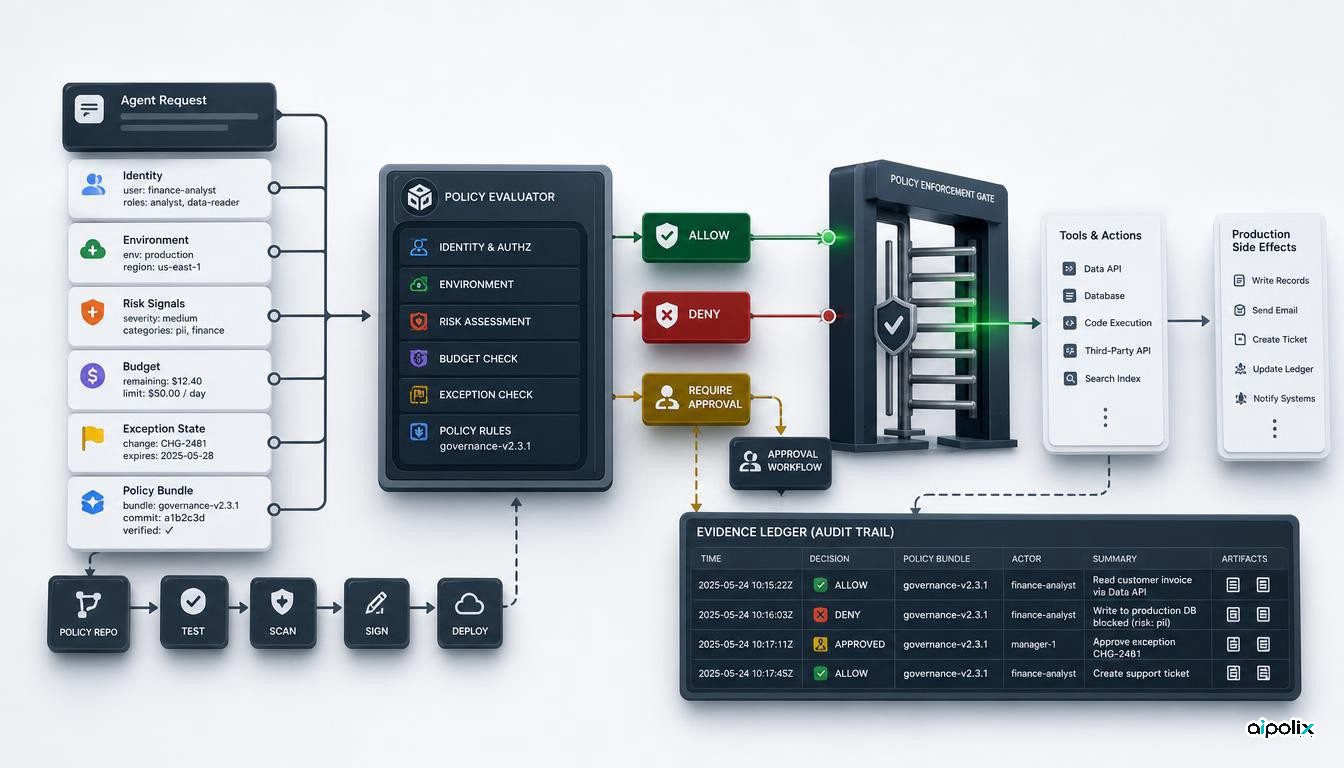
A useful flow is:
request -> structured intent -> policy decision -> enforcement -> action -> evidence
The agent or orchestration layer first turns the intended action into structured data. The policy decision point evaluates that intent against identity, scope, environment, runtime state and the active policy bundle. The enforcement point then applies the verdict before the side effect occurs.
The policy decision should be able to return more than yes or no.
Useful verdicts include:
- allow: proceed within the approved scope
- deny: block the action with a structured reason
- require approval: pause until a named human or authority approves
- defer: do not execute now because a required runtime condition is unavailable
- degrade: proceed through a lower-risk or lower-cost path when policy explicitly permits it
- quarantine: allow production of an artifact but keep it outside the live path pending review
The vocabulary can vary by organization. The important part is that the behavior at each verdict is defined before the incident.
A verdict that exists only in logs is not enforcement.
What the decision point needs to know
A policy evaluator is only as good as the state it can see.
At minimum, material agent actions usually need attributes from several groups.
Identity and delegation
- agent identity
- capability identity and version
- requesting human or service
- delegated authority
- delegation expiry and scope
Action
- requested tool
- operation
- target resource
- intended side effect
- data classes read or written
Environment
- development, staging or production
- tenant or customer scope
- region
- service criticality
Risk and autonomy
- action class
- autonomy tier
- maximum allowed blast radius
- required evidence level
- human approval requirements
Runtime state
- remaining cost and token budget
- remaining time or step budget
- rate-limit headroom
- current incident or maintenance state
- recent refusal or anomaly signals
Governance state
- active policy bundle
- exception records
- expiry times
- required controls
- policy ownership
This is why runtime governance cannot live only in a prompt. A prompt does not reliably own all of this state, and even if it sees the state, it should not be able to waive its own boundary.
Prompts are not permission boundaries
A common implementation starts with an instruction:
"Do not deploy to production without approval."
That instruction is useful. It is not an enforcement mechanism.
The model may misunderstand it. A later prompt may conflict with it. A tool may expose a path that bypasses it. The agent may be manipulated by retrieved content. A host update may change precedence between instructions.
None of those should turn a production boundary into a suggestion.
The correct separation is:
- prompts and skills guide behavior
- tools expose capabilities
- policy decides whether a capability may be exercised in the current context
- enforcement prevents disallowed side effects
This separation also makes the system easier to test.
You can evaluate whether the model usually follows the instruction.
Separately, you can prove that the runtime blocks a forbidden action even when the model does not.
Those are different guarantees, and governance needs both.
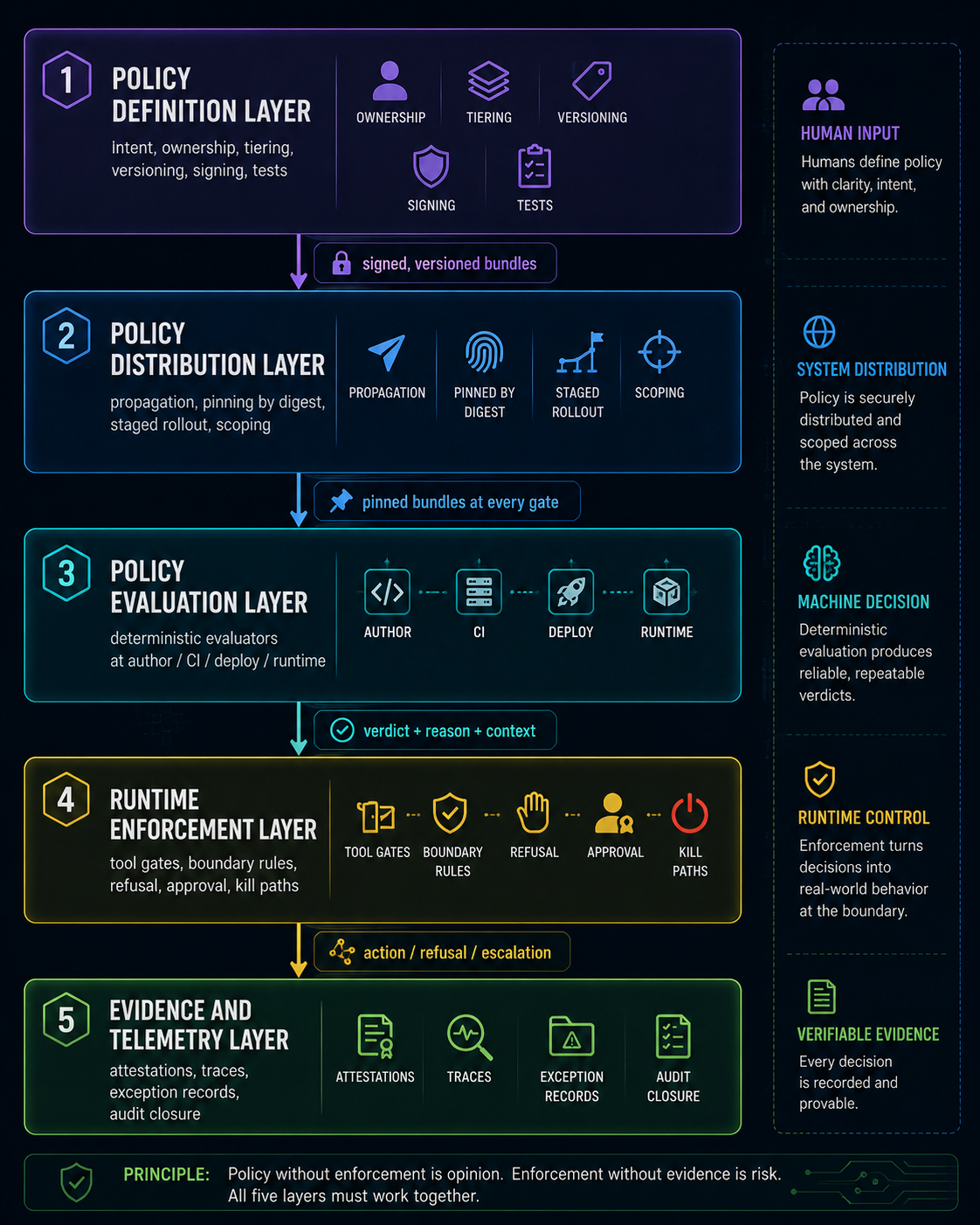
Policy has to exist at more than one gate
Runtime is the final enforcement boundary, but it should not be the first time policy appears.
A mature system reuses policy across the delivery lifecycle.
Authoring
Policy should shape what an agent is allowed to propose.
A coding agent should know that it cannot add an unapproved dependency, access a restricted data domain or change a production secret path. Early feedback reduces wasted work.
Pull request and CI
The pipeline should evaluate machine-checkable policy before merge.
Architecture boundaries, dependency restrictions, evidence requirements, security controls and required reviewers belong here.
Deployment
Policy should decide whether the artifact may move into an environment.
Risk classification, test evidence, rollout strategy, owner approval and rollback readiness can all be deployment inputs.
Runtime
The runtime evaluates the concrete action against current state.
This is where identity, target, budget, environment, tool, exception state and live conditions finally converge.
The policy language does not have to be identical at every layer. The policy model should be coherent.
If authoring says an action is prohibited but runtime allows it, the system has a policy conflict.
If runtime blocks something that CI approved, the evidence should explain which state changed.
Behavior is a deployment surface
Policy also has to recognize that code is not the only thing that changes behavior.
For an agentic system, all of these can alter what happens in production:
- model version
- system prompt
- instruction files
- skills
- rules
- tool schemas
- tool permissions
- routing logic
- retrieval configuration
- knowledge sources
- policy bundles
- runtime host version
A model swap can change behavior.
A skill update can change behavior.
A new tool permission can change behavior.
A policy bundle can change behavior.
If behavior changes, something deployed.
That means policy artifacts themselves need release discipline.
They need versions, owners, tests, promotion stages, rollback and traceability.
A policy change that can alter runtime behavior is a production change.
Skills, rules and instructions are artifacts, not the governance system
Agent frameworks increasingly expose files or objects called skills, rules, instructions, guardrails or policies.
Those artifacts are useful because they turn human intent into machine-consumable guidance.
But naming an instruction "policy" does not make it an enforcement boundary.
The useful question is not:
"Do we have a rules file?"
The useful questions are:
- Who owns it?
- Is it versioned?
- How is it tested?
- Can the agent ignore it?
- Can a tool bypass it?
- Does the runtime evaluate it before side effects?
- Does a deny verdict stop execution?
- Can we prove which version was active?
- Can we roll it back?
Skills, rules, agent instructions and tool constraints are part of the behavior surface.
Governance is the operating system around those artifacts.
Exceptions have to be first-class
Every serious policy system eventually needs exceptions.
The mistake is treating exceptions as informal overrides.
"Temporary access for this incident" becomes a Slack message.
"Allow this tool for the migration" becomes a configuration edit.
"Skip the approval this once" becomes a manual bypass nobody can explain later.
A governed exception should be an explicit object with:
- requester
- approver
- reason
- affected policy
- exact scope
- start time
- expiry time
- allowed action class
- evidence requirements
- revocation path
Exceptions should be narrower than the rule they override.
They should expire automatically.
And the runtime should evaluate them like any other policy input.
An exception without expiry is a policy change pretending to be temporary.
Policy changes need progressive delivery
A bad runtime policy can break production as efficiently as bad code.
A deny rule that is too broad can stop critical workflows.
A missing condition can allow something dangerous.
A changed threshold can flood humans with approvals.
So policy should not move from authoring straight to full enforcement.
A safer sequence is:
- test against known scenarios
- replay against recent traces
- shadow the new policy without enforcing it
- compare old and new verdicts
- canary enforcement on a bounded scope
- promote when evidence is acceptable
- rollback if refusal, escalation or incident signals regress
This is ordinary progressive delivery applied to governance.
The artifact changed, not the engineering principle.
Every verdict should leave evidence
Policy without evidence creates a different form of mystery.
The runtime should emit a compact decision record for material actions.
A useful record includes:
- root trace ID
- policy decision ID
- agent and capability identity
- structured intent
- relevant state attributes
- policy bundle and version
- matched rule or reason
- verdict
- enforcement result
- human approval reference when applicable
- exception reference when applicable
- timestamp
Do not log every possible piece of context by default.
Record enough to reconstruct why the action was allowed, blocked or escalated.
The evidence should join the same trace model used for execution and change.
Then an incident reviewer can move from:
"What happened?"
to:
"Which policy allowed this action, under which state, and why?"
That is a much better question.
Failure modes are repetitive
When executable policy is missing, the failures tend to look familiar.
The policy-in-a-wiki failure. The rule exists and everybody agrees with it, but nothing in the runtime reads it.
The policy-in-a-prompt failure. The rule is present, but the same system being constrained is also responsible for interpreting and obeying it.
The split enforcement failure. One tool checks policy and another path reaches the same side effect without the check.
The stale-state failure. The decision is logically correct against state that is incomplete or outdated.
The silent exception failure. An override exists but has no owner, expiry or trace.
The mutable policy failure. A rule changes in place, so nobody can prove which version governed yesterday's decision.
The evidence-free deny. The system blocks work but cannot explain which rule fired, creating pressure to bypass the control.
The evidence-free allow. The action succeeds but nobody can prove why it was authorized.
The common pattern is simple.
Policy existed as intent.
It did not exist as an executable control.
Practical build order
Do not start by trying to encode the entire governance manual.
Start with one high-value action path and make the control real.
1. Define structured intent
Choose one material action such as deploy, write customer data, rotate a secret or invoke a production tool.
Represent the action with typed fields instead of prose.
2. Put a policy decision point outside the model
The model proposes.
The evaluator decides.
Keep the enforcement authority outside the probabilistic component.
3. Put an enforcement point in front of the side effect
A deny must prevent execution.
Do not rely on cooperative refusal.
4. Add the minimum runtime state
Identity, action, target, environment, autonomy tier, budget state, policy version and exception state are enough to start.
Add attributes when a real decision requires them.
5. Emit decision evidence
Give every material verdict an ID and connect it to the execution trace.
Make allow, deny and approval decisions explainable.
6. Version and test the policy bundle
Run deterministic policy tests and replay recent traces.
Treat the bundle as a production artifact.
7. Shadow, canary and promote
Observe what the new policy would do before it controls everything.
Roll it out progressively and keep rollback boring.
That sequence is intentionally small.
The goal is not to build a policy empire.
The goal is to establish one trustworthy handoff from governance intent to runtime behavior, then expand it.
Closing
The hardest part of AI governance is not writing the rule.
It is making the rule survive contact with execution.
Policies, principles, review boards and approval matrices all matter. But they become governance only when the system can evaluate them against the action that is about to happen, enforce the verdict and preserve the evidence.
That is the executable policy layer.
It sits between probabilistic behavior and real-world side effects.
It gives runtime state a voice.
It makes exceptions visible.
It makes policy changes deployable and reversible.
And it lets the organization answer the question that matters during an incident:
"Why was this action allowed to happen?"
If the answer is "because the agent was instructed to behave," the policy layer is still missing.
If the answer points to a versioned rule, evaluated against recorded state, enforced before the side effect and linked to a trace, governance has finally reached runtime.
Governance is not what the policy says. Governance is what the runtime can enforce and prove.
The next article moves one level closer to the agent itself: prompts are too vague to carry the full relationship between humans, agents and tools.
Next in the series: AI Agents Need Contracts, Not Better Prompts.
Originally published by Reza Arani on Medium on May 18, 2026. Adapted for Aipolix as Part 4 of the AI Governance in an AI-Native Software Development Company series.
Comments
No comments yet. Be the first to comment.
Leave a comment