
Most teams discover agent budgets through an invoice. By then, the important design decision has already been missed.
A useful budget for an AI agent is not merely a ceiling on spend. It is a runtime rule about what the system may do as resources become scarce. If a budget reaches its limit and the agent has no defined response, the organization has accounting, not governance.
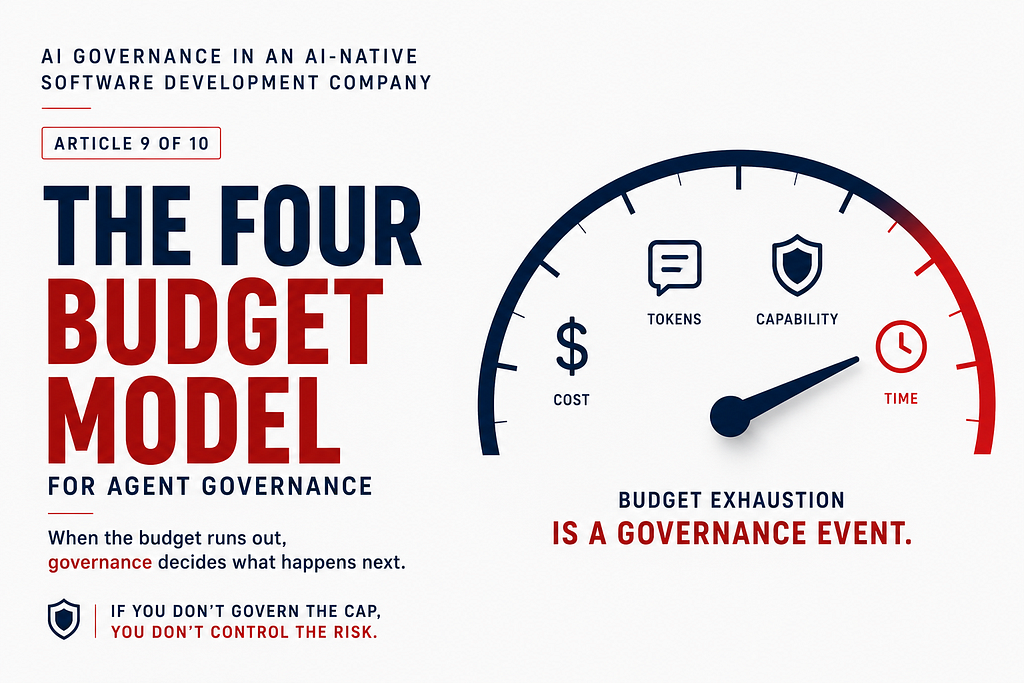
This is Part 9 of the ten-part series AI Governance in an AI-Native Software Development Company. Part 8, The Agent Change-Management Playbook, treated changes to models, prompts, skills and tools as production deployments. This part asks the next operational question: once an agent is allowed to act, how much cost, computation, capability and time may it consume?
One budget is not enough
A single monthly dollar limit is too coarse for agent systems. The same total spend can hide very different failure modes: a runaway loop, an oversized context, a tool surface that keeps expanding, or one workflow monopolizing a shared allowance.
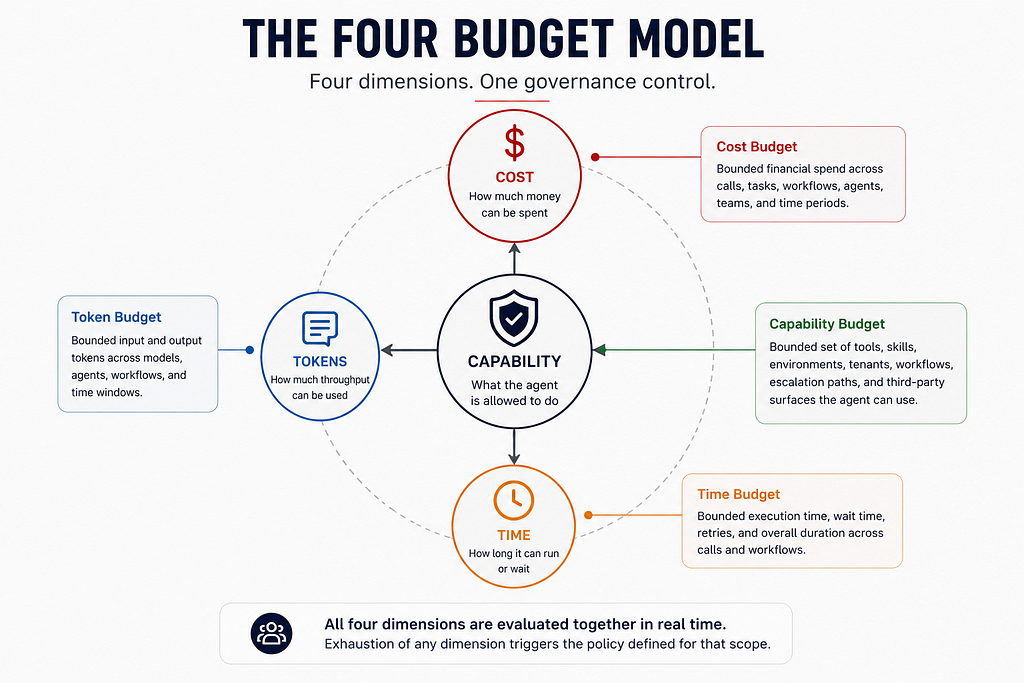
The more useful model has four dimensions that are evaluated together.
Cost budget. Money remains essential. It can be bounded per request, task, workflow, agent, team or billing window. But cost is a lagging signal: it tells you what was consumed, not always why.
Token budget. Tokens expose behavior closer to the model. Unexpected growth can reveal retrieval over-fetch, bloated prompts, repeated retries or an agent that keeps rereading the same context. Token headroom can therefore be used before the financial cap is reached.
Capability budget. This is the dimension many teams omit. An agent does not become risky only because it spends more money; it becomes harder to govern as it gains more tools, environments, tenants and escalation paths. Capability should be treated as a scarce resource. Adding a tool increases evaluation work, audit surface and blast radius even if the tool itself is cheap.
Time budget. Wall-clock time, step count and loop depth are often the fastest way to contain runaway behavior. A loop may be inexpensive per iteration and still become operationally dangerous if it can continue indefinitely. Time limits give the runtime a deterministic place to stop before the bill becomes the incident report.
Together, these four dimensions form one operating control: cost, tokens, capability and time.
The budget must exist where the decision happens
A dashboard that updates after the task completes cannot govern the task that is already running. Budget state has to be available to the same runtime policy layer that decides whether an action may proceed.
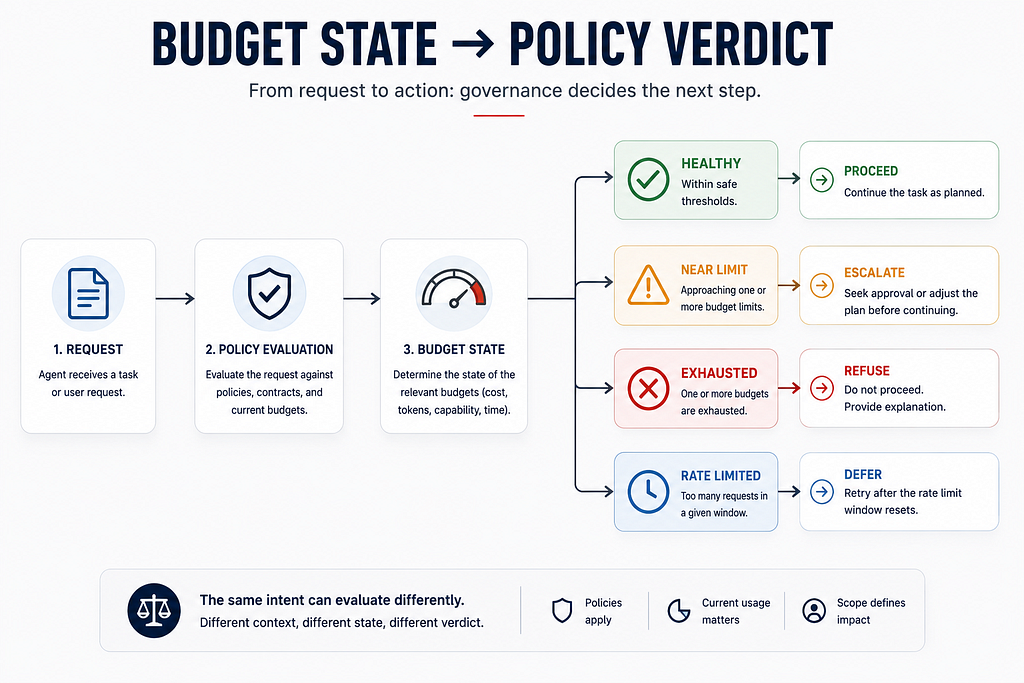
For each decision, the evaluator can receive state such as remaining cost, token headroom, remaining steps, active tool quota and the scope that owns the allowance. The verdict can then change as the budget drains.
An expensive synthesis may proceed when most of the daily allowance remains, require approval near the limit, and refuse once the allowance is exhausted. A tool call may be denied because its skill-level budget is empty even though the team still has money available.
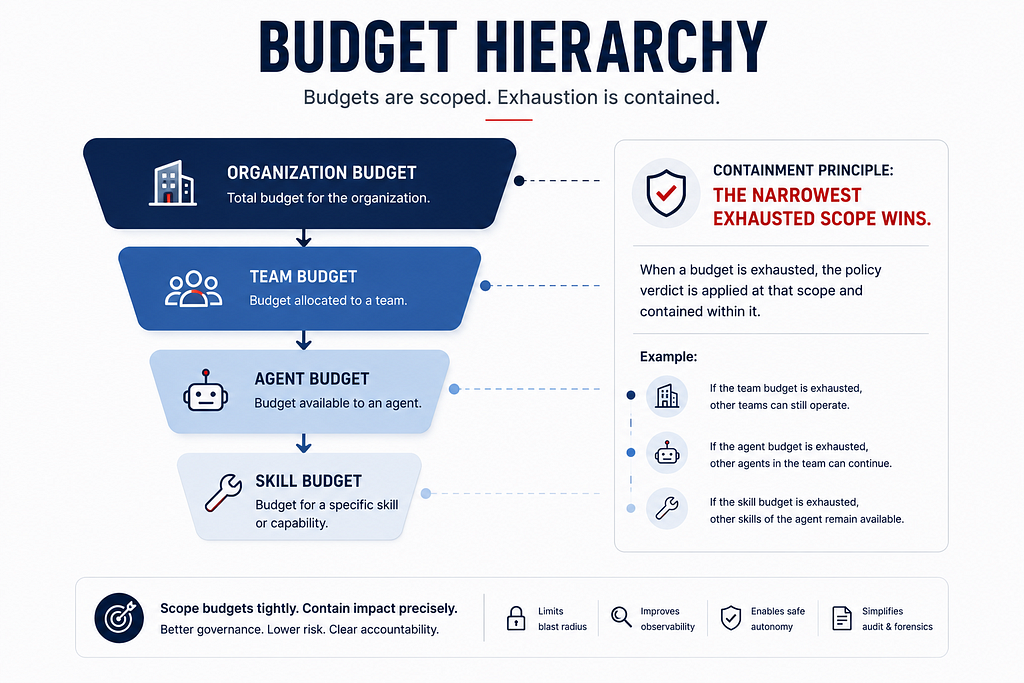
That last point matters. Budgets should be hierarchical, but they should not become an excuse for uncontrolled borrowing.
The narrowest exhausted scope should win.
If one skill has consumed its allowance, silently drawing from a parent budget defeats containment. The purpose of the hierarchy is to keep one noisy workflow from becoming an organization-wide incident.
What should happen at the cap?
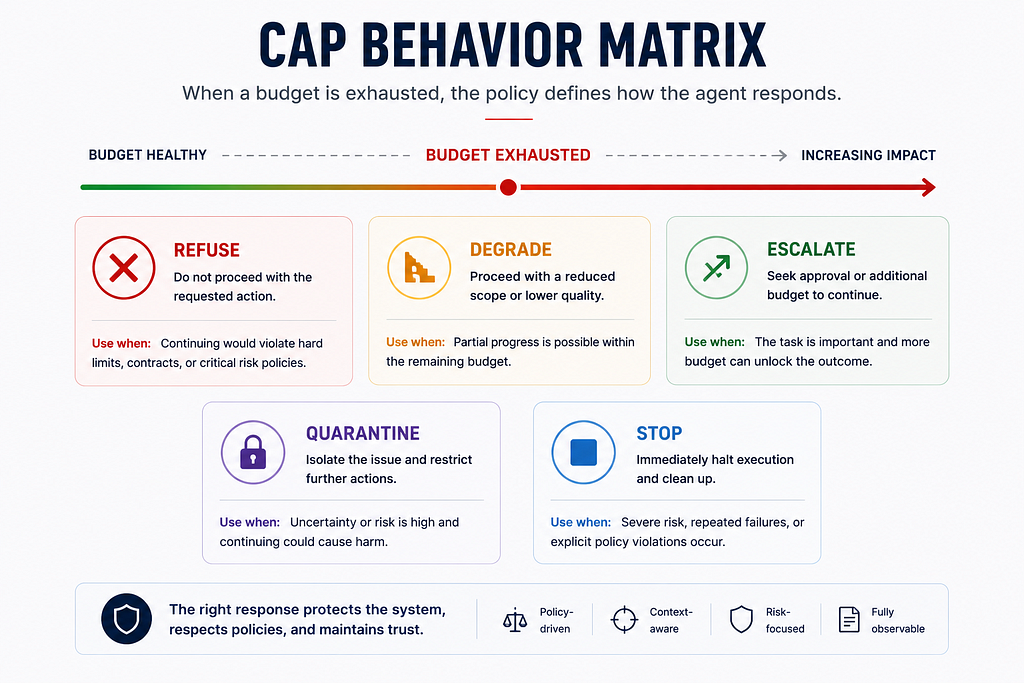
The most important part of a budget is not the number. It is the behavior attached to the number.
A practical cap-behavior model has five responses:
- Refuse. Decline the action and return a structured reason.
- Degrade. Continue with a cheaper model, smaller context, fewer retries or a narrower plan.
- Escalate. Pause and request explicit authorization for additional budget.
- Quarantine. Continue producing output, but keep it out of production until reviewed.
- Stop. Suspend the agent or workflow until the relevant budget resets or an operator intervenes.
These responses are not interchangeable. Degradation is appropriate only when lower quality remains safe and useful. Refusal is better when a partial answer would mislead. Escalation makes sense when extra spend can be justified by a human. Quarantine is useful when the budget breach may indicate abnormal behavior. Stop is appropriate when the breach itself is the safety signal.
A global rule such as “always refuse at 100%” is simple, but it creates a new failure mode: workflows can collapse abruptly at the limit. The cap behavior should therefore be selected per action class and per budget dimension.
A production example
Consider an incident-investigation agent. It queries logs, retrieves traces, inspects recent deployments and builds a diagnosis.
During a noisy outage, the agent begins widening every search. Cost is still at 55% of the incident allowance and token usage is at 68%, so a money-only dashboard looks healthy. But the workflow has already used 95% of its step budget.
The runtime policy can react before the expensive failure appears. It can narrow the time range, prevent new fan-out, switch low-value summarization to a cheaper model and require approval before any additional broad search.
The important property is not that the agent became cheaper. It is that the system recognized which budget was failing first and applied a predefined response.
Attribution turns budgets into evidence
Budgets cannot govern what cannot be attributed.
The useful accounting unit is not only “the AI bill.” Spend and resource use should be attributable to the agent, the skill, the workflow, the owning team and, where relevant, the tenant. Those dimensions should share the same correlation identifiers used for provenance and audit trails.
This changes the conversation. Instead of asking why AI spend increased by 30%, the operator can identify that one workflow doubled its retrieval depth after a prompt change, or that one skill began calling an expensive tool three times per task.
Attribution also makes budget events explainable. A refusal can record which scope was exhausted, which dimension triggered the verdict, what the remaining headroom was and which policy selected the response.
Capability deserves its own budget
Cost and tokens are visible because providers bill for them. Capability is easier to ignore because it arrives as product functionality.
That makes it more dangerous to leave unbounded.
For each deployed agent, the organization should be able to list the tools it can call, the skills it can invoke, the environments it can reach, the data domains it can touch and the escalation paths it can trigger. New capability should be an explicit addition to that inventory, not ambient growth.
A useful operating rule is simple: capability should be added with an owner, an evaluation obligation and a removal path.
Without subtraction, shared agents accumulate tools until nobody can reason about the complete action surface. The financial cost rises, but the governance cost usually rises faster.
Failure patterns to look for
Several patterns show that a budget exists only on paper.
A cap is repeatedly raised without investigating what consumes it. A skill exhausts its local allowance and quietly borrows from a parent scope. An agent enters a cheap retry loop that runs for hours. Teams add tools continuously but never retire them. Budget breaches appear first in finance reports rather than runtime events. Or the system has only two states: unlimited execution and total refusal.
Each pattern has the same root cause: the budget is being treated as a number rather than as an enforcement input.
A practical implementation order
A team does not need a new FinOps platform before it can improve control. Start with the highest-impact agents and build the control surface incrementally.
- Inventory deployed agents and their active capabilities.
- Attribute cost and token use to agent, skill and workflow.
- Add explicit budgets for cost, tokens, capability and time.
- Define cap behavior for each important action class.
- Feed remaining budget into runtime policy evaluation.
- Emit evidence for refusals, degradations, escalations, quarantines and stops.
- Review unused capability regularly and remove what no longer earns its operational cost.
- Stress-test budget exhaustion before production does it for you.
The point is not to predict every possible overrun. It is to make overrun behavior deterministic, bounded and observable.
The governance boundary
Agent FinOps is often described as a finance problem because the bill is visible. The deeper issue is authority.
A budget answers how much authority the system has to consume scarce resources before it must change behavior. Money is one resource. Tokens, tools and time are others.
Once budgets are treated this way, they fit naturally beside permissions, containment, provenance and change management. They become part of the runtime contract rather than a report produced after the fact.
That is the Four Budget Model in operational terms: govern cost, tokens, capability and time together, and decide in advance what the system does when any one of them runs out.
The team that only explains the bill is observing its agents.
The team that defines budget behavior is governing them.
Next in the series: The AI-Native Governance Maturity Model, the capstone that connects the previous controls into a staged operating model.
Originally published by Reza Arani on Medium in June 2026. Adapted for Aipolix as Part 9 of the AI Governance in an AI-Native Software Development Company series.
Comments
No comments yet. Be the first to comment.
Leave a comment