Most engineering organizations have a mature change-management discipline for code.
They have almost none for agents.
A model upgrade ships. A prompt gets retuned. A skill gets a new tool. An IDE host pushes a runtime change. None of it necessarily goes through a registry, a canary, a communications plan, or a rollback path. Most of it does not even get a changelog entry.
Then production behavior shifts, and the team treats it like weather.
It is not weather. It is a deploy.
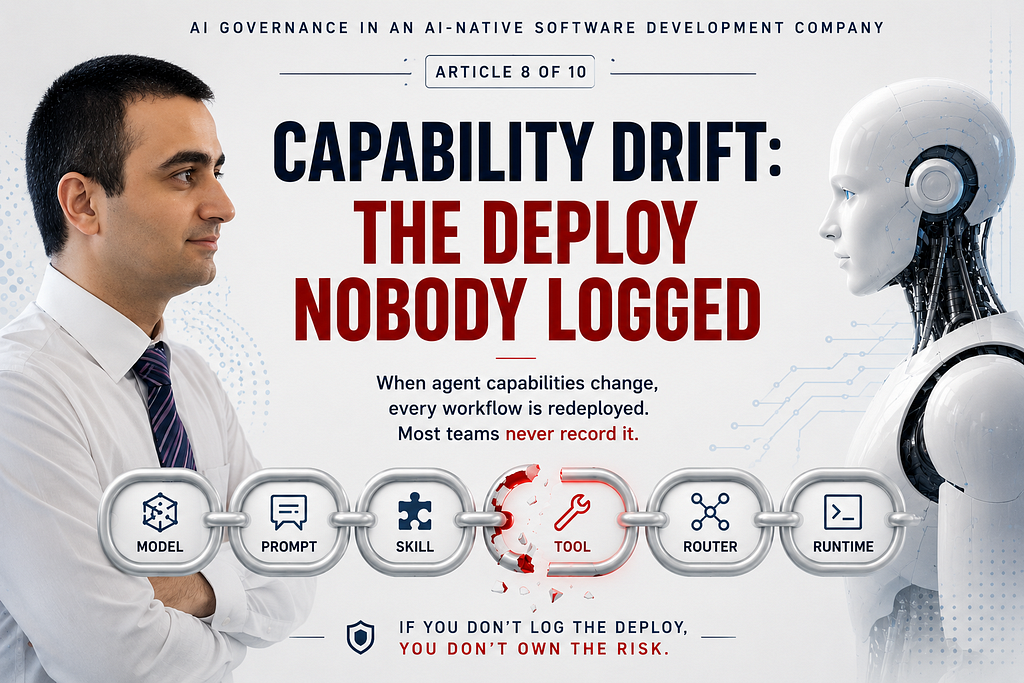
When an agent's capabilities change, every workflow that touches it has effectively been redeployed. The team may not have authored the change; they will still operate its consequences.
An untracked agent upgrade is a silent production deploy across every workflow that touched it.
This is Part 8 of the ten-part series AI Governance in an AI-Native Software Development Company. Part 7, Traceability: Who (or What) Wrote This Line of Code?, made the audit chain real. This article is about preventing the next class of audit findings: capability drift that the system never noticed shipping.
⚠️ A Tuesday Nobody Deployed
Imagine a team running an agent that triages incoming support tickets, drafts a response, and files a structured summary for the on-call engineer. It has worked for months.
Over the weekend, the model behind the default endpoint is upgraded. The version string the team pins against does not move. Nobody is notified because, from the provider's side, nothing the customer explicitly deployed changed.
By Wednesday the on-call queue is backing up. Summaries are longer, softer, and the severity field the downstream router depends on is missing. Tickets that used to auto-escalate now sit. A customer escalation reaches a VP before anyone connects it to the agent.
The investigation takes two days. Logs are clean, latency is flat, error rate is flat. Every dashboard built for code is green because nothing in the code changed. Someone finally diffs recent summaries against last month's output and sees the new shape. The model moved. The behavior moved. The contract the router depended on moved. None of it appeared anywhere a human would normally look for a deployment.
No deploy record. No changelog. No canary. No rollback plan.
The most consequential production change that quarter shipped itself, and the team spent two days proving it had happened at all.
That is capability drift. The reason it hurts is structural, not accidental.
🌫️ The Capability Drift Problem
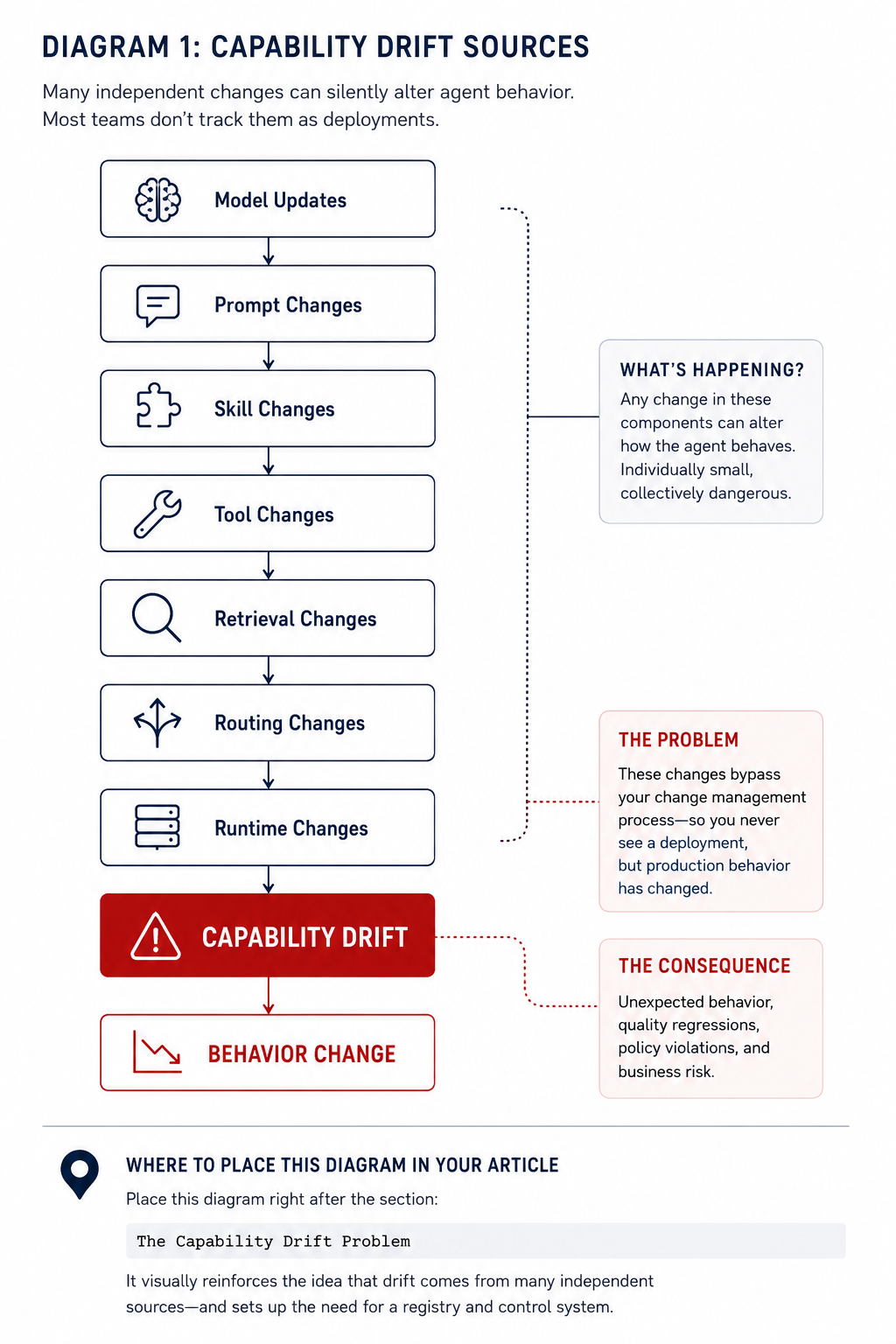
Capability drift is the change in what an agent can do, how well it does it, or how differently it behaves, without a corresponding change in the organization's change-management surface.
It can come from many directions:
- Model-provider upgrades. The model behind a default endpoint changes while the visible name or alias stays stable.
- Prompt edits. A small system-prompt fix for one case quietly rebalances many others.
- Skill modifications. A skill gains a tool, a branch, or a stricter refusal path.
- Tool-schema changes. A tool adds or changes parameters and callers begin behaving differently.
- Retrieval-corpus updates. Same request, different context, different output.
- Routing changes. A router chooses a different model for the same class of task.
- Host changes. An IDE, agent runtime, or orchestration layer changes defaults that every downstream workflow inherits.
Any one of these can alter behavior. Together, they alter it continuously.
The problem is not that change happens. The problem is that it happens outside the change pipeline.
That is the asymmetry: a code change may have eight gates and a communications plan. A model swap may have none.
If behavior changed, something deployed. The only question is whether the organization saw the deploy.
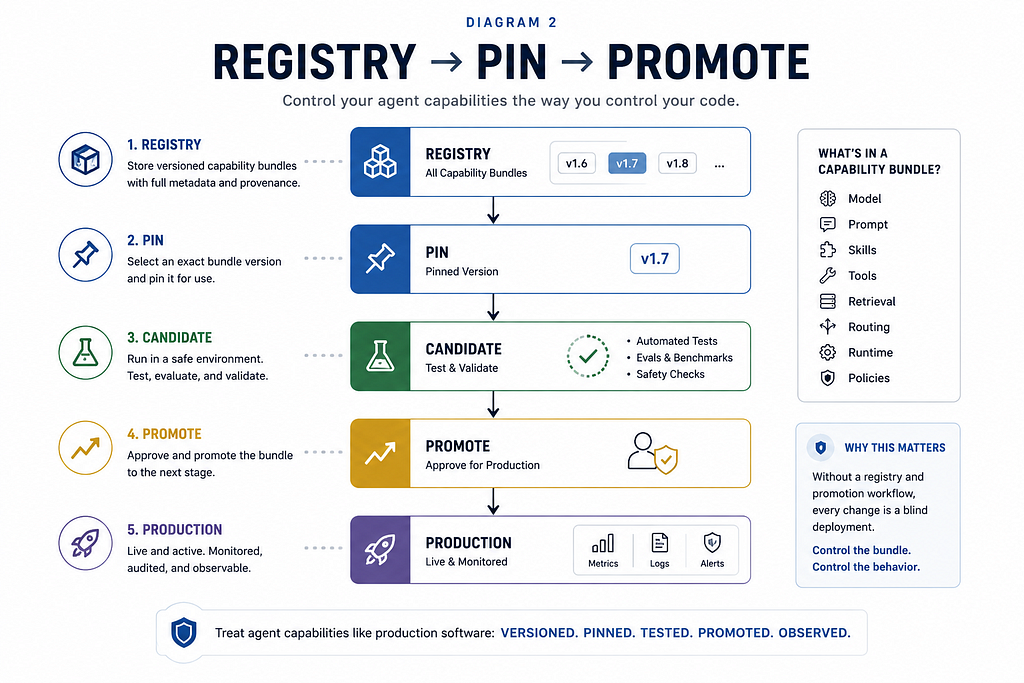
📚 Registry, Pin, Promote
The most leveraged primitive for agent capability change is an unglamorous one: a registry of what is actually live.
Not what a meeting approved. Not what a wiki says. What the runtime is loading now.
A useful agent registry records, for every deployed agent:
- model and version pin;
- prompt version and hash;
- active skills and their versions;
- active rules and their versions;
- tool manifest and signature;
- policy-bundle digest;
- host runtime version;
- last upgrade event and its provenance;
- owner.
That list is more than an inventory. Together those elements define the deployed capability.
From there, two disciplines become possible.
Pin. Every live agent uses an explicit set of versions. Nothing changes through ambient drift when a pin can be enforced; a change requires moving the pin, which becomes an event the system can see.
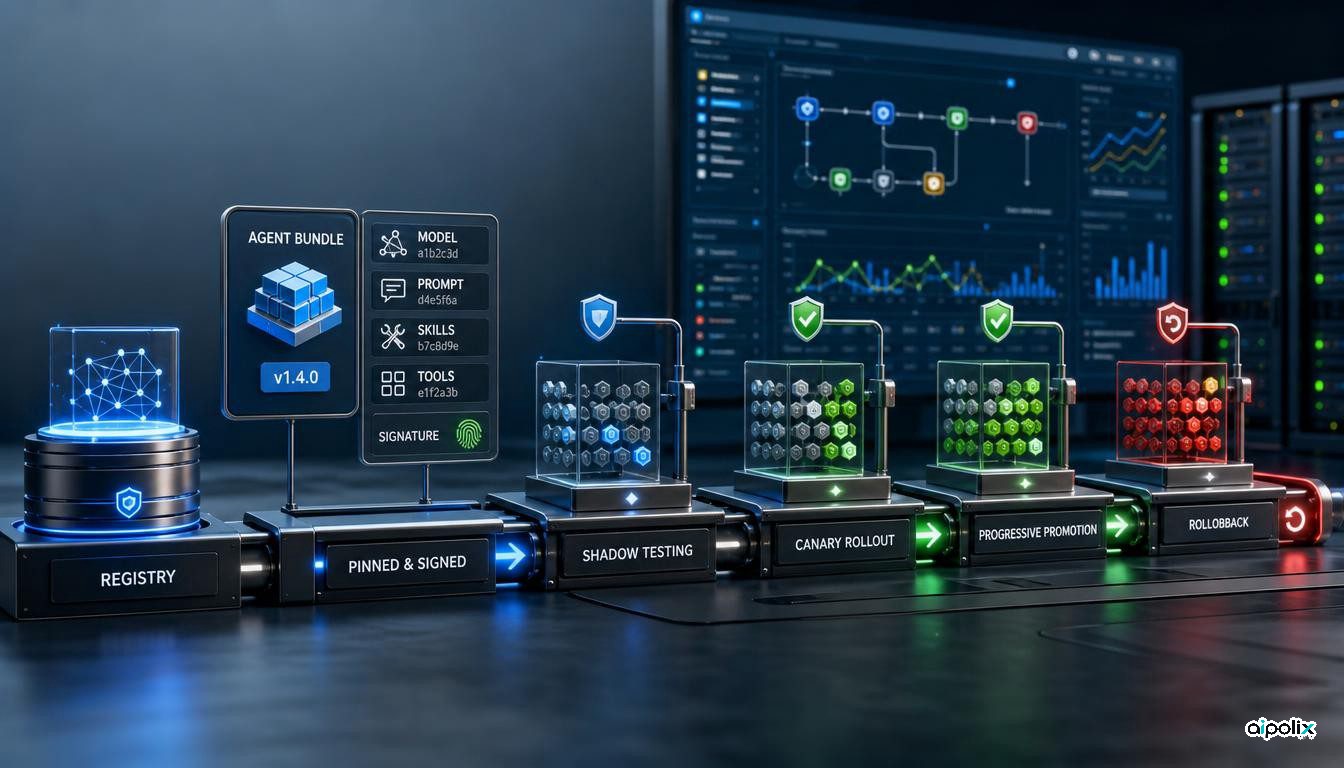
Promote. Moving a pin is a deploy. It has a candidate, verification, staged rollout, a verdict, and a rollback path.
The discipline is the same as software release management. The artifact is different.
If you cannot list what your agents are running today, you cannot manage their changes tomorrow.
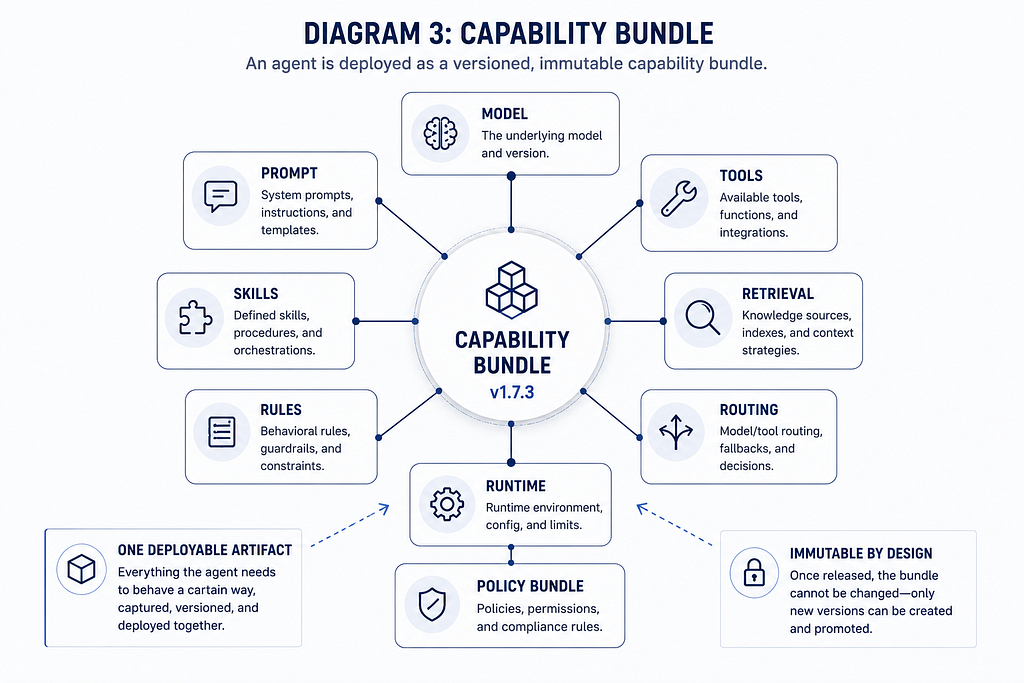
📦 An Agent Is Deployed as a Capability Bundle
A service is deployed as a binary. An agent is better understood as a capability bundle assembled at runtime.
That bundle contains at least:
- model and version;
- prompt and hash;
- skills and versions;
- rules in force;
- tools in the manifest;
- policy bundle evaluating the output;
- runtime hosting all of it.
Each part may have a different owner and a different release path. That scatter is why agent change can feel ungovernable: there is no single artifact to point at and say, "that is what changed."
The capability bundle is that artifact.
Change any of the seven and the bundle version moves: a model swap, a one-line prompt fix, a skill that quietly grows a tool, a new policy bundle, a runtime upgrade.
The bundle prevents a behavior change from hiding inside an unchanged label.
If you cannot name the artifact that changed, you cannot govern the change. The bundle is that name.
🐤 Staged Rollout for Agent Capability
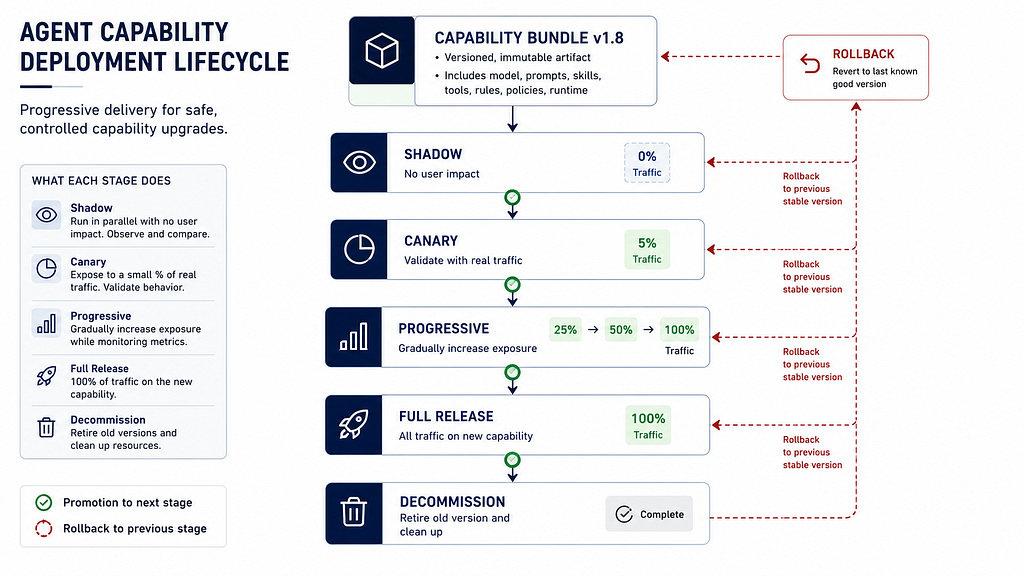
A capability upgrade is not simply "ship" or "do not ship." It should move through a rollout curve, just as risky code does.
The familiar stages translate cleanly:
- Shadow. The candidate runs alongside the current capability on the same inputs, but its outputs do not cause side effects. This is where behavior drift becomes visible before it becomes operational.
- Canary. A small slice of traffic, users, or workflows uses the candidate for real.
- Progressive. The slice grows on a schedule with explicit go/no-go checks at each step.
- Full. The new capability becomes the default, while the previous bundle remains reversible for a defined window.
- Decommission. The old capability is removed after a soak period and notice.
What changes versus code is the signal set used to gate the rollout. Latency and error rate are not enough.
Useful agent-specific signals include:
- refusal rate and where refusals occur;
- escalation rate;
- tool-call distribution and rate;
- output-structure compliance with the skill contract;
- evidence-emission rate;
- blast-radius distribution of recent actions;
- supervisor override rate where humans remain in the loop.
These signals are observable, but most teams do not observe them by default.
Put them on the dashboard before the upgrade and drift can appear during canary. Add them after the incident and they become postmortem material.
📣 The Comms Layer
Agent capability changes have a communications problem that code changes often avoid.
A service deploy usually affects a known set of consumers. An agent capability change can affect everyone who uses the agent, and in an AI-native organization that may span engineering, product, support, and operations. Many of those users do not subscribe to a technical changelog and do not know they should look for one.
A useful communications practice includes:
- Release notes for behavior. Not merely "we upgraded the model," but what users should expect to behave differently.
- Behavioral diffs in plain language. Concrete before/after examples are more useful than abstract release language.
- Migration notes for downstream consumers. If a skill or workflow depends on an output shape, its owner needs warning before that shape moves.
- Rollback expectations. State what will cause a rollback, what will be rolled back, and how long the decision window remains open.
The point is not bureaucracy. It is to turn capability change into a known event rather than ambient background noise.
An agent upgrade nobody knew about will be discovered as a postmortem item.
↩️ Rollback for Agents, Not Just for Code
A practical test is simple: take the most recent capability upgrade for any deployed agent. Could the team roll it back today, in under an hour, with confidence?
For many teams the honest answer is no. The previous pin may no longer exist. The old prompt may have been overwritten in place. The provider may have deprecated the prior model. The new behavior may already have produced downstream artifacts that depend on it.
Rollback discipline should mirror upgrade discipline:
- preserve the previous capability bundle for a defined window;
- exercise the rollback path rather than assuming it works;
- emit the same quality of evidence for rollback as for forward promotion;
- tell downstream consumers what changes when rollback occurs.
Agent systems also have a category that ordinary code deployments do not always expose as clearly: soft rollback.
The new capability may stay in place while a specific behavior is restricted through policy or contract. The policy layer from Article 4, The Executable Policy Layer makes this possible: a capability upgrade can be partially constrained without necessarily repinning the underlying model.
Soft rollback is useful when an upgrade has real benefits alongside a regression. It only works when the policy layer underneath the capability is already executable and versioned.
🧪 What Good Actually Looks Like
A real agent change-management discipline is recognizable.
It is working when:
- every deployed agent has a discoverable current capability pin;
- every capability change has a candidate, a stage, a verdict, and a rollback path;
- behavior-specific signals are on the dashboard before an upgrade;
- behavior changes are communicated to the people whose work depends on them;
- hard and soft rollback are rehearsed outside incidents;
- "the model changed" is an event in the system, not a rumor in the team.
It is missing when nobody can name the active model, prompt hash, or skill version; when the first signal of a bad upgrade is a customer complaint; when rollback is a conversation instead of a path; and when capability changes appear in incident timelines but never in change logs.
That last condition breaks the provenance chain from Part 7. A change that does not appear as a change cannot be reconstructed as one.
🚨 Failure Modes When Capability Change Is Ambient
The failure patterns repeat.
Provider drift. The model behind a stable name changes; behavior shifts; the team blames everything except the silent update that never entered the change log.
Prompt-by-Slack. A prompt tuned for one edge case changes behavior for everyone, and nobody reruns a canary suite that never existed.
Skill creep. A skill grows a new tool because "the agent needed it," and its blast radius now exceeds the approved boundary.
Routing surprise. A router begins preferring a cheaper model. Cost improves, quality degrades, and the change was tuned rather than deployed.
Rollback fantasy. The team believes rollback is possible but has never tried it; the first rehearsal happens during an incident.
The underlying pattern is always the same.
The agent's capabilities moved.
The pipeline did not notice.
🛠️ Practical Build Order
Capability change management is one of the highest-leverage governance disciplines because many other gaps become easier to see once changes are explicit.
Sequence it.
- Build the registry first. For every deployed agent, list model, prompt, skills, rules, tools, policy bundle, host, and owner.
- Pin everything you can. Convert "latest" and "default" into explicit pins wherever the platform allows it.
- Define the capability bundle as a versioned artifact. A change to any component changes the bundle version.
- Wire shadow and canary for capability bundles. Reuse progressive-delivery discipline rather than inventing a separate release process.
- Put behavior signals on the dashboard. Refusal, escalation, tool calls, evidence, blast radius, and overrides belong in pre-release observation.
- Establish and rehearse rollback. Hard rollback for bundles and soft rollback through policy and contracts.
- Stand up a communications surface. Behavior release notes, plain-language diffs, and migration notes for downstream consumers.
- Make ambient changes detectable. Probe provider behavior, pin where possible, and quarantine unverified drift where necessary.
None of this is conceptually new. It is release management, progressive delivery, and SRE discipline pointed at a new kind of artifact.
That is the line between "we have agents in production" and "we operate agents in production."
🎯 Closing
The mistake is to treat agent capability as ambient infrastructure, like weather arriving from a model provider.
It is not weather. It is a deploy.
Every prompt tune, model swap, skill update, tool addition, policy change, or runtime change can move production behavior across multiple workflows.
Strip the playbook down and three sentences remain:
Capability changes are deploys. Deploys require governance. Governance requires visibility.
The chain breaks when a change happens that the system never recorded as one.
So the practical demand is simple: make every capability change show up as a change. Pin the bundle, version it, and then apply the release-management tools the platform team already understands: registry, canary, communications, and rollback.
If your agents' behavior changed and your change log did not, you are not running agents in production. You are hosting them and hoping.
Next in the series: Cost, Token, and Capability Budgets: The New FinOps for Agents.
Originally published by Reza Arani on Medium in June 2026. Adapted for Aipolix as Part 8 of the AI Governance in an AI-Native Software Development Company series.
Comments
No comments yet. Be the first to comment.
Leave a comment