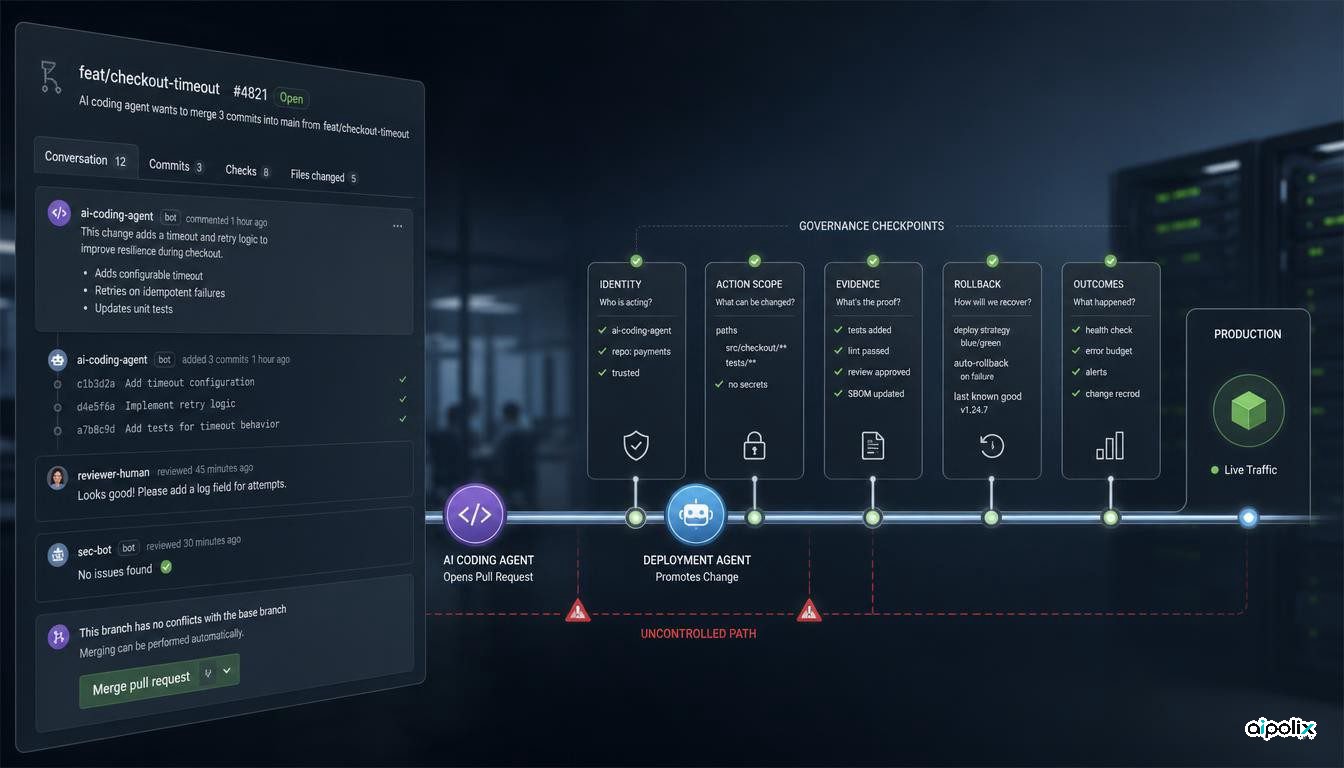
If an agent opens the pull request, another agent deploys it, and nobody can explain why it went live, you do not have AI governance.
You have automation with better branding.
That distinction matters because agentic software development is moving faster than the operating controls most engineering organizations were built to support. Many teams believe they are governed because agents authenticate through SSO or service accounts, repository permissions exist, and a human still approves production changes. Those are useful controls. They are not a governance system.
This is Part 1 of a ten-part series on AI Governance in an AI-Native Software Development Company.
The model is not your operating system. The pipeline around it is.
A Tuesday afternoon you will recognize
Consider a mid-sized fintech. A senior engineer asks an IDE agent to speed up the checkout path. The agent reads the service, rewrites a database call, opens a pull request and posts a clean summary. Tests pass. A teammate reviews the diff, sees green and approves it.
The change merges.
A deployment agent picks it up, rolls it to canary, sees no obvious error spike and promotes it. Everything looks normal until checkout latency rises sharply and customers begin timing out. On-call rolls back the release and service recovers.
Technically, the incident is resolved.
Structurally, governance has failed.
Now the questions begin. Who actually authored the change? What context did the agent read? Which model version, prompt, skill set and tool configuration were active? Why did the deployment agent promote the release despite early drift? How many other agent-authored changes followed the same path?
Most teams can answer parts of those questions. Few can answer all of them quickly and with evidence.
That is the problem. Nobody had to be reckless. Every local decision could look reasonable while the overall system remained ungoverned.
A non-human workforce is operating inside a pipeline designed for humans. Controls that were tolerable at human speed become fragile at agent speed.
The agent is not the risk by itself. The pipeline decides the blast radius.
Why the AI safety frame is not enough for engineering organizations
AI safety matters, but it is not the same problem as operational governance inside a software company.
For an engineering leader consuming models through APIs or developer tools, the most actionable control surface is rarely the model weights. The organization controls the surrounding system: identities, tool scopes, data access, skills, policies, approval gates, deployment flows, logs, rollback paths and kill switches.
That distinction changes where governance work belongs.
1. Safety points at the model; operations must govern the system
A question such as “Is the model aligned?” can be important, but a VP of Engineering usually cannot inspect or modify the model itself.
They can modify the pipeline.
They can decide which tools the agent can call, which repositories it can change, what data it may read, what evidence is required before a merge, what conditions block deployment and who can revoke access.
If the organization cannot change the model, the model cannot be its main operational control surface.
2. The agent often amplifies existing weakness
Agentic systems rarely need to invent a completely new class of operational failure. They can simply move through weak credentials, incomplete approvals, missing provenance, unbounded tools and human-era change controls much faster than people do.
The agent exposes the weakness. The pipeline decides the damage.
3. Shutdown is not the same as consequence management
A kill switch matters, but the hard governance questions start after it is used.
What state did the agent already change? Which artifacts were created? Which downstream systems were touched? What can be rolled back automatically? What requires manual recovery? Can the organization prove what happened under the policy version that was active at the time?
Stopping an agent is not the same as governing what it already set in motion.
What AI governance actually means in an AI-native engineering organization
A practical definition is:
AI governance is the set of controls, operating practices and measurement disciplines that make agent-assisted and agent-autonomous work legible, contained, reversible and improvable at the speed those agents operate.
Those four properties are more useful than a generic policy statement.
Legible
Every important change should be explainable. Who or what acted? Under which identity? Which model, prompt, skill, tool and policy version were in effect? What evidence supported the action? Who approved it?
If agent-authored work becomes mysterious as soon as it lands in main, governance is already broken.
Contained
Every agent needs an explicit autonomy boundary: tool scope, repository scope, data scope, credential scope, cost envelope and approval threshold.
If the agent can quietly step outside its lane, the organization does not have a boundary. It has an intention.
Reversible
Humans must be able to stop and unwind agent-authored change without depending on the agent's cooperation.
Canaries, automated rollback, immutable artifacts, independent kill switches and known-good restore points belong here.
Improvable
Governance should tell the organization which agents are helping, which are drifting and which should receive more or less autonomy.
Usage charts are not enough. The system needs outcome measures, incident signals, review quality, escalation rates and evidence about where agent autonomy is actually paying off.
Trust is not a sentiment. It is a property of the system.
The four categories where most teams are exposed
Operational agent governance can be viewed through four practical categories.
Access and identity asks who the agent is, what credentials it uses and what systems it can reach. Most organizations have at least partial controls here.
Action and change asks what the agent may do, how large the blast radius can be and how actions are approved or blocked. These controls are often inherited from human workflows and are underbuilt for agent throughput.
Output and evidence asks what the agent produced and whether the organization can reconstruct the inputs, decisions, evidence and approvals that led to that output. This is where many programs become weak.
Outcome and learning asks whether the agent improved the system, introduced risk, drifted over time or should have its autonomy adjusted. This layer is often replaced by anecdotes and vendor usage dashboards.
Ask one question across all four categories:
If an auditor, regulator or incident reviewer asked us to prove this today, could we do it in under an hour?
If the answer is no, the organization has governance debt.
What failure looks like in practice
The failures are usually ordinary, not exotic.
Mystery merges. Code lands in production and nobody can cleanly explain how an agent decided to create it or why it was approved.
Audit surprises. Compliance asks for all autonomous changes to a sensitive service and the team needs days to reconstruct them.
Silent capability drift. The model changes, a prompt is retuned, a tool is added or a skill gains new scope without being treated as a production change.
Cost runaway. Background loops and chained agents consume budget because cost limits are monitored after the fact instead of enforced as policy inputs.
Trust collapse. Senior engineers stop trusting agent-authored work and review everything as suspicious, eliminating the productivity benefit the agents were meant to create.
These are not abstract alignment failures. They are operational governance failures.
Where to start on Monday
A company does not need a giant transformation program to begin. Four moves expose most of the important gaps.
- Draw the real flow. Map how a request becomes production code today, including unofficial and shadow agent paths.
- Inventory agents like employees. Record owner, scope, credentials, data access, kill-switch owner and last review date.
- Install one real blast-radius control. Scoped credentials, agent-specific canary rules, automatic rollback or an out-of-band kill switch are all valid starts.
- Create an append-only decision trail. For every non-trivial agent decision, retain what was asked, what was done, what evidence was used and who or what approved the action.
Visibility comes before control.
If the work is not legible, it is not governable.
What this series is about
The rest of this series turns the idea into an operating model: governance layers, executable policy, agent contracts, containment, traceability, change management, budgets, metrics and a maturity model.
The goal is not to slow engineering down with governance theatre.
The goal is to build an engineering system where agent work can be trusted at speed.
The winners in AI-native software development will not simply be the companies with the most agents. They will be the companies that can make agent work legible, contained, reversible and improvable without turning every change into a committee meeting.
That is what trust at speed means.
AI safety asks what models might do. Operational AI governance controls what your systems already allow.
Those are different conversations, and engineering organizations need both.
Originally published by Reza Arani on Medium on April 23, 2026. Adapted for Aipolix as Part 1 of the AI Governance in an AI-Native Software Development Company series.
Comments
No comments yet. Be the first to comment.
Leave a comment