
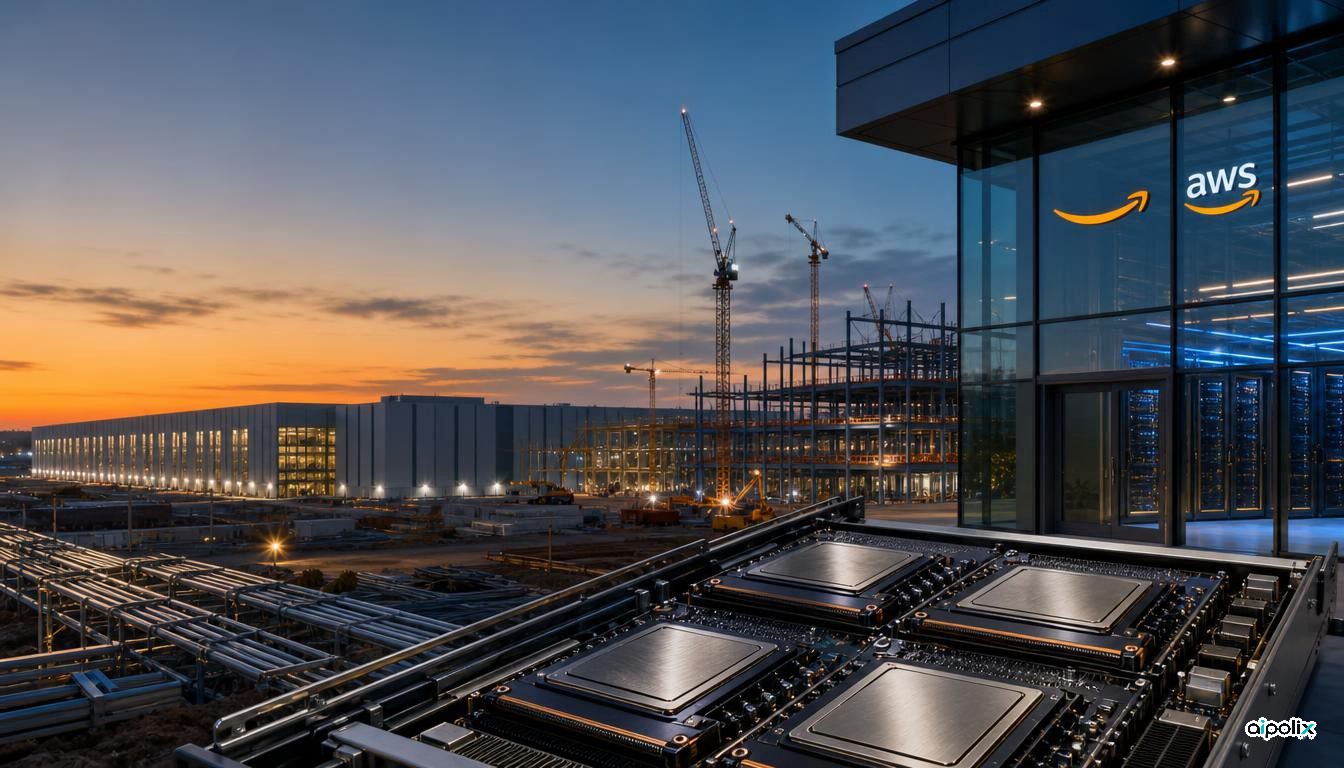
Amazon's cloud unit is growing faster than at any point in almost five years, and the company is paying heavily to keep it that way. In results released on October 29 for the quarter that ended on September 30, Amazon said Amazon Web Services brought in $46.0 billion, a 39% increase on a year earlier, while the cost of building AI data centers pushed trailing free cash flow deep into negative territory.
Group net sales rose 12% to $201.9 billion. Amazon noted that Prime Day moved into the second quarter in most large countries this year, and estimated that growth would otherwise have been about four percentage points higher. Operating income jumped to $28.1 billion from $17.4 billion, a record margin of 13.9%. Net income slipped to $20.7 billion, or $1.89 per diluted share, because the year-earlier quarter included $9.5 billion of pre-tax gains on Amazon's stake in Anthropic. CNBC reported that both revenue and earnings fell short of analyst forecasts.
AWS was the bright spot. Its operating income reached $17.8 billion, up from $11.4 billion, and Amazon put the unit's annualized revenue run rate at $184 billion. On the earnings call, chief executive Andy Jassy said growth had accelerated for a sixth consecutive quarter and that the AWS backlog stood at $578 billion, more than double its level a year ago. He told analysts that inference already accounts for most of the unit's AI revenue, and Amazon said Fortune 500 customers were spending nearly seven times more on Bedrock, its model service, than a year earlier, with token volume up almost 17 times.
The price is a historic build-out. CNBC reported capital expenditures of $77.3 billion in the quarter, compared with $35.1 billion a year earlier and an analyst estimate of $58.7 billion. Amazon kept its forecast of roughly $220 billion in cash capex for 2026, most of it for AWS, and Jassy said spending in 2027 would be meaningfully higher. Over the past twelve months, purchases of property and equipment rose by $94.8 billion, mainly for AI, turning free cash flow into an outflow of $42.4 billion against an inflow of $14.8 billion a year before.
Custom silicon is becoming a business in its own right. According to CNBC, Jassy said Amazon's chip revenue is growing at triple-digit rates, and he confirmed plans to sell Trainium accelerators to external customers starting late in 2027. On the call he added that most Bedrock traffic already runs on Trainium, which he presented as a margin advantage over rivals that rely on the same third-party hardware.
Jassy predicted that AWS could keep growing above 40% in both 2027 and 2028 and become a business with a trillion dollars in annual revenue within five to ten years. Investors were less convinced in the short term: TechCrunch and CNBC reported that the shares fell about 6% in after-hours trading. Amazon guided to fourth-quarter sales of $240 billion to $247 billion, a midpoint CNBC said was below expectations, and operating income of $28.5 billion to $33.5 billion.
The results complete a week of hyperscaler earnings that tell a consistent story. CNBC noted that Microsoft cut its full-year spending outlook to $170 billion and Alphabet held its range at $195 billion to $205 billion, while Amazon is signalling that its own spending will keep climbing. Alongside the numbers, Amazon listed recent launches including a preview of Bedrock Managed Agents powered by OpenAI, general availability of the AWS Continuum security service and the acquisition of DuckLabs, the company behind DuckDB.