
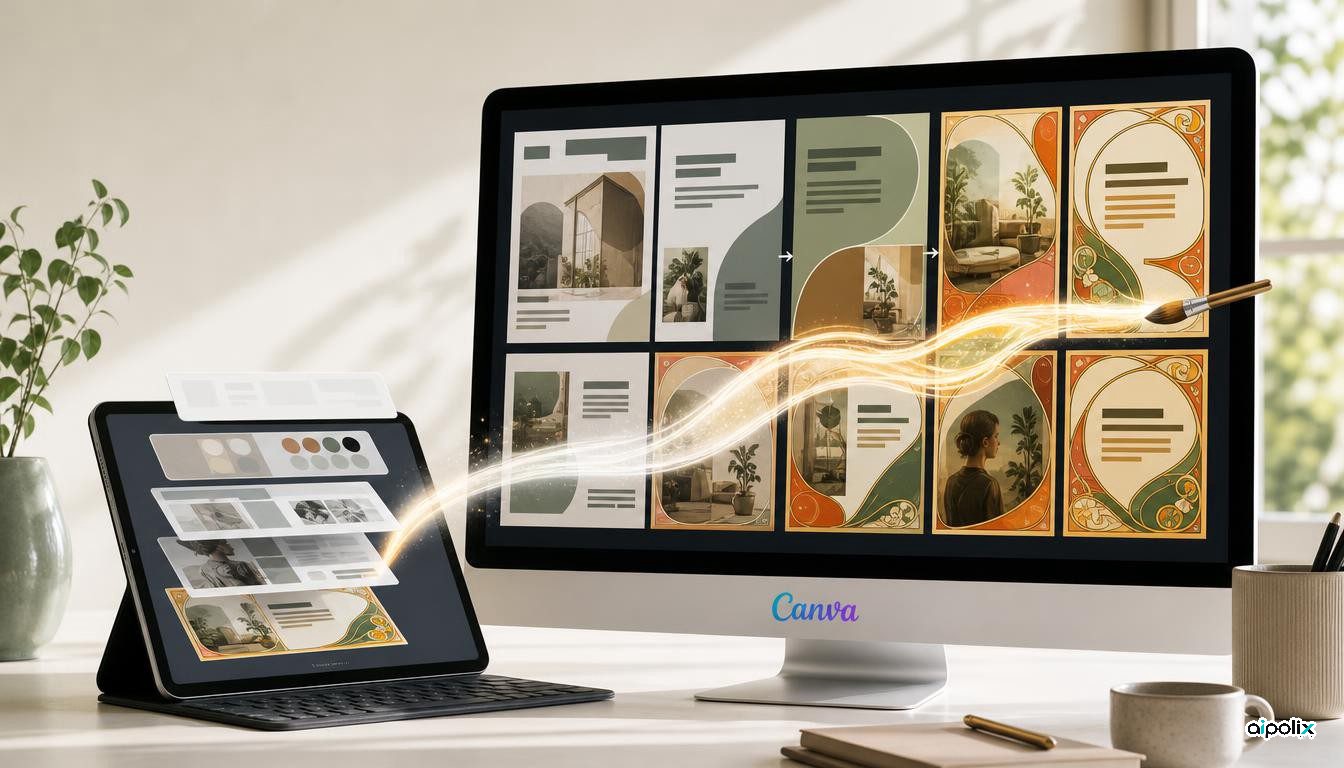
Canva has shipped its second home-built AI model in eight days, and this one is aimed at the part of design work that usually eats the most time: changing something that already exists. On October 29 the company unveiled Canva Brush, a vision-language model developed by Canva Research that interprets the layout, layer structure and visual style of a design and then applies the edits a user asks for, from rewording one line of text to updating every slide of a presentation.
Brush follows Canva Craft, the image-generation model Canva released the previous week. Canva frames the pair as a division of labour: Craft produces images, while Brush works on the surrounding design. Both come from Canva Research, which the company describes as a 160-person AI lab. Capital Brief and The AI Economy, which covered the launch separately, both presented Brush as the follow-up to Craft and repeated the same company figures.
The model does not edit in a single pass. Canva says Brush runs an agentic loop in which it writes and executes code that adjusts individual design elements, inspects the resulting page and uses what it sees to decide the next step. Output stays fully editable inside the Canva editor, so text, images, colours and layout can still be moved or changed by hand. Canva's own example is a three-page pitch deck for a bakery in an Art Nouveau style, a request that requires planning a narrative across pages while keeping typography, colour and spacing consistent.
On training, Canva says it did not build Brush from scratch. It started from a leading open-weights model that it has not named, post-trained it on real design and editing tasks using in-house design expertise and anonymised data from users who chose to share it for Canva AI improvements, and then applied large-scale reinforcement learning. The reward system scores visual quality, adherence to layout principles and whether the requested task was completed. According to the company, it draws on Canva's design library, editing behaviour, hundreds of thousands of simulated interactions and standards set by professional designers on staff.
The headline numbers are about cost and speed rather than benchmarks. Canva says Brush is up to 69% faster on general editing tasks and 46% cheaper per edit than its previous design agent, and that in internal testing it matched or beat the earlier setup on most editing work, doing best when restyling a design or reworking it for a new format. The company links that efficiency to scale: with hundreds of millions of people making billions of designs, even small per-task savings add up. The AI Economy noted that Canva slowed its AI rollout earlier this year because the economics were not yet workable, which makes the cost figure central to the launch.
Brush is available now for supported edits in Canva AI on Canva Pro plans, where users select it from the model menu, with broader access promised but not dated. The AI Economy described the release as a beta. Canva lists three gaps it is already working on: support for Brand Kit, letting users point Brush at attachments, and stronger results on layouts dominated by images.
The move puts Canva on a slightly different path from Adobe. The AI Economy pointed out that Adobe's Firefly Image 5 brought layered, prompt-based editing to single images last year and that Adobe also offers third-party models, whereas Brush operates on whole multi-page designs. Canva, which also uses partner models, is betting that specialised models trained in-house will deliver better results at lower cost. None of the speed, cost or quality figures have been tested independently, and Canva has not documented any public API or model identifier for Brush.