Cost-saving inference cascades have a simple promise: let a cheaper model answer most requests, and send only uncertain or difficult cases to a stronger model that acts as a verifier. A new preprint tests a failure mode hidden inside that design. If the same verifier decides which answers are accepted and also supplies the metrics used to judge quality, the system can become confident in a dashboard that cannot see its own mistakes.
The paper, submitted on September 1 by Dushyant Rajput of AltSlate Labs, measures this problem with real language models and publishes the code, committed measurements, and reproduction instructions. The strongest operational result is not that cascades are inherently unreliable. It is that a verifier used as both traffic controller and measurement instrument is not an independent quality signal.
The verifier can miss more as the student gets stronger
The study defines a blind spot as the fraction of genuinely wrong student answers that the verifier accepts. In experiments using Qwen2.5-Instruct students from 0.5B to 32B parameters, the author reports that the blind-spot rate rose from 0.12 to 0.55 as student capability increased under a fixed verifier.
That result matters because a cascade is usually justified by cost separation. The cheaper student handles the broad stream, while an expensive frontier model is reserved for cases the verifier rejects. But subtle student errors can become harder for a weaker verifier to recognize. Improving the student does not necessarily improve the verifier's ability to detect the remaining mistakes.
The opposite move has a cost. The paper reports that a stronger frontier verifier reduced the blind-spot rate to about 0.05 on the tested setup, but escalated 46% of hard-MATH requests while the student's true error rate was 39%. Reliability improves by buying much more frontier-model traffic, which erodes the economic reason for using the cascade.
The dashboard can stay green while delivered quality moves
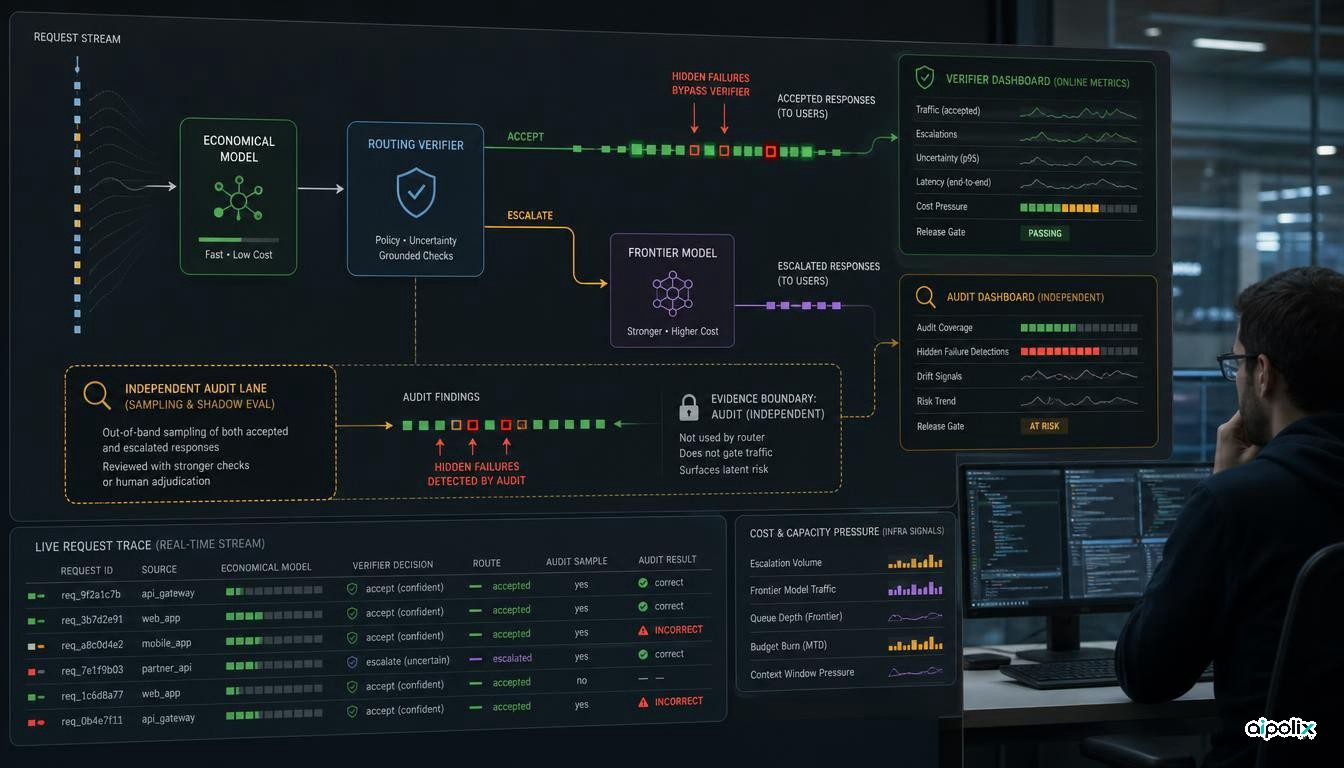
The most useful finding is the monitoring failure. The paper reports that verifier-computed metrics showed roughly 3% error while the true user-facing error, measured with an independent gold oracle, moved as high as 32% in the tested runs.
This is not an ordinary observability bug. An answer that the verifier wrongly accepts cannot later appear as an error in a quality metric computed through that same verifier. The routing decision and the quality estimate share the same blind region.
For production systems, escalation rate, verifier-estimated accuracy, and similar in-loop metrics should not be treated as sufficient evidence that the cascade is healthy. A cheap cascade can look more efficient and apparently accurate at the same time that undetected errors concentrate in the accepted stream.
Self-improvement did not rescue the tested loop
The paper also tests a natural cost-reduction strategy: fine-tune the cheap student on examples rejected and corrected by the stronger model so fewer requests need escalation over time. In the reported real-model experiments, that corrective loop did not improve the small student. It degraded and eventually collapsed across the tested teachers.
The author is careful about what this does and does not establish. The theoretical error-floor argument depends on a loop that actually improves the student, so that claim is explored in a controlled synthetic study rather than presented as demonstrated on the real-model runs. The directly measured result is narrower: the verifier has blind spots, those blind spots move with model capability, and the verifier-derived dashboard can fail to reveal delivered error.
The work therefore does not prove that all self-improving cascades will collapse, and it does not establish a universal reliability floor.
Independent auditing belongs in the cascade architecture
The practical design implication is stronger than simply using a better verifier. If the verifier is part of the control plane, teams need a separate measurement path that does not inherit the same accept or reject decisions.
One option is a statistically sampled audit stream with independent ground truth or a deliberately different evaluation mechanism. Another is to use a verifier from a different model family or methodology when feasible, reducing correlated failure modes. For high-risk workflows, sampled human review or deterministic domain checks can provide an external reference even when they are too expensive to run on every request.
This also changes the cost calculation. A cascade budget should include the cost of independent auditing, not only the student and escalation traffic. If the economics work only when quality measurement reuses the same verifier, the apparent saving may depend on an unmeasured reliability risk.
The key control question is therefore not simply how many requests the expensive model handled. It is what independent evidence shows that the accepted stream is still correct.
The evidence is reproducible but deliberately narrow
The repository publishes experiment code, committed result files, reproduction instructions, and an MIT license for code and data. The real-model setup uses Qwen2.5-Instruct students, OpenAI models as verifiers and teachers, GSM8K and hard MATH tasks, LoRA fine-tuning, and a single H100 for the reported training setup. It also reports 95% Wilson intervals for blind-spot measurements.
Those artifacts make the result unusually inspectable for a fresh preprint, but the limitations are material. The real-model experiments are a mathematical wind tunnel where an independent gold oracle is cheap. The author explicitly says the study did not run the same measurement on genuinely fuzzy tasks such as long-form claim verification or code-review quality. The real-model runs are also single-seed experiments.
The numbers should therefore not be read as a measured failure rate for production RAG, coding, or enterprise-agent cascades. The more defensible contribution is architectural: a quality monitor that depends on the same verifier as the routing decision is structurally unable to measure some of the errors that matter.
For teams deploying model cascades, that is enough to justify a concrete release gate: do not promote a cheaper routing configuration until an independent audit channel shows that delivered quality remains inside the required envelope.