
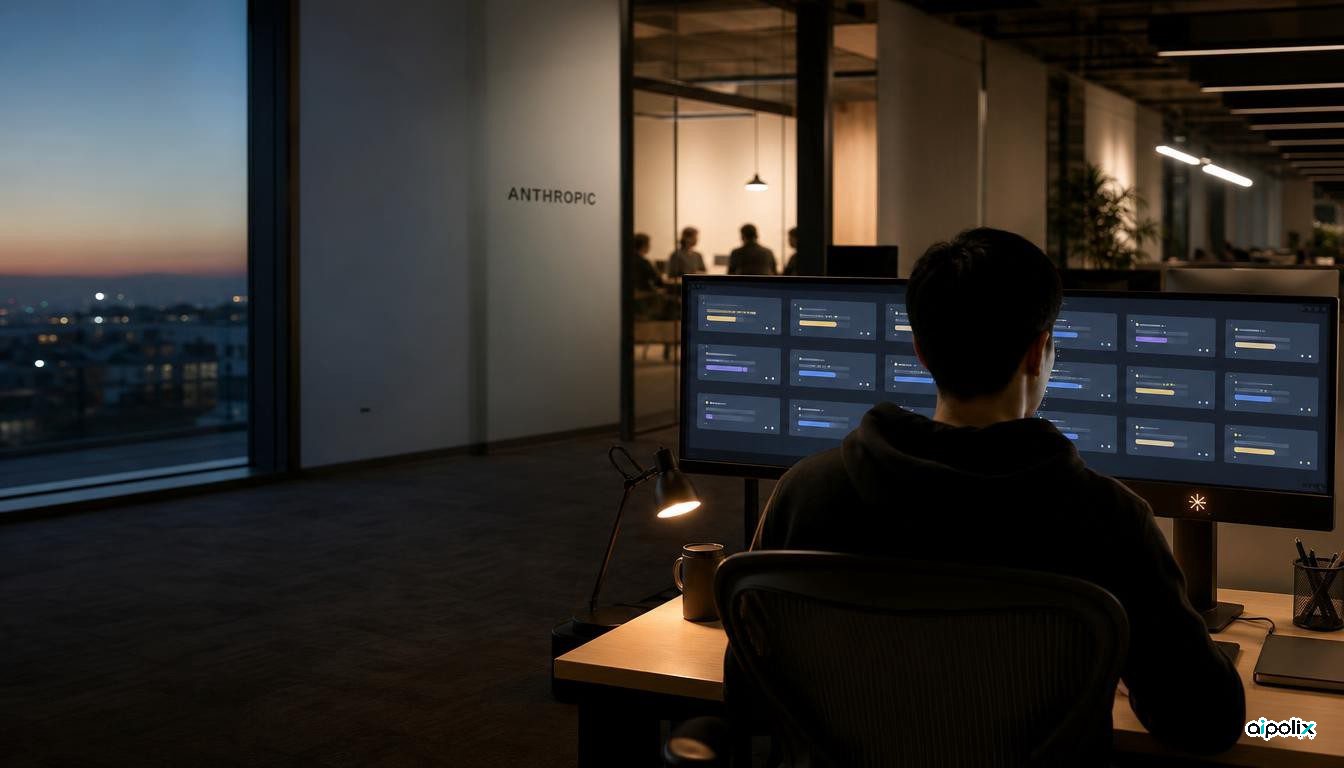
Anthropic has turned its research lens on itself. On October 16 the company published two linked reports: one on how AI agents have reshaped work and hiring inside Anthropic, and one comparing what its employees and the American public expect AI to do to jobs and the economy. The company presents its own workforce as a possible early signal of changes that could spread more widely, while acknowledging that an AI lab is an unusual employer.
The employment report draws on internal records covering headcount, AI use, output metrics, employee surveys, Slack activity, calendars and hiring decisions, plus 17 interviews. Its central finding concerns entry-level roles. The share of junior employees in Anthropic's technical departments fell from 21% to 14% since early 2025, and junior technical hires dropped from 27% to 9% of the total. Technical departments overall slipped from 61% to 56% of headcount over the past year, even though technical hiring kept growing in absolute numbers. A majority of managers surveyed in April said AI had changed the skills they hire for.
Anthropic ties the shift to the spread of agents. Agent session telemetry shows that in March 2026 the combined hours worked by autonomous and interactive agents passed human working hours for the first time. Counting only agents directed by individual employees, agents logged six times as many hours as their human handlers by August. Code commits per engineer are about five times their level of six months earlier. When the company followed 192 engineers who adopted coding agents against 74 who did not, the adopters added much more code afterward, and Anthropic says it found no difference in how often agent-written and human-written lines were later removed or reverted. Sales representatives closed deals with more clients and lawyers processed more contracts after adopting agents.
The report also documents the strain. Agents spend roughly 80% of interactive session time waiting for a person, and simply reading what they produce would fill more than half the work week even for non-technical teams. The share of employee sessions spent on so-called meta-work, such as writing specs for multi-agent runs and building monitoring dashboards, rose from 10% to 22% between fall 2025 and spring 2026. Median meeting time is up 20%. Hiring managers now mention candidates' use of AI tools three to four times as often as in 2024 and put more weight on autonomy and judgment than on narrow domain expertise.
The second report compares an August survey of Anthropic staff with a nationally weighted sample of about 11,000 US adults fielded by Morning Consult. Both groups broadly agree on what AI can do today but diverge on how fast it will advance. By 2030, 91% of staff expect AI to be capable of a Nobel-level discovery, against 39% of US adults. Staff expect AI to be able to do 75% of their own current work by then; US workers put the figure at 28%, and only one in twenty expects 80% or more. Between 19% and 40% of adults, depending on the task, say AI will never manage it, compared with at most 2% of staff.
Anthropic argues the gap reflects experience more than theory. Within each group, people who expect AI to take over more of their own work forecast higher unemployment, and at the same expected level of automation the two groups predict similar jobless rates. US workers who expect AI to handle 80% or more of their hours forecast unemployment of 12.2% in 2030.
The findings carry clear limits. All workplace data are Anthropic's own, collected and analysed by the company, and have not been independently reviewed. The company notes that tool adoption was not random, so productivity estimates may be biased, and that its stock-heavy pay, rapid growth and AI-centred culture cannot be replicated in most firms. Anthropic says it has set up an internal early warning system for jobs at risk and prioritises redeployment, but it does not claim these measures would work elsewhere.