
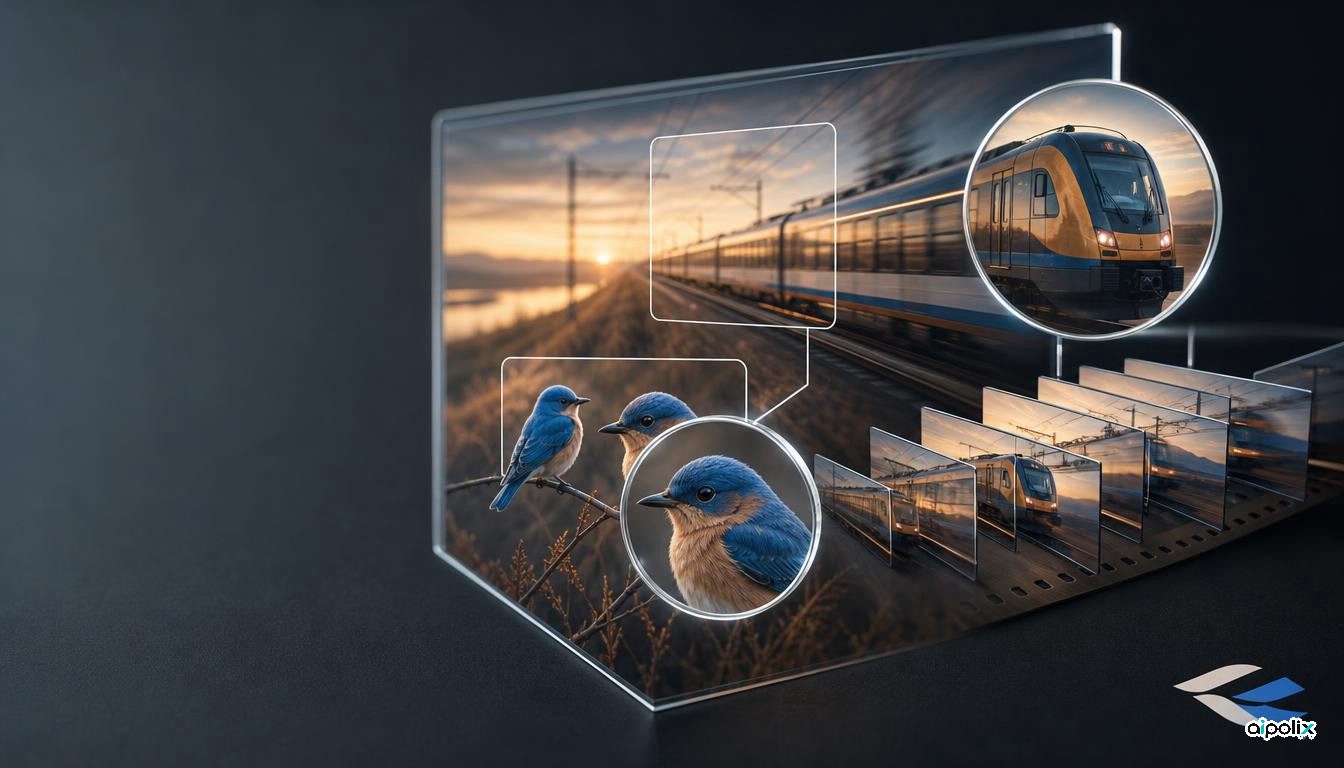
Elorian, a Palo Alto AI startup led by former Google DeepMind researcher Andrew Dai, released its first model on October 16, 2026. Called Glimpse and offered as a research preview, it is pitched as a "visual thinking" model: instead of converting an image into tokens once and then reasoning about it in text, it keeps returning to the pixels while it works through a problem.
Elorian's launch post says Glimpse can revisit and refine internal visual representations as its reasoning unfolds, and that it was trained end-to-end as an agent to use multimodal tools that write code, transform images and watch video. It can also spawn subagents that pass text, visual artifacts and internal representations to one another. TechCrunch, which reported the release as an exclusive, describes the mechanism as a "visual scratch space": mid-reasoning, the model can crop into a region, pull specific frames from a clip, or run code to measure what it sees. One trace published by Elorian shows the model rewatching a 0.9-second stretch of video at about 14 frames per second to decide whether a camera move was a pan or a hard cut.
The benchmark table comes from Elorian's own evaluations. It shows Glimpse ahead of GPT-6 Astra on four tests: CharXiv-R scientific chart reasoning (92.90 against 92.10), FSC-147 open-vocabulary counting (83.36 against 82.02), UGC-VideoCap short-form captioning (82.66 against 80.32) and WGO Bench manipulation-event understanding (42.70 against 39.42). It ties Astra on ERQA embodied reasoning at 83.75. The same table has Glimpse behind Astra on several others, including HSS scene understanding (46.36 against 53.6), DREAM-1K dense captioning, TOMATO temporal reasoning, Video-MME v2 and CountQA, and Claude Opus 5.5 posts the highest CharXiv-R score at 93.40. Elorian says every model was run at its highest thinking effort with its native agent harness.
Price is a large part of the pitch. Glimpse costs $0.60 per million input tokens and $3.00 per million output tokens, which Elorian says is 94% below GPT-6 Astra, 85% below Claude Opus 5.5, 70% below GPT-6.1 Sol and 20% below Gemini 3.8 Flash at its introductory rate. The company says a small team built the model on only a few hundred GPUs by post-training an open-weights base model; it does not say which one.
On access, the two sources differ slightly. Elorian says Glimpse is available through an API and a chat interface, with a sign-up step; TechCrunch reported that the chat interface is waitlist-only for now. Elorian emerged from stealth about six months ago after raising a $55 million seed round at a $300 million valuation, co-led by Striker Venture Partners, Menlo Ventures and Altimeter Capital, with Nvidia and Google chief scientist Jeff Dean participating, according to TechCrunch. Earlier this month the company published Humanity's Sixth Sense, a visual reasoning benchmark built with Scale AI.
Initial targets are organisations with large amounts of video, such as robotics firms, scientific labs, media groups and creative companies. The longer plan is to move from seeing to acting: reconstructing scenes, predicting what happens next and eventually controlling robots directly. Elorian itself says calibrated reconstruction and robot control remain work ahead, and Dai told TechCrunch the goal for next year is a model that leads every visual reasoning test.
Re-examining images during reasoning is not a new idea. TechCrunch notes that OpenAI added crop-and-zoom to its o-series reasoning models in 2025; Elorian's argument is that it built an entire model around the approach, cheaply. No independent evaluation of Glimpse was found at publication, so the performance comparisons should be read as company claims.