
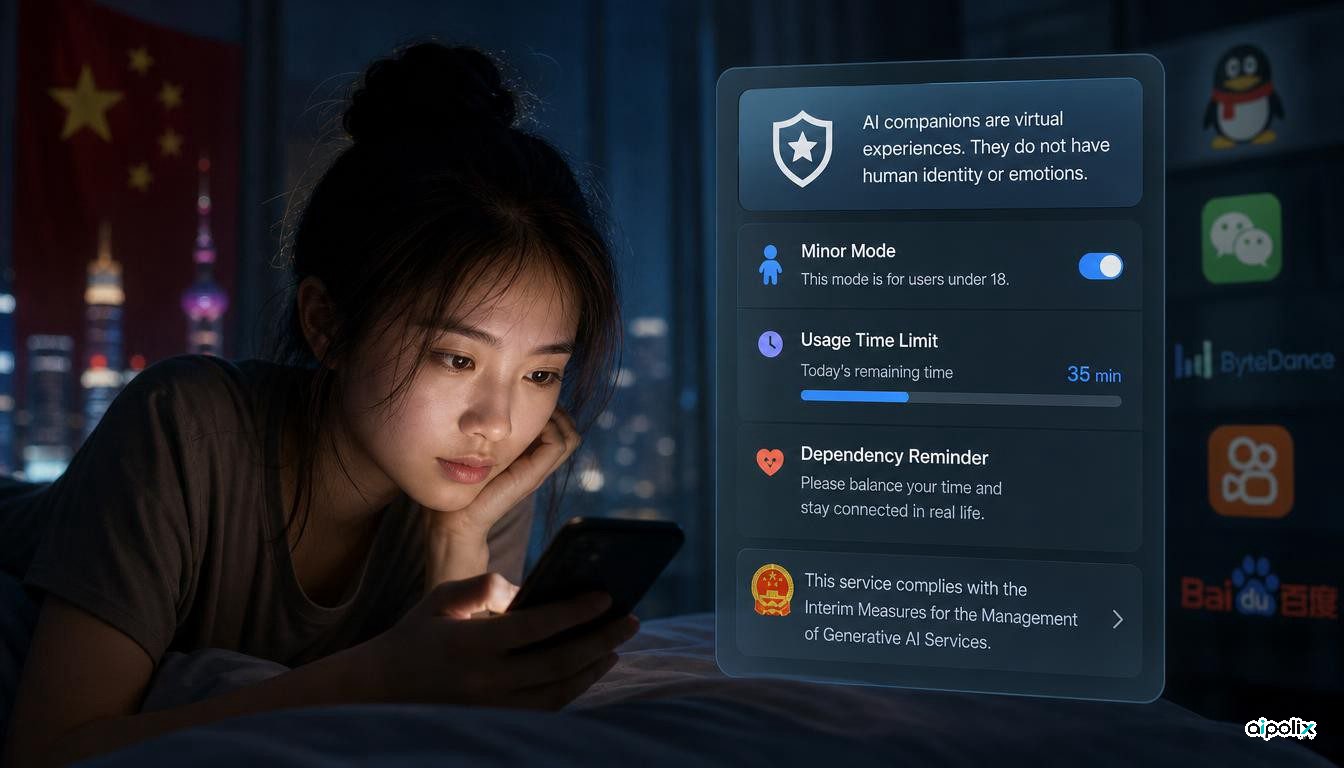
China’s rules for anthropomorphic AI interaction services are now reshaping the consumer AI market, with major technology companies pulling or redirecting companion products to comply. The rules, formally issued in April by the Cyberspace Administration of China and four other agencies, took effect on July 15. An Associated Press report published in August documented the user impact after ByteDance, Alibaba and Tencent shut down or altered popular AI companion services.
The regulation targets services that simulate human personality traits, thinking patterns and communication styles in sustained emotional interactions. It excludes ordinary customer service, knowledge Q&A, work assistants, education and scientific research when those services do not involve persistent emotional companionship.
The rules draw explicit boundaries around emotional dependence. Providers may not make replacing real social interaction, controlling users psychologically or inducing addiction and dependency a service objective. They must also avoid content that excessively flatters users, encourages emotional reliance or harms real-world relationships. Platforms are required to recognize signs of excessive dependency and reinforce reminders that users are interacting with AI rather than a human.
The framework is stricter for minors. Providers may not offer virtual intimate relationships such as simulated relatives or romantic partners to minors. For children under 14, other anthropomorphic interaction services require parental or guardian consent. Services must also provide a minor mode, time-limit controls, reality reminders and tools that let guardians receive safety warnings or restrict certain characters and spending.
Privacy is another major part of the rules. Interaction logs with companion systems can contain highly sensitive emotional information, so providers are required to protect that data through measures such as encryption and access controls. Except where law provides otherwise, providers cannot share interaction data with third parties without consent, and sensitive personal interaction data generally cannot be used for model training without separate consent.
The rules also require intervention capabilities when a user appears to face serious safety risks. That means companion products are being regulated not only as content-generation systems but as systems that may influence emotional behavior over long periods. China’s approach effectively treats sustained AI relationships as a distinct product category with different duties from general-purpose assistants.
The immediate market effect has been visible. AP reported that ByteDance, Alibaba and Tencent were among companies discontinuing AI companion offerings after the rules took effect. Some users described grief and frustration after losing long-running virtual relationships, while companies began redirecting users toward alternative character or story products that may fit the new boundaries more safely.
The policy creates a notable test for AI product design. Companion products have often optimized for engagement, continuity and personalization, the same properties that can increase emotional attachment. China is now requiring providers to design against excessive dependency while still delivering useful interaction. That tension between retention and safety is likely to matter far beyond China as regulators elsewhere examine the risks of AI systems designed to feel socially present.