Thinking Machines Lab has released Inkling 2 Mini, a compact multimodal model built for local use, and Hugging Face published a launch post for it on November 20, 2026. The post is credited to Hugging Face staff merve, Pedro Cuenca, Aritra Roy Gosthipaty and Guarin Flück. The model is a mixture-of-experts system with roughly 26 billion parameters in total, of which about 3 billion are active for each token. It accepts text and images and supports a context window of one million tokens.
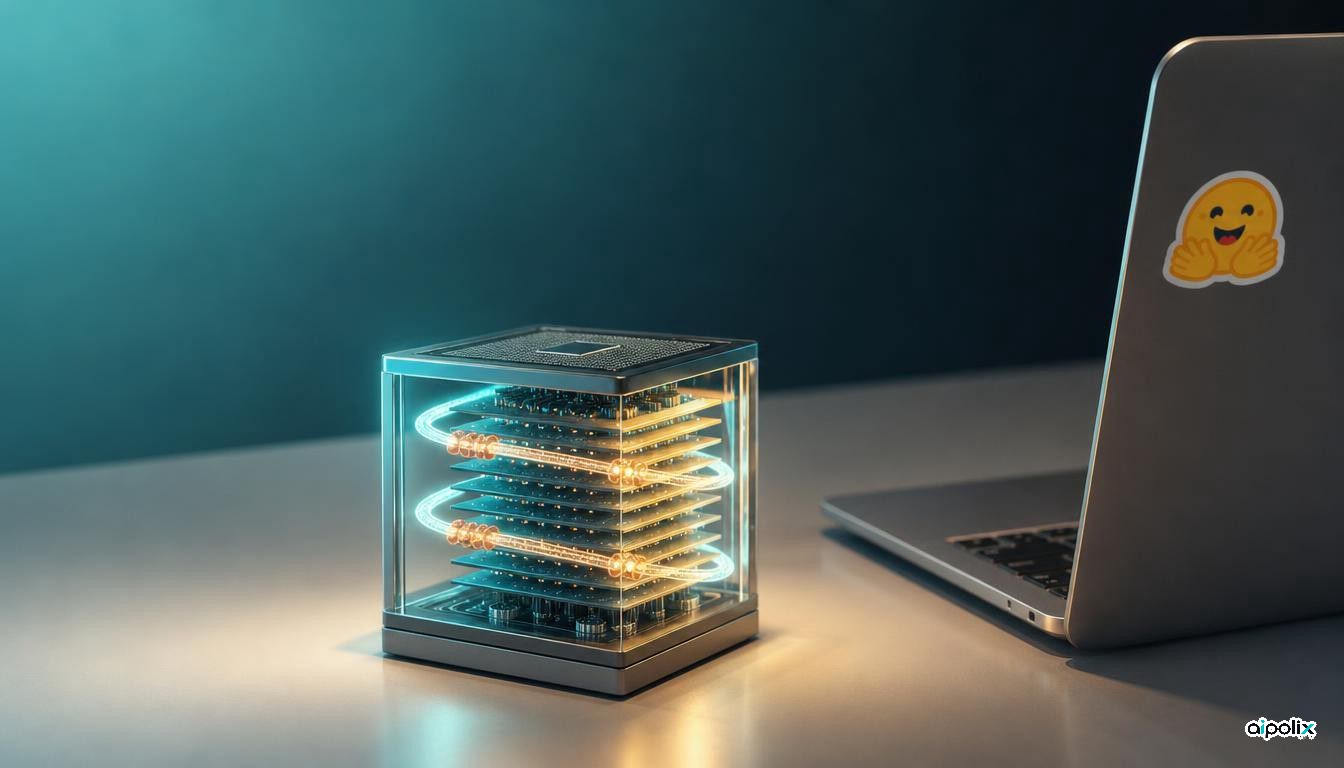
The unusual part is the architecture. Inkling 2 Mini stores 24 decoder layers, but the 12 in the middle are run three times in a loop, so every token passes through 48 layer visits while the checkpoint holds far fewer distinct layers. The passes share the same weights and exchange information through learned messages, with a small gating controller deciding how much of the current input to keep and how much of the previous pass to add. At each visit the router picks 8 experts out of 128. Thinking Machines Lab describes the design as a way to gain capacity without growing the stored model.
The release ships in a mixed-precision format, with NVFP4 and MXFP8 weights for the experts, and includes a DSpark drafter intended to speed up generation at a small memory cost. A second research checkpoint, called TML-d24-varloop-research, was trained to accept a variable number of loop passes. Running one or two passes instead of three makes inference faster at some cost in quality, and the authors say they have tested that it works but have not evaluated it in depth.
On performance, the launch post reports that Inkling 2 Mini is state-of-the-art for its size class on the Artificial Analysis Intelligence Index v5 and leads in 32 of 48 benchmarks against Gemma 4 31B, Muse Glimmer, Qwen3.8-27B and Nemotron 3.5 Super VL. It leads on FrontierCode v2.0, ties Qwen3.8-27B on Terminal-Bench 4.0 and trails it on AutomationBench-AA. Hugging Face adds that its own informal tests put the model at least on par with Qwen3.8-27B, and says that more validation is needed. These figures come from the developers and their partner, not from an independent evaluation.
For developers, the practical news is support on day one. The model runs in transformers, in llama.cpp through the Llama App, and in MLX for Apple hardware, and SGLang offers production inference on datacenter GPUs. Reasoning effort can be set per request, from none to max. Hugging Face showed examples in which the model, used with the Pi coding agent, built a small expense-splitting web app from a photographed sketch, and a 4-bit quantized build produced a complete website from a one-line prompt.
The release follows the original Inkling launch of July 2026 and positions the family at the small end of the open local-model market, where it competes directly with 20 to 30 billion parameter models. Whether the looped design holds its edge outside the published benchmarks is the open question, and independent testing will decide it.