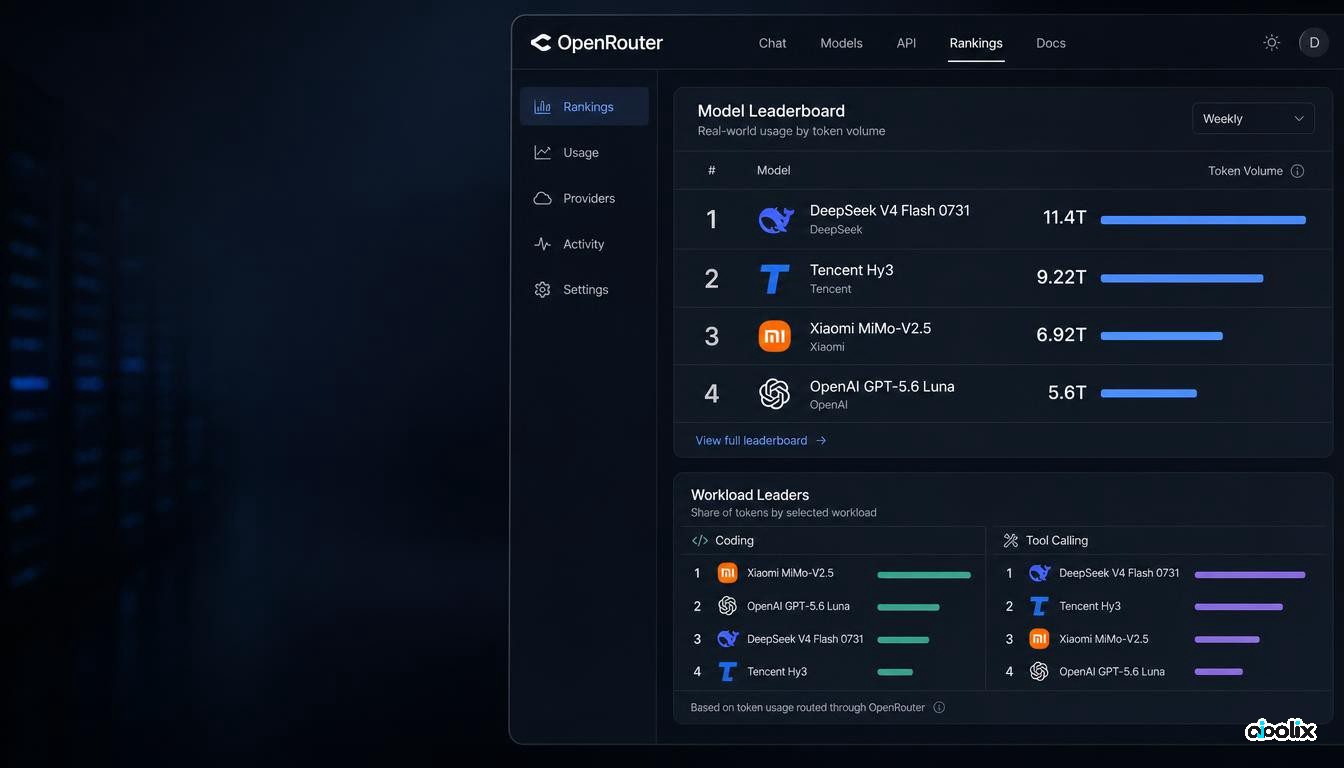
OpenRouter's latest weekly usage leaderboard has put three models from Chinese technology companies at the top of one of the largest public views into multi-model developer traffic. According to OpenRouter's rankings, DeepSeek V4 Flash 0731 processed 11.4 trillion tokens in the displayed weekly window, Tencent Hy3 processed 9.22 trillion, and Xiaomi MiMo-V2.5 processed 6.92 trillion. OpenAI's GPT-5.6 Luna followed with 5.6 trillion, while an earlier DeepSeek V4 Flash variant ranked fifth with 5.06 trillion.
The result is notable because it is not a benchmark table assembled from synthetic tests. OpenRouter says its rankings are based on tokens actually processed through its API by millions of developers, counting both prompt and completion tokens. The page's newest complete usage bucket is dated August 20, 2026. That makes the ranking a useful signal of developer adoption inside OpenRouter's ecosystem, although it should not be mistaken for a measure of global model market share or model quality.
The concentration at the top is also visible when the workload is narrowed to programming. OpenRouter's programming leaderboard puts Xiaomi MiMo-V2.5 first with 6.79 trillion tokens and 25.3% of the tracked coding usage, followed by DeepSeek V4 Flash with 3.51 trillion and 13.1%. OpenAI's GPT-5.6 Luna ranks fourth at 8.2%, while Tencent Hy3 is sixth at 5.7%. Those figures suggest that the strength of the Chinese models is not being driven only by chat or entertainment workloads.
Agent-oriented usage points in the same direction. On OpenRouter's tool-calling collection, DeepSeek V4 Flash 0731 is the most-used model in the tracked weekly tool-calling set, with about 11.5 trillion tokens. Tool calling matters because it is a core building block for agents that query databases, invoke APIs, execute workflows and interact with external systems. High usage there is more directly relevant to application developers than a general popularity chart.
Independent aggregation of OpenRouter data shows a similar shift at the provider level. Tidelines reports DeepSeek at roughly 25.7% of the tracked OpenRouter token share as of August 20, with Xiaomi at 10.9%, Tencent at 10.3% and OpenAI at 10.4%. It also identifies DeepSeek V4 Flash 0731 as the largest 30-day mover, gaining about 13.6 percentage points of OpenRouter token share. Because Tidelines is derived from OpenRouter traffic rather than a separate global dataset, it corroborates the direction of the shift rather than independently measuring the whole AI market.
The scale of OpenRouter makes that shift worth watching. Reuters reported this week that the platform serves more than 10 million developers and companies, processes more than 10 trillion tokens daily and offers access to hundreds of AI models. OpenRouter is still only one gateway, but it is large enough that movements in its traffic can reveal which models are gaining practical adoption among developers who are willing to switch providers behind a common API.
Cost is likely part of the story, although the ranking itself cannot prove causation. OpenRouter makes it easy to change models without rebuilding an integration, and lower-priced open or open-weight models can be attractive for coding agents, batch processing, tool-heavy workflows and other workloads where token volume grows quickly. DeepSeek, Tencent and Xiaomi have all positioned their latest models around a combination of competitive capability, large context windows and lower inference costs than many premium frontier offerings. The usage data is consistent with developers responding to that tradeoff, but it does not reveal why any individual user selected a model.
That limitation is important. OpenRouter explicitly says the rankings measure adoption, not accuracy, reasoning quality or benchmark performance. Private traffic is excluded. Usage that goes directly to OpenAI, Anthropic, Google, Tencent, DeepSeek or another provider's own API is invisible. Token volume is also not the same as user count, request count or revenue. Models differ in tokenization and verbosity, so one model can process more tokens without serving more people or being preferred for more tasks.
OpenRouter's Data API documentation adds another technical caveat: token counts come from each upstream provider's tokenizer. A token reported by one provider is therefore not perfectly comparable with a token reported by another. The public dataset is valuable for trend analysis, but it is better interpreted as directional telemetry than as a precise census of the model market.
Even with those constraints, the composition of the leaderboard is strategically significant. For much of the generative AI cycle, developer mindshare outside China was dominated by models from OpenAI, Anthropic and Google. OpenRouter's current traffic shows that developers using a neutral model gateway are now directing large production-like workloads toward DeepSeek, Tencent and Xiaomi. The competition is increasingly about operating economics and integration fit as much as benchmark leadership.
For engineering and product teams, the practical takeaway is to evaluate models at the workload level rather than treating one flagship model as a permanent default. Coding, tool calling, long-context processing and high-volume automation can have different cost, latency and quality requirements. The OpenRouter data suggests that developers are already making those tradeoffs aggressively, and that Chinese models have become mainstream options in at least one large multi-provider ecosystem.
For the wider AI market, the next question is whether this pattern holds as OpenRouter's next usage buckets arrive and whether it appears in other independent gateways and enterprise deployment data. A one-week leaderboard can change quickly, especially after model releases or pricing moves. But if DeepSeek, Tencent and Xiaomi remain near the top across several weeks, the story will be larger than a temporary ranking: it would indicate that the competitive center of gravity for developer AI workloads is becoming materially more global.