
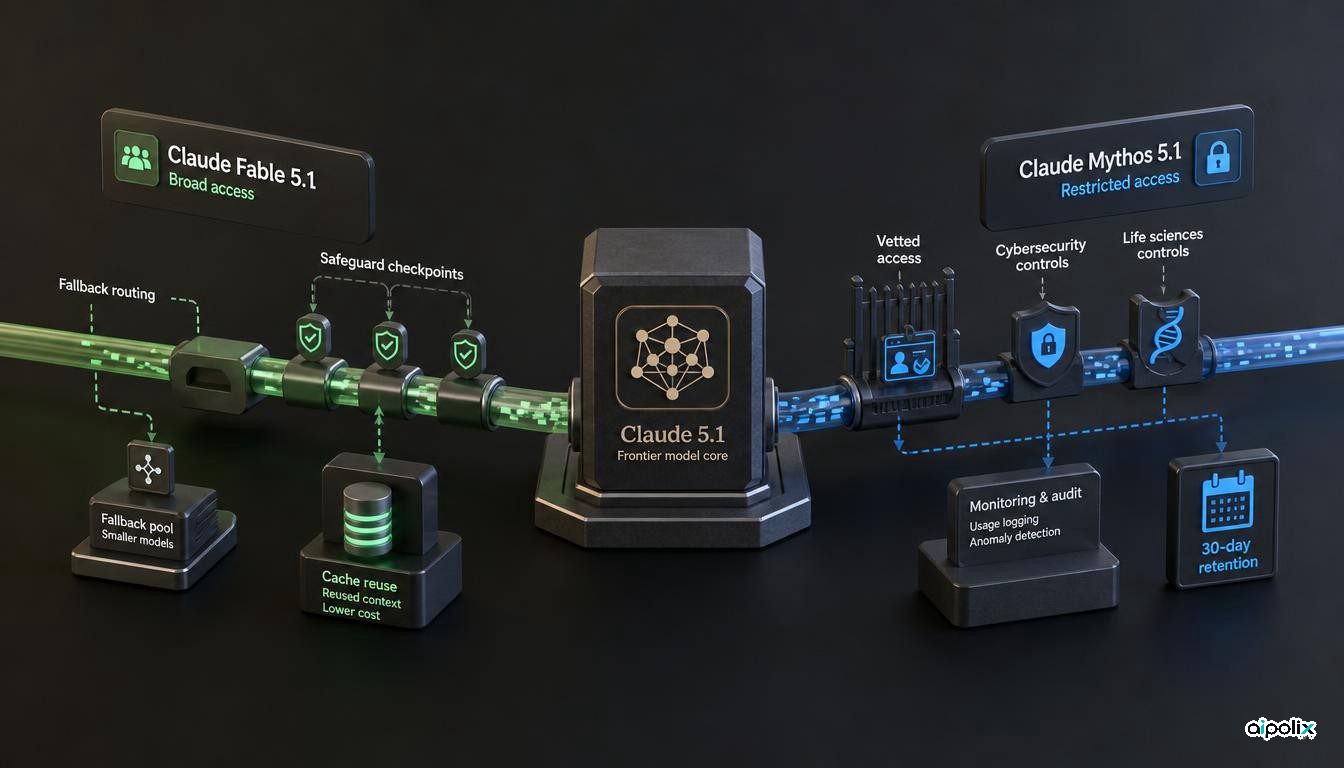
Anthropic has released Claude Fable 5.1 for broad use and Claude Mythos 5.1 for vetted organizations, while stating that the two products use the same underlying model. The difference is not a separate intelligence tier. It is the policy envelope around the model: safeguards, fallback behavior, eligibility, retention rules and pricing.
That makes the launch more consequential than a routine model refresh. For enterprise teams, the production unit to evaluate is no longer just a model name or benchmark score. It is the complete serving path that determines which requests reach the frontier model, which are rerouted, what data is retained and what repeated context costs.
One underlying model, two serving policies
Anthropic says Fable 5.1 and Mythos 5.1 are the same underlying model. Fable 5.1 is generally available, while Mythos 5.1 remains limited to vetted organizations through trusted-access programs for cybersecurity and life-sciences work.
Fable is therefore not simply a weaker sibling. It is a broader-access configuration with safeguards designed to restrict or reroute higher-risk requests. Anthropic says cybersecurity requests caught by its safeguards can fall back to Claude Opus 4.8, while biology safeguards can route to Claude Opus 5. API customers must configure fallback behavior through the company's fallback controls.
That distinction matters because a production evaluation can no longer assume every request is handled by the same model. Task success, safeguard intervention and fallback routing need to be measured separately.
The safeguards are becoming more selective
Anthropic says Fable 5.1 can now help identify software vulnerabilities in source code while still preventing penetration testing, exploit generation and binary-based vulnerability scanning. It also says biology safeguards intervene on benign requests substantially less often than the safeguards introduced with Fable 5.
The practical point is not that the safety boundary disappeared. The company is trying to reduce false positives while preserving restrictions around higher-risk cyber and biological capabilities.
For developers and security teams, that means refusal rate alone is a poor quality metric. A more useful evaluation tracks what category of work was blocked, what was rerouted, what model completed the request and whether the result remained useful for the intended workflow.
Cache pricing changes the economics of long-running agents
Fable 5.1 is priced at $10 per million input tokens and $50 per million output tokens. Anthropic says cache reads cost $0.25 per million tokens, 75% less than with Fable 5. The company estimates this can reduce the cost of typical workloads by about 25% and highly agentic workloads by up to roughly 45%.
That pricing change is especially relevant to coding and research agents because they repeatedly reuse repositories, plans, instructions, tool state and intermediate results. In those workloads, the cost of re-reading context can become a major share of total spend.
The useful procurement comparison is therefore not only input and output price. Teams should model cache-hit rate, session length, fallback frequency and the amount of persistent context reused across a task.
Mythos makes access policy part of model selection
Anthropic says Mythos 5.1 is available to vetted cyberdefenders and life scientists. Its Life Sciences Verification Program is launching as an invite-only beta, while its Cyber Verification Program is expected to include Mythos access as it expands.
Mythos also carries a default 30-day data-retention requirement for safety monitoring. That means the more permissive capability envelope comes with governance conditions that may matter to regulated organizations.
For enterprise architecture, model selection therefore becomes a joint decision across performance, security, privacy and legal requirements. A team may prefer the capability profile of Mythos but be unable to accept its retention or eligibility conditions.
Benchmark results need serving-path context
Anthropic reports strong benchmark results for Fable 5.1, but its own notes state that production safeguards can intervene and that some requests may be completed by fallback models. That makes raw benchmark percentages harder to interpret as pure model comparisons.
A more realistic enterprise evaluation should record at least four dimensions: task success, safeguard intervention, fallback use, and total latency and cost. Without those fields, a single score can hide important behavior in the production path.
The architectural lesson is broader than this release. As frontier models are exposed through different policy envelopes, the model weights become only one component of what customers actually buy. Safeguards, routing, identity, retention and pricing are now part of the effective model.