CrowdStrike has introduced Falcon Guardian, an AI detection and response product that extends its endpoint security model to autonomous AI agents. The important change is not another dashboard for model usage. Guardian is designed to connect an agent’s prompts, identity, tool calls and skills with the operating-system actions that follow, then apply controls at the point where those actions execute.
That approach addresses a gap that becomes more visible as coding assistants and other agents gain permission to edit files, launch processes, call services and act with a user’s credentials. Prompt inspection can show what an agent was asked to do. Runtime telemetry can show what the machine actually did. Falcon Guardian attempts to join those two views into one investigation path.
From AI inventory to execution control
CrowdStrike says the Falcon sensor can discover known and shadow AI agents on Windows and macOS endpoints, identify who deployed them and report their security status. Guardian also lets administrators define which supported agents are allowed to run on managed endpoints, turning an access policy into an enforceable endpoint control.
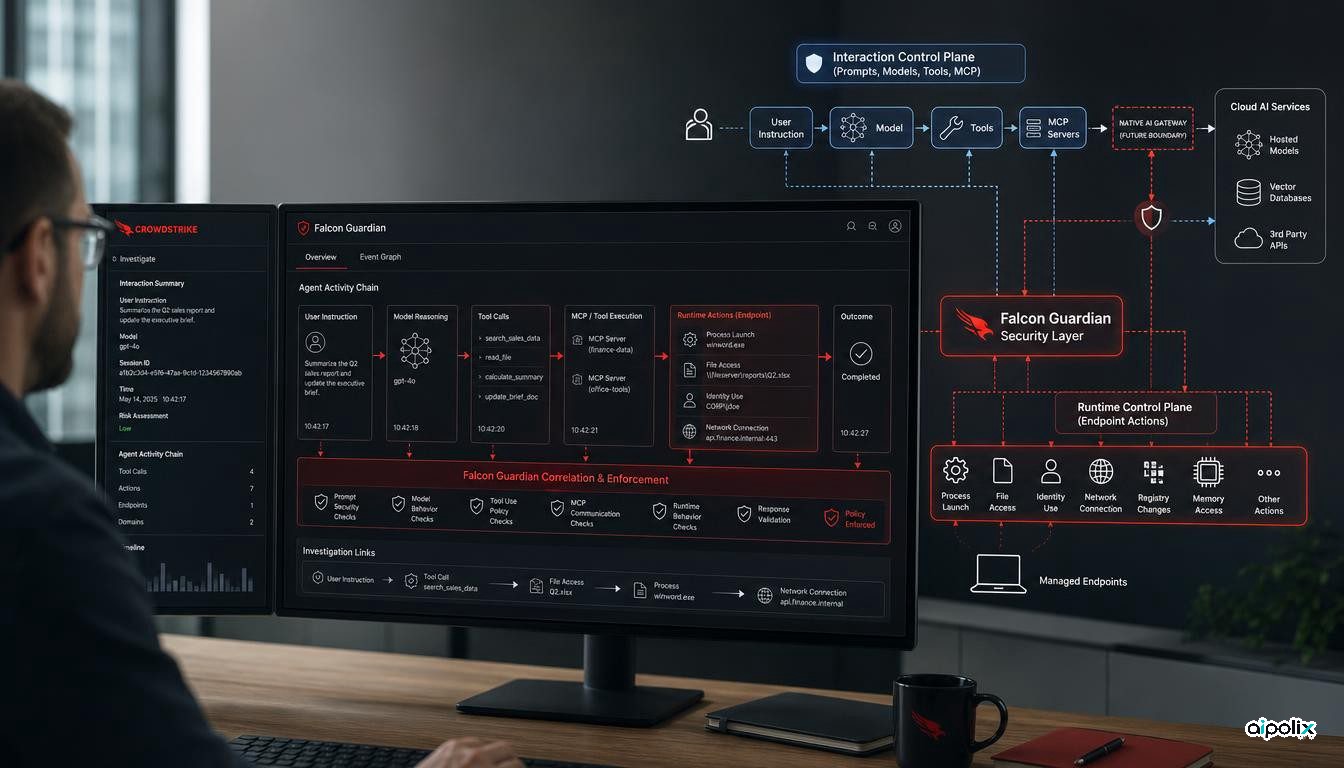
The more consequential capability is runtime correlation. CrowdStrike says Guardian links prompts, identity, tool calls and skill use to downstream processes and system actions recorded by Falcon endpoint telemetry. Security teams can then reconstruct an execution chain, estimate the affected scope and contain malicious or compromised activity.
This is materially different from treating agent security as a model-safety problem alone. An agent can receive a harmless-looking instruction and still produce dangerous side effects through a poisoned tool, an over-permissioned credential or a compromised workflow. The security question is therefore not only whether the model produced an unsafe response, but whether the resulting action crossed a control boundary.
Agent security is becoming a two-plane architecture
Falcon Guardian points toward a useful architectural split. One control plane governs the interaction layer: prompts, model access, data movement and tool or MCP communication. A second controls execution: processes, files, identities, network activity and other host-level effects.
CrowdStrike already has the second plane through its endpoint sensor. Guardian adds agent context so endpoint events can be tied back to the interaction that caused them. The company is also developing a native AI gateway for the first plane, but that gateway is still pre-beta and is expected to become generally available next quarter. Teams should therefore distinguish what is available now from what is still on the roadmap.
The separation matters for procurement. A gateway can block or inspect an interaction before it reaches a model or tool, but it may not see every downstream effect after an agent starts acting. Endpoint enforcement can see local execution, but it does not replace controls around model traffic, SaaS services or cloud-native agent infrastructure. A production design may need both.
Google Cloud integration extends the boundary beyond the endpoint
CrowdStrike also announced that Falcon Guardian is being extended through Google Agent Gateway for enterprise AI applications built on Google Cloud. The companies position the integration around risks such as prompt injection, sensitive-data leakage and malicious AI activity, with Falcon context contributing to policy and detection.
That is important because many enterprise agents will not live entirely on a laptop. They may call managed models, cloud services, remote tools and SaaS applications. A runtime security architecture that stops at the local process boundary would miss part of that path.
The Google Cloud integration shows how CrowdStrike is trying to bridge those environments: endpoint telemetry supplies execution context, while gateway and cloud integrations supply visibility into AI communications and services. Whether that becomes a genuinely unified control system will depend on the coverage of supported agents, models, gateways and execution environments.
The strongest claim is the causal chain, not the detection score
CrowdStrike’s product page includes vendor-reported efficacy and latency figures, but those numbers are not the most useful reason to evaluate Guardian. Without independent methodology and comparative testing, performance claims should remain vendor claims.
The more testable architectural proposition is the causal chain from agent interaction to system effect. Security teams can evaluate that directly. Does an investigation show the original user request? Can it identify the agent and identity involved? Does it capture the tool or skill invocation? Can analysts follow that activity into the process, file, network or credential action that changed the environment? And can policy stop the action at the appropriate boundary?
Those questions turn “AI agent security” from a broad category label into a measurable control problem.
What security teams should test before deployment
A practical evaluation should start with coverage rather than marketing scope. Teams should inventory which agents are actually recognized, which endpoint platforms and execution paths are covered, what happens when an agent invokes remote tools, and which actions can be blocked rather than merely observed.
They should also test ambiguous cases. A legitimate coding agent may launch shells, modify configuration, read secrets or communicate with external services as part of normal work. Useful runtime security must distinguish expected automation from compromised behavior without making agents unusable.
Finally, teams should keep the interaction and execution planes in the same incident model. If prompt injection causes an agent to call a malicious tool and that tool changes a credential or launches a process, investigators need one chain of evidence rather than separate logs that must be reconstructed manually.
Falcon Guardian is significant because it makes that chain the center of the product. The broader lesson is not that endpoint security alone solves agent risk. It is that governance becomes operational only when policy can be connected to what an agent actually executes.