
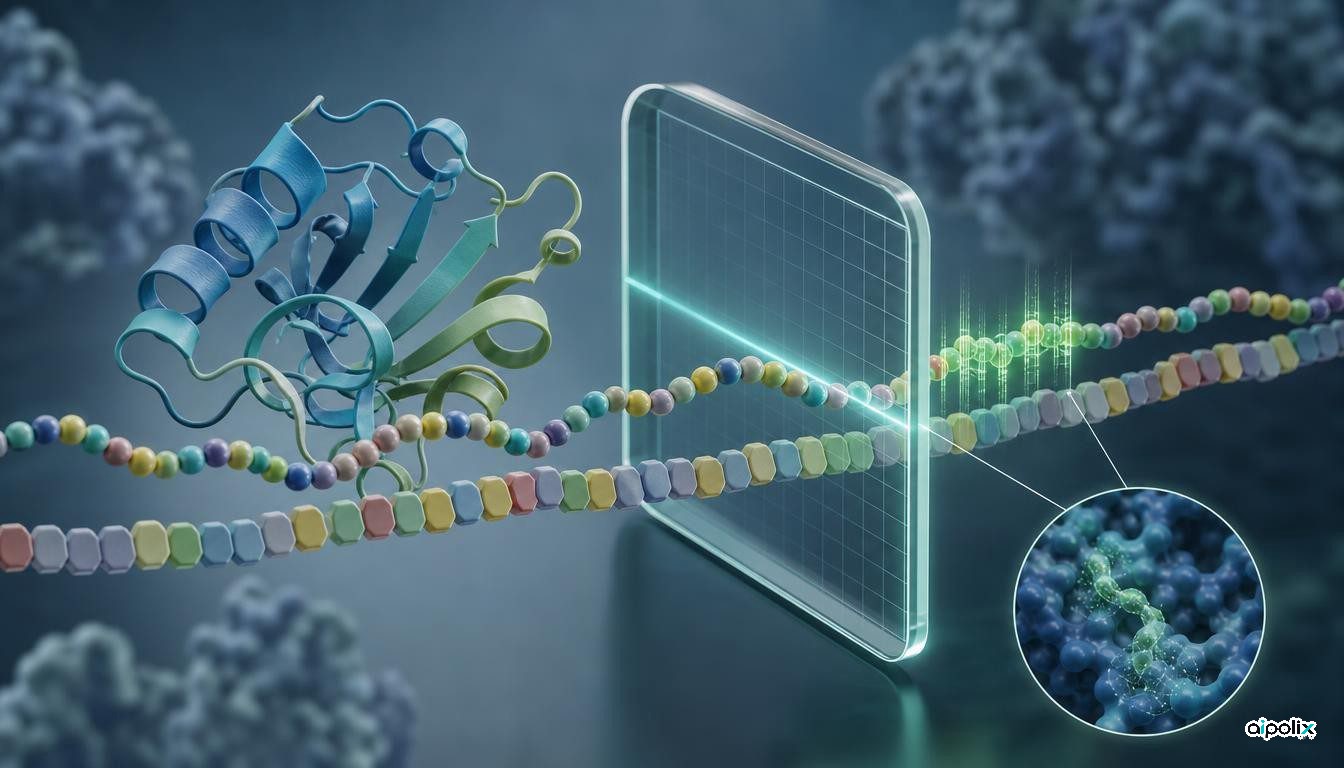
Google DeepMind has introduced SynthID Bio, a family of watermarking methods intended to make AI-generated protein sequences and predicted biomolecular structures more traceable. Instead of attaching provenance only as external metadata, the methods embed a detectable signal into the generated biological artifact itself. DeepMind presents the work as a proof of concept rather than a complete biosecurity system, but the release is notable because it includes wet-lab testing of watermarked functional proteins as well as a watermarking path for AlphaFold 3 structures.
The sequence method is integrated with ProteinMPNN, a widely used protein sequence design model. DeepMind says it used known AlphaProteo binder backbones and generated watermarked and non-watermarked sequences for comparison. In laboratory tests against VEGF-A, the SARS-CoV-2 receptor-binding domain and PD-L1, the watermarked designs produced binding hit rates, binding affinities and sequence diversity comparable with the unwatermarked versions. The Nature paper reports low-nanomolar binders for the SARS-CoV-2 target and subnanomolar binders for VEGF-A and PD-L1.
The watermark travels with the biological design
The important architectural idea is that the provenance signal is carried in the sequence rather than only in a database record or file wrapper. For a synthesized protein, that means the watermark can still be checked after the design has moved from a software pipeline into a physical biological object. This is different from provenance systems that depend on retaining a sidecar record, a signing envelope or a platform-specific audit trail.
SynthID Bio does not make the sequence visually or functionally special to a researcher. Detection depends on knowing how the watermark was generated and applying the corresponding detector. In the sequence implementation published by DeepMind, watermarking is applied during autoregressive decoding in ProteinMPNN. The official repository exposes parameters for embedding the signal and tools for calculating detection values on existing FASTA sequences.
That creates a practical governance consequence: organizations using such a watermark would need to manage detector versions, watermark parameters and access to verification material as part of their provenance infrastructure. A watermark is useful only if the organization receiving the artifact can determine which detector and configuration are authoritative.
AlphaFold 3 structures get a separate watermarking mechanism
DeepMind also developed SynthID Bio-structure for predicted biomolecular structures. Instead of modifying a finished coordinate file after prediction, the approach fine-tunes a small part of AlphaFold 3's diffusion network so that generated coordinates carry a detectable signal. DeepMind reports near-perfect detection while preserving AlphaFold 3 prediction accuracy and key structural distributions, with robustness to digital noise and small coordinate modifications in the tested settings.
This matters because structure databases increasingly mix experimentally determined structures, predictions and computationally designed artifacts. A model-level watermark could provide another signal for identifying AI-generated structures if it survives the transformations that occur when structures are stored, reformatted or analyzed.
The current evidence does not establish universal robustness. DeepMind explicitly identifies deliberate watermark removal as an open challenge. A determined actor may optimize against a known detector, transform a sequence or structure, or regenerate an artifact through a different model. The paper therefore supports feasibility in the tested settings, not an unbreakable provenance guarantee.
Provenance could complement screening, not replace it
The most useful interpretation is as an additional provenance control rather than a substitute for existing biosecurity measures. DNA synthesis screening, access controls, laboratory procedures, model safeguards and provenance metadata address different failure modes. A biological watermark may help answer whether a sequence or structure was produced by a participating AI generation pipeline, but it does not determine whether the biological object is safe, benign or appropriate to synthesize.
For synthesis providers and biological databases, this could eventually become a machine-readable signal that feeds into existing review workflows. A detected watermark might trigger additional provenance checks, identify the generation system involved or help separate synthetic model output from naturally occurring or experimentally derived material. Those uses would require interoperability agreements and clear rules for false positives, false negatives and detector access.
DeepMind also suggests combining SynthID Bio with metadata approaches similar to C2PA or with repositories of AI-generated biological material. That layered design is more credible than treating watermarking as a single control point because each layer can preserve different evidence.
The release is still a proof of concept
The scope is important. The reported experiments cover specific protein-binder and structure-prediction settings. They do not show that the same watermark survives every downstream biological transformation, every sequence-editing strategy or every model family. DeepMind says improving robustness against deliberate tampering remains a key challenge.
The team is also exploring watermarking for more complex biological objects. DeepMind describes ongoing work with the Hie lab at Stanford University and Arc Institute using Evo 2 to watermark an AI-designed bacteriophage genome, but says the technical manuscript for that work is still forthcoming.
For engineering teams, the immediate lesson is not that biological watermarking has solved provenance. It is that provenance can potentially be designed into generative biology models and carried into the resulting sequence or structure. If the technique matures, deployment will require the same disciplines that other security controls need: key and detector management, versioning, interoperability, adversarial testing and explicit policies for how a detected or missing watermark changes a decision.
Sources
https://deepmind.google/blog/introducing-synthid-bio/
https://www.nature.com/articles/s41586-026-10965-y
https://github.com/google-deepmind/synthidbio