
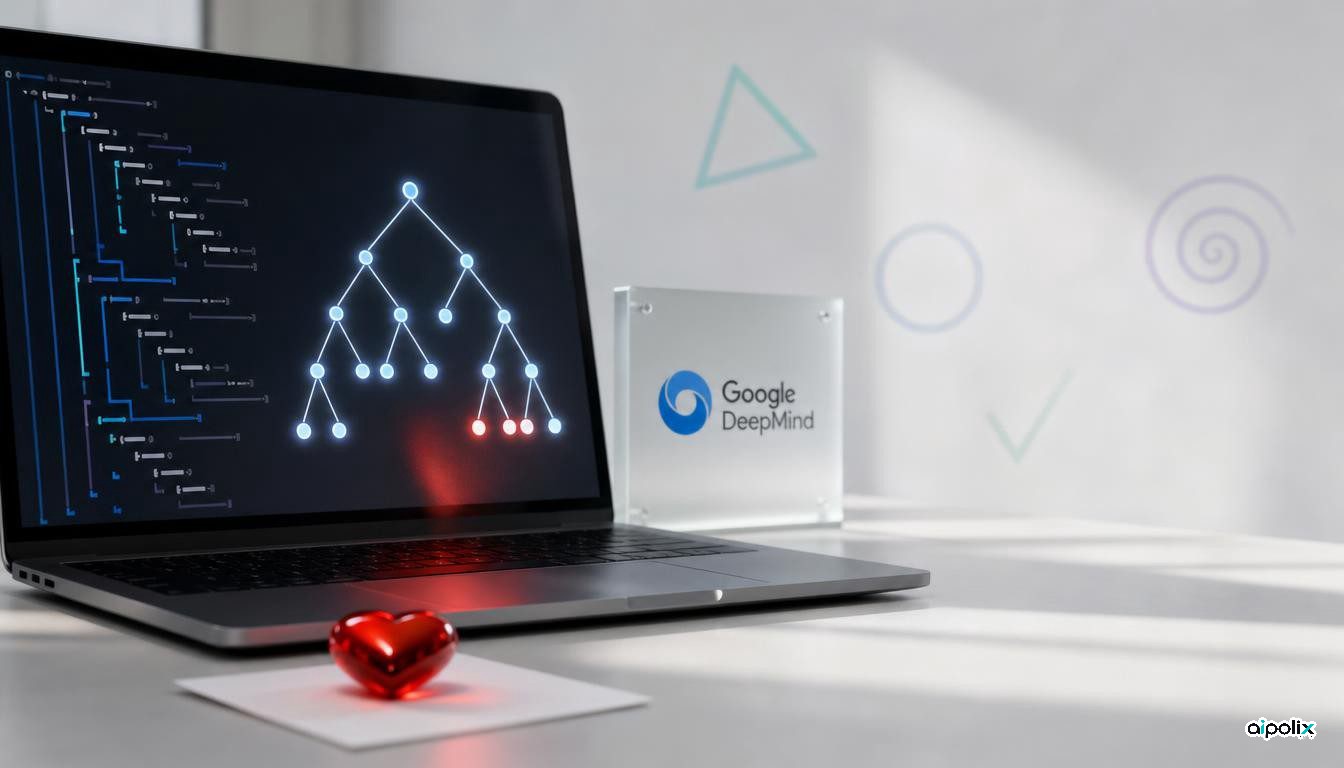
Researchers at Google DeepMind report that a small picture of a red heart, placed in front of a routine coding request, was enough to change how two leading AI models wrote their answers. In a preprint posted to arXiv on October 27, 2026, titled "A Heart Means Recursion: Exploring Visual Meaning and Communication in VLMs", the team says Claude Opus 4.7 and GPT-5.4 switched from loop-based code to recursive code in every sampled answer when the heart was present, and that the models' own reasoning rarely acknowledged the image's role. The authors present the work as preliminary findings.
The paper is by Alexa Tartaglini, a Stanford researcher who did the work as a student researcher at Google DeepMind, with Zhengxuan Wu, Thaddäus Wiedemer, Martin Wattenberg, Been Kim and Yuxuan Li of Google DeepMind. The main test is an inorder traversal of a binary tree, a textbook problem that can be solved equally well with recursion or with an explicit stack. Each model was told to look at an attached 400 by 400 pixel image of a simple symbol and then solve the task, with 20 answers sampled per condition. Without an image, Claude Opus 4.7 and GPT-5.4 never chose recursion and Gemini 3.1 Pro chose it 40% of the time. With a red heart, the paper reports, Claude and GPT-5.4 went to 100%. For Gemini, a yellow checkmark lifted the share to 90%. Those shifts come close to what the team measured when it simply instructed the models to use recursion.
The researchers then built a library of 288 symbols from 24 shapes and 12 colours, and each model reacted in its own way. According to the paper, triangles, hearts and circles pushed Claude toward recursion regardless of colour, hearts did most of the work for GPT-5.4, and Gemini responded to particular combinations such as a pink plus sign or a cyan spiral. Branching arrows, a shape a person might link to recursion, did not move Claude at all. Several controls point to the symbols themselves: text captions describing the same shapes produced much weaker and poorly correlated effects, Gaussian noise and ordinary ImageNet photos caused no systematic shift in the frontier models, and shuffling a symbol's pixels or rotating it away from its usual orientation weakened the effect.
The pattern was not limited to one exercise. The team reports similar steering on other recursion problems, on the choice between depth-first and breadth-first search, and on data structures; circular shapes, for example, nudged models toward ring buffers. Outside coding, symbols changed writing style and answers to simple preference questions. Pink shapes and hearts made all three models write more poetically, and blue triangles led Gemini 3.1 Pro and GPT-5.4 to prefer winter over summer.
The result with the most practical weight concerns what the models say about their own choices. When images were inserted without any instruction to look at them, the strongest symbols still shifted behaviour, and GPT-5.4's reasoning traces never mentioned the image. Asked directly whether a symbol meant recursion or iteration, the models gave answers that only weakly matched the measured effects. In Gemini 3.1 Pro's thinking traces, 71.5% of the cases where a symbol actually steered the answer dismissed it as irrelevant and cited technical reasons instead. GPT-5.4 showed the opposite error: in 74.7% of cases where a symbol had no effect, its traces claimed the image had decided the strategy.
A second set of experiments had a model draw or pick images to steer or inform another copy of itself. Senders tended to choose spirals, infinity signs and arrows, shapes that humans find intuitive, rather than the shapes that actually moved the receiver, which the authors call a generation-interpretation gap. With free-form drawings written as Python PIL code, 97.8% of the concept and story games eventually succeeded. Restricted to simple symbols, only 47.8% worked on the first try and 30.7% never got there within five turns. In a small human study with seven participants, people matched the steering direction of the top symbols only about 36% of the time, below the 50% chance level.
The authors argue that deliberate covert signalling between models looks unlikely for now, because the associations are only weakly shared across models. They see a nearer risk in unintended visual steering of agents that work through screenshots and graphical interfaces, where an icon or banner could shift behaviour in a way that oversight based on reasoning traces would miss. AlphaSignal, which covered the paper on October 27, and DAIR.AI Academy, which listed it among its papers of the week, summarised the same results.
The caveats are substantial. This is a preprint that has not been peer reviewed, each condition rests on 20 samples, and the tasks are synthetic. The effect also depends on wording: when the prompt stopped asking the model to choose a strategy, steering nearly disappeared for Claude and GPT-5.4, and moving the image to the middle of the prompt largely suppressed it. The human study is exploratory, and no code or data has been released. What the paper shows is that simple images can measurably move model choices in controlled tests, not that this already happens in real agent workflows.