
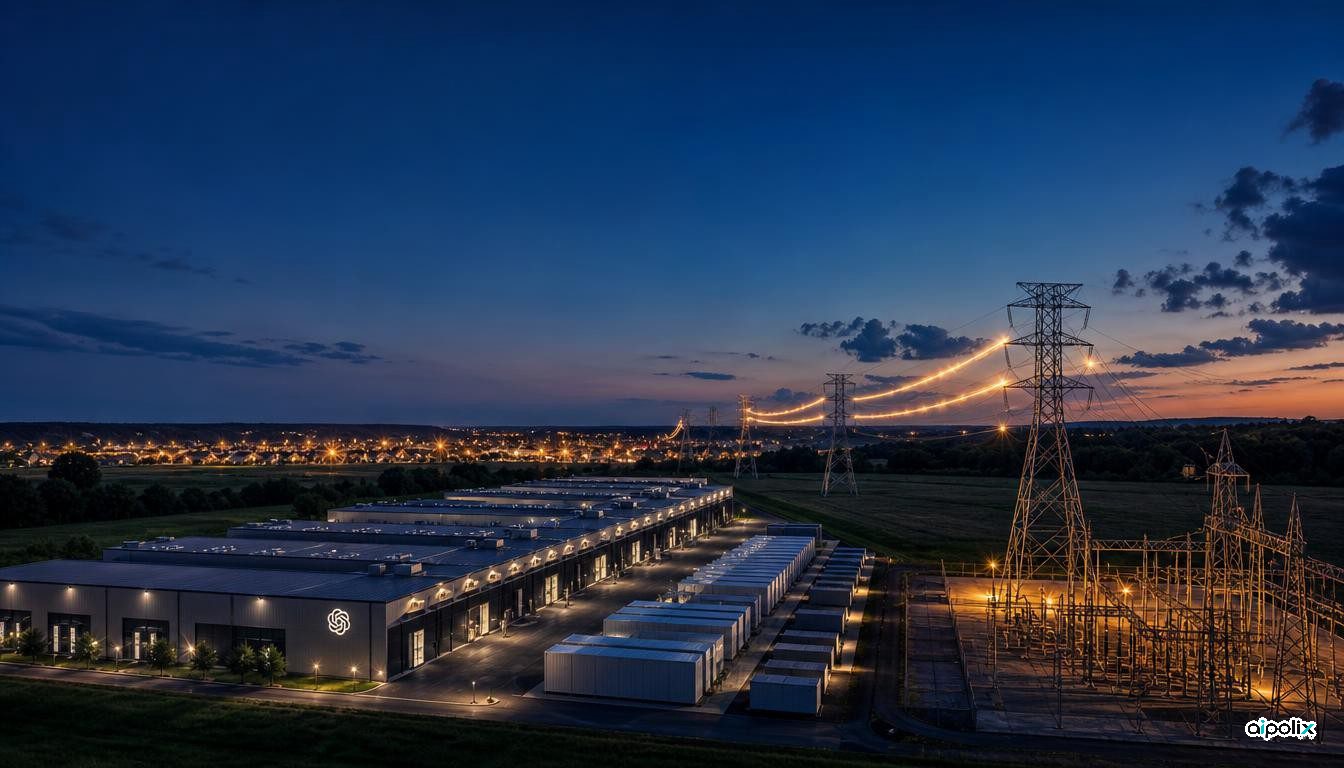
OpenAI on Monday, November 2, 2026, launched what it calls the Grid Protectors Program, a national framework under which the AI compute campuses it builds in the United States will reduce their electricity use when local power grids are under strain. The company says it will negotiate the terms with utilities, regulators and policymakers site by site, and that it will pay the full cost of the electricity and grid infrastructure its campuses require.
Under the program, each campus agreement would set three things: how much demand the facility can drop, how quickly it can do so and how long the reduction can last. OpenAI says the arrangements will differ by location and that it will publish further commitments as they are finalized. Depending on local needs and available equipment, it may also supply power back to the grid from on-site generation or storage, and use batteries and power controls to smooth swings in its own demand.
The pilot is OpenAI's planned campus in Effingham County, Georgia. There, the company says, it has already committed to pay the full infrastructure and electric-service costs of serving the project, and its agreement with Georgia Power includes up to 1,000 megawatts of flexible demand response. OpenAI compares that amount to the average electricity demand of roughly 700,000 households, which it says is more than Washington, D.C. and Boston combined. The Next Web reports that the campus is expected to need about 3.2 gigawatts and that the 25-year arrangement was approved in August. The campus is still in development.
OpenAI's economic argument is that grid assets such as power lines and substations are a fixed cost. A campus that draws power steadily through the year spreads those costs over more electricity sales, while flexibility at peak times limits the need for expensive upgrades. The company cites Georgia Power's projection of roughly $950 million in annual customer savings from 2029, a figure the utility attributes to its whole portfolio of large-load agreements and expected growth, including a project known as Project Camellia, and which it puts at no less than $15 a month for a typical household using 1,000 kilowatt-hours.
The announcement lands as resistance to data centers grows across the United States. The Verge notes local protests against large projects and laws in states including Tennessee, Florida, Oklahoma and Oregon meant to stop AI companies from passing energy costs on to residents. It also points out that OpenAI has started calling its facilities compute campuses rather than data centers. OpenAI itself cites projections that U.S. data center capacity will exceed 100 gigawatts by 2030.
Axios reports that the program covers U.S. campuses OpenAI develops directly, and quotes John McCarrick, the company's head of energy policy, saying that a year ago another large hyperscaler was still defending five-nines availability for its facilities and that he does not think anyone is doing that now. Axios adds that regulators are already pushing in the same direction: a Federal Energy Regulatory Commission demand on how grid operators connect large power users promotes flexible loads, and a Senate permitting bill would let states require data centers to limit consumption as a condition of grid service.
OpenAI concedes that flexibility cannot replace investment in new generation and transmission, and says long-term contracts and financial assurances can protect other customers if a project is delayed, reduced or canceled. Beyond Georgia, it has not named other sites or published the size of any other commitment, and its partnerships with Oracle and SoftBank on Stargate campuses in Texas and New Mexico are not described as part of the program.