
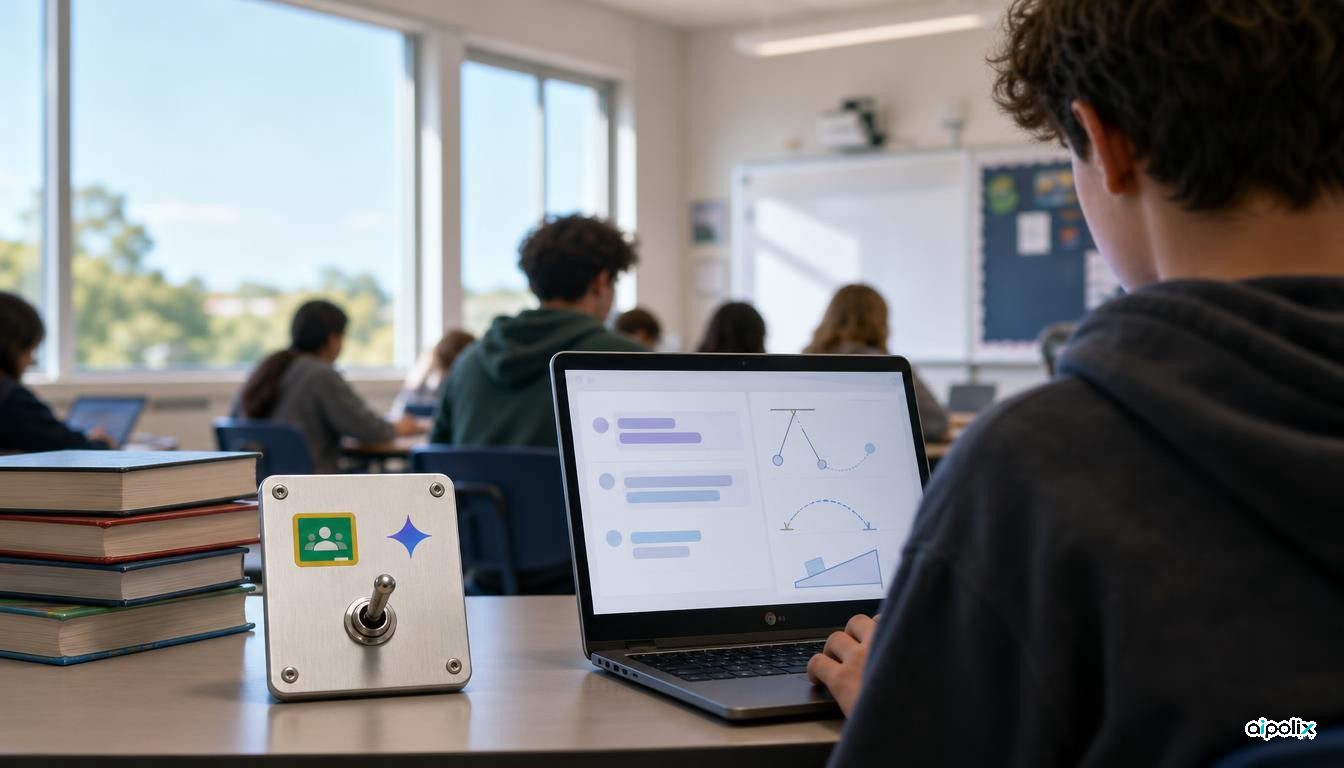
Google is changing how its AI tools reach schoolchildren. In a package of education announcements on November 3, 2026, the company said Guided Learning, a Gemini mode that coaches students through a problem instead of handing over the answer, is now available worldwide inside Google Classroom, and that a similar experience will be tested in Google Search with select U.S. schools later this month. In the same post, Google said access to Gemini, Gemini Notebook, Gemini in Classroom and Google Search will be entirely off for K-12 student accounts until a school administrator explicitly turns each product on.
The new default reverses the direction Google took this summer. Its Workspace Updates blog announced that from August 10, 2026, Gemini in Classroom would open to K-12 and university students of all ages whose administrators had already allowed Gemini or Gemini Notebook, with the Classroom Gemini tab on by default. Education Week reported in September that many districts were caught off guard and had to decide almost overnight whether to block it. Google now says the change follows feedback from schools, teachers, researchers and policymakers. It is not in force yet: the company says it will share specifics with schools in the coming months before the new controls roll out, gives no date, and does not explain what switching off Google Search will mean in practice for a student account.
In Classroom, Guided Learning is assigned by the teacher and then works as a one-to-one study tool anchored in the class's own materials, with real-time insights that show teachers where students are stuck. Google says it shaped the release after a four-week pilot run with Ark in three UK secondary schools, where some teachers asked for clearer visibility into student activity and fewer distractions during lessons. The company responded by adding educator insights and stronger grounding in uploaded curriculum.
The Search pilot works differently. When Google's systems recognize that a student account is looking for certain kinds of homework help, such as a pasted physics problem or a request to write a book report, Search will prompt the student through the reasoning step by step rather than jumping to a finished answer. Google plans to collect educator feedback before expanding the feature to other districts over the coming months.
To support the approach, Google points to its own research. In a randomized controlled trial with more than 300 University of Tokyo students who studied a statistics lesson for half a day, those using standard web resources raised their test scores by 5.3 percentage points, while those who also had Guided Learning in the Gemini app gained 8.1 points. Google presents that as 1.5 times the learning gain and concedes the figure may look modest for a single session.
The package also includes money and training. Google.org is committing more than $9.5 million to five organizations working with educators, among them the City University of New York, the Krause Center for Innovation, Teaching Lab and Fab AI, which Google says is working with Google DeepMind and the Gates Foundation on open models for lesson planning and early reading. The free Google AI Educator Series, already offered in the U.S., India, Korea, Malaysia, the Philippines and the UK and Ireland, will reach Brazil, Mexico, Spain, Australia and sub-Saharan Africa in the coming months, and new U.S. modules go live on November 4.
For schools, an opt-in default puts the decision on student AI access firmly with administrators, which answers the main complaint about the August rollout but also means districts that want Gemini for younger students will have to act. Several questions remain open: when the new controls take effect, how existing settings will carry over, and what the Search restriction covers. The learning-gain results come from Google-run studies and have not been independently replicated.