
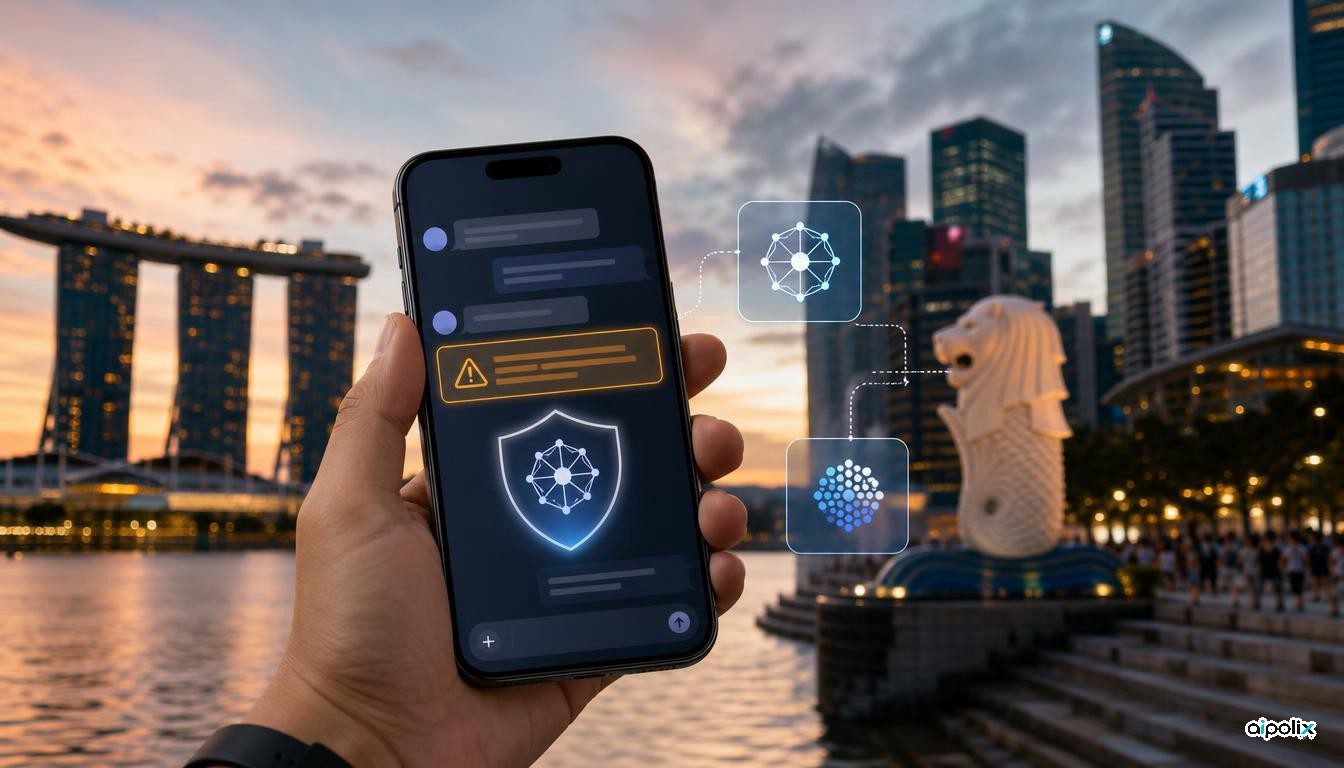
Google DeepMind and Singapore's Government Technology Agency (GovTech) said on October 14, 2026 that they have fine-tuned a lightweight Gemma model for on-device scam detection as part of their National AI Partnership. The work was presented at Singapore International Cyber Week. The model is designed to spot manipulative conversational patterns that mark investment scams, bogus hiring pitches, and spoofed bank or official identities, which Singapore authorities say now drive most scam losses.
Unlike cloud scanners that need server-side access to messages, the system is meant to analyze conversations on the handset after the user consents inside a host app. DeepMind says neither Google nor the Singapore Government can read those conversations through the deployment because inference stays on device. When the model judges a thread as manipulative, it triggers a local warning that asks the user to pause before sharing credentials or money. Mark Chen, GovTech's director for trust and safety, framed the project as bringing advanced protection onto citizens' devices while keeping personal communications private. DeepMind authors JJ Geewax and Miguel de Andrés likewise stress that the model only sees on-device conversations under each host app's terms of use. That consent framing matters for encrypted messengers that cannot offer server-side content scanning without breaking end-to-end encryption.
Training focused on local scam tactics rather than generic phishing. The team fine-tuned Gemma on anonymised scam dialogues drawn from reports and intelligence feeds, covering impersonations of Singapore institutions and regional schemes. Fine-tuning ran inside a GovTech-managed Google Cloud sandbox so training data stayed under Singapore control, and the companies say private citizen messages were not used.
Battery life is a hard constraint on phones, so the pipeline is two-stage. A light classifier screens inbound messages at low power. Only suspicious threads are passed to the fine-tuned Gemma model for deeper in-context analysis. DeepMind presents that design as a way to keep always-on monitoring practical without draining the battery on every message.
No launch date, accuracy figures, battery measurements or named messaging apps were published. Independent coverage in The Straits Times and CNA confirms the announcement and notes that Android is the initial target while many Singapore users still carry iPhones. The companies describe a carefully phased rollout with Singapore authorities and say similar on-device approaches could later be explored in other countries. Until those details appear, the public claim is architectural: local fine-tuning, on-device inference, and a government sandbox for training governance.
The project sits beside Singapore's wider scam-defence stack, including GovTech systems that already scan large volumes of suspicious websites. Officials argue that end-to-end encrypted chat apps leave a gap that only on-device models can fill without breaking encryption. For AI product teams, the story is a concrete government partnership that treats a small open model as public-safety infrastructure rather than a cloud API feature.