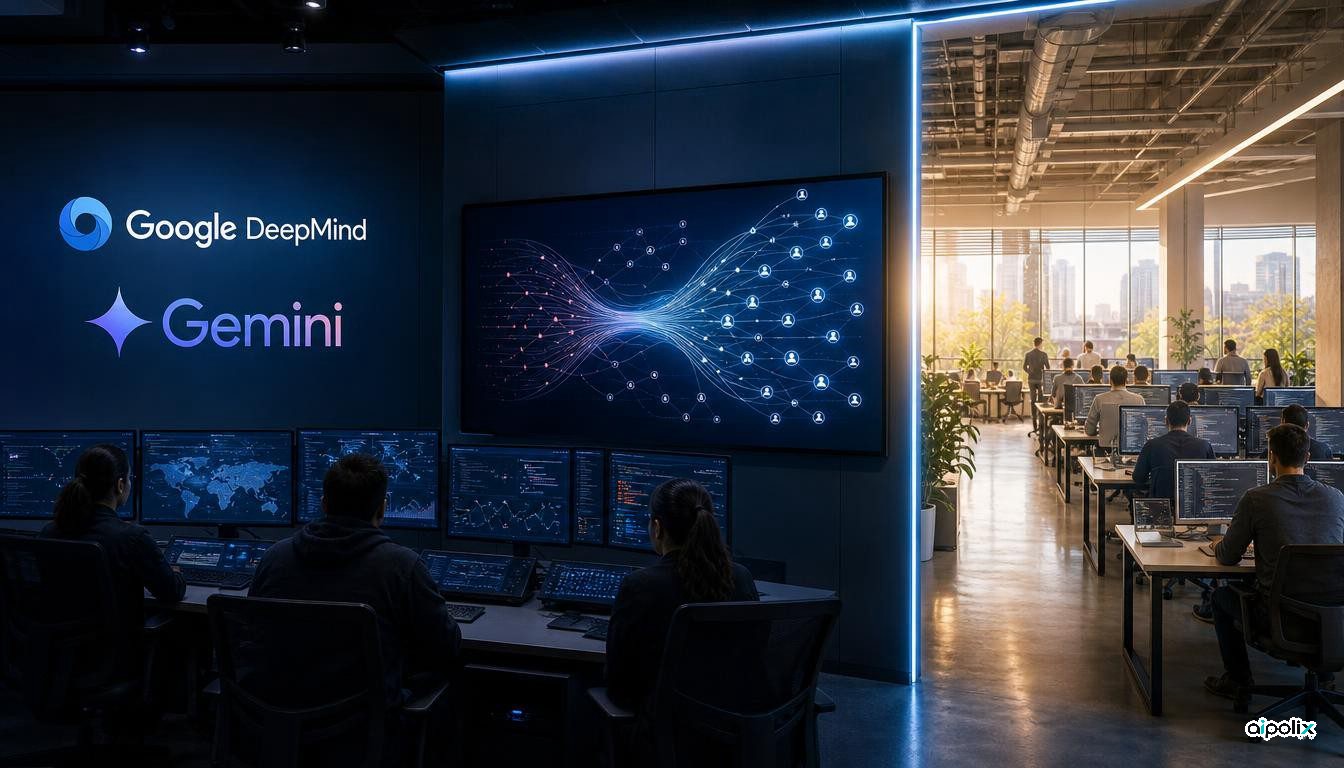
Google DeepMind said on November 10, 2026 that Gemini 4 Carbon is now available to developers, enterprises, scientists and consumers, two weeks after the company limited the model to vetted cybersecurity defenders in its Fairwind Program. Koray Kavukcuoglu, senior vice president of Google DeepMind and chief AI architect at Google, wrote the first-party post. He described Carbon as the company's strongest model for cybersecurity work and for long-horizon agent tasks in complex knowledge work, software engineering and scientific reasoning.
The October 28 announcement had presented Carbon as a frontier model that would at first reach only approved security teams. Today's post changes that availability. Google said paying developers and enterprises can use Carbon through the Gemini API in Google AI Studio and in Gemini for business, and that Google AI Ultra subscribers are getting it in Google Antigravity, the Gemini app and AI Mode in Search. A companion developer post and the Gemini API changelog record the same date, listing the public model as gemini-4-carbon. Cyber-focused access through Fairwind remains a separate track; defenders still apply to that program on a rolling basis.
Google set Carbon's introductory API price at the same level as Gemini 4 Argon: 2 dollars per million input tokens and 10 dollars per million output tokens through November 30, 2026. After that date, the company said, the public Carbon model will cost 4 dollars per million input tokens and 20 dollars per million output tokens. Kavukcuoglu wrote that Argon remains the better everyday choice for most software engineering and knowledge work, while Carbon is meant for harder multi-step coding, debugging and open-ended scientific research, and that it uses more tokens than Argon to explore, reason and run longer verification loops.
To support larger projects, Google is previewing a /swarm command in Antigravity that turns one prompt into a coordinated group of agents. The company said developers can assign Carbon to roles that need the deepest reasoning, such as design, coordination and auditing, and pair it with faster models in isolated workspaces and with adversarial verifiers. Google also said it partnered with Artificial Analysis on a new Multimodal Knowledge Agent benchmark for agent workflows over dense files; it reported that Carbon ranked second on that test while costing more than six times less per task than the top model. Separate vendor-reported results have Carbon first on CursorBench 4.0, Perplexity's WANDR and Zapier's AutomationBench, at more than twice lower cost per task than the next external model. Those figures come from Google and have not been independently audited in this reporting.
On cybersecurity, Google said that when Carbon is used through Fairwind it leads internal comparisons on SEC-bench Pro, ExploitGym and CWE-bench v1. The company described early uses inside Project Fortify, where it said Carbon reached 100 percent recall on scanning and 95 percent precision on triage in an internal benchmark, and an over 25 percent relative improvement on Argon's recall when testing open-source repositories. It also said Google's Cloud Vulnerability Research team used Carbon to show that two bugs in popular open-source software were exploitable, and that Wiz used the model in its Scan for Good program to find zero-day issues at two major software-as-a-service providers in under two hours. Those accounts are Google's own.
The same post described stronger scientific reasoning and said access to Carbon is being added to a program that already invited 10,000 scientists to use Argon in Antigravity free for six months. Researchers at Google, using Carbon with other models, built an agentic formal-verification system called AlphaProof Code and applied it to Signal's cryptographic protocol, a result DeepMind published the same day in a separate research post. A safety and security report attributed to Anca Dragan and Raluca Ada Popa accompanies the launch. Google said Carbon blocked 99 percent of attack trajectories in simulated tests and reached a 0 percent success rate on Gray Swan's indirect prompt-injection benchmark two weeks earlier, while also warning that automated red teaming still finds room to improve against sophisticated attacks. Readers should treat benchmark ranks, factory-style demos in Antigravity, and safety percentages as the company's reported results, and should note that Fairwind access for the cyber-specialized path is still gated.