
Google DeepMind said on November 10, 2026 that it is introducing Gemini Robotics 2.5, which it called its most capable vision-language-action model to date. The first-party post is bylined Carolina Parada. She wrote that the model increases both the range of skills a robot can learn and the speed at which it can acquire them, with gains in dexterity, reliability and safety intended to help robots move from laboratories into less structured workplaces.
DeepMind said it evaluated the model across more than 200 distinct tasks, including using everyday tools, tying a bow on a gift box and pipetting liquid. Compared with previous baselines, the company reported a 30 to 100 percent higher success rate depending on the type of task, and said robots completed tasks 20 to 30 percent faster. As with earlier Gemini Robotics models, it said the system works with many robot types, including Apptronik's Apollo 2 humanoid, which uses the five-finger, 22-degree-of-freedom SharpaWave hand, and a Franka Duo platform with two-fingered grippers.
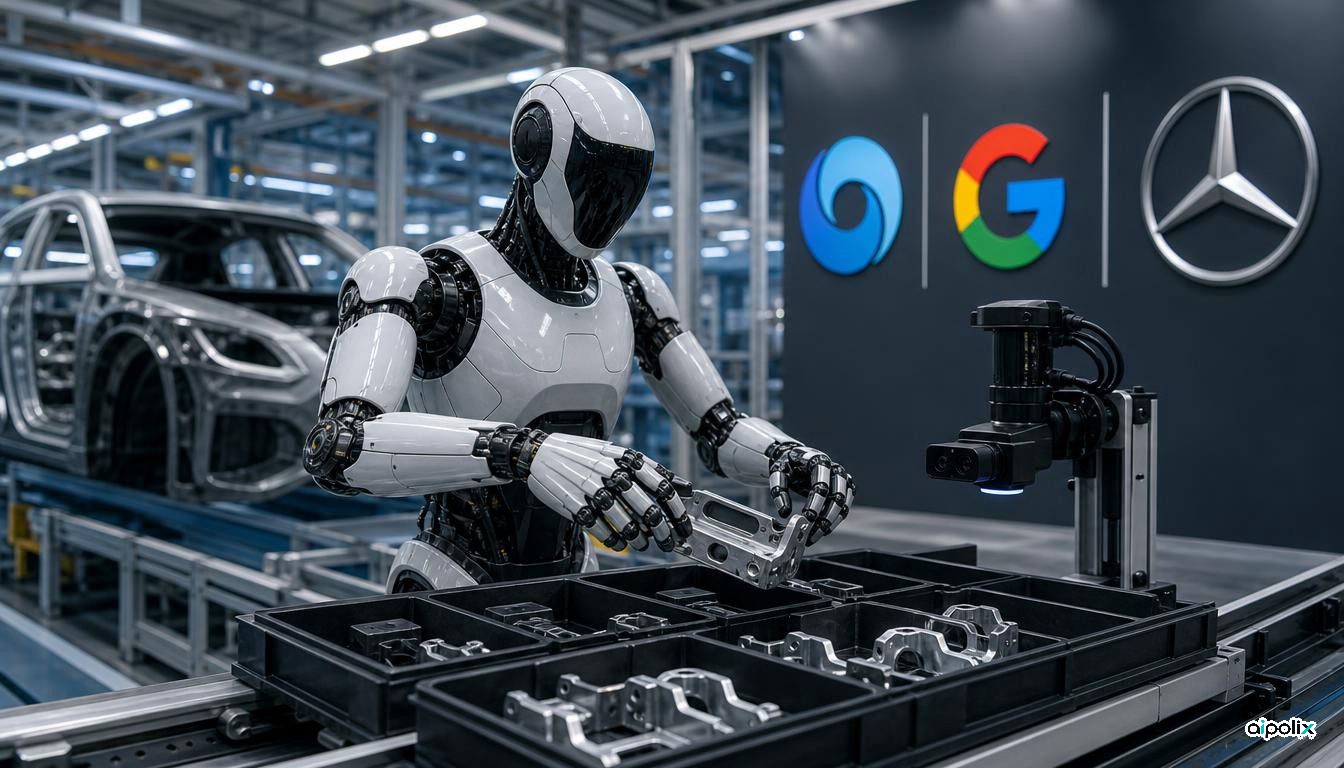
The most specific real-world claim is a proof-of-concept with Apptronik and Mercedes-Benz on active automotive lines in Kecskemét, Hungary, and Sindelfingen, Germany. DeepMind said Apollo 2 used an embodied reasoning model, Gemini Robotics ER, to keep track of the workflow and Gemini Robotics 2.5 to control its hands and arms while picking metal brackets from supply bins and placing them into sequencing trays. The company reported a 96 percent success rate on that kitting task. Jeff Cardenas, co-founder and chief executive of Apptronik, is quoted as saying the models improved dramatically in a few weeks of post-training and carried over to Mercedes-Benz production with very little drop-off.
On safety, DeepMind said Gemini Robotics 2.5 uses inference-time reasoning guidance to steer around physical hazards as it works. In its evaluations, that capability increased safe task completion around obstacles by 33 percent and around nearby people by 43 percent. The company also said Gemini 4 Argon currently leads its agentic robotics evaluations on refusing unsafe tasks, resolving uncertainty and working near humans. To test jailbreak robustness it is releasing ASIMOV-Jailbreak, an open benchmark of hundreds of prompts that disguise unsafe requests across dozens of scenes. DeepMind said Argon achieved 99.5 percent jailbreak resistance, compared with 82 percent for its previous baseline, Gemini Robotics ER 2.
The post also described Gemini 4 Argon as an accelerator for robotics research itself. DeepMind said Argon can generate thousands of varied simulated practice runs from a real camera scene, help build a digital twin, and help researchers hypothesize why a task failed from video and test improvements in simulation and on real robots. Combined with real demonstrations, the company said, that loop helps a robot generalize more quickly to new scenes and objects.
Gemini Robotics 2.5 is rolling out to DeepMind's robotics partners. The acknowledgements thank partners including Agile, Apptronik and Mercedes-Benz. The performance percentages, the 96 percent factory figure and the jailbreak rates are DeepMind's reported results from its evaluations and from a partner proof-of-concept; this reporting did not independently time or score those trials. Readers should treat the factory work as a pilot on a defined kitting task rather than as evidence that humanoid robots are ready for unconstrained factory floors.