
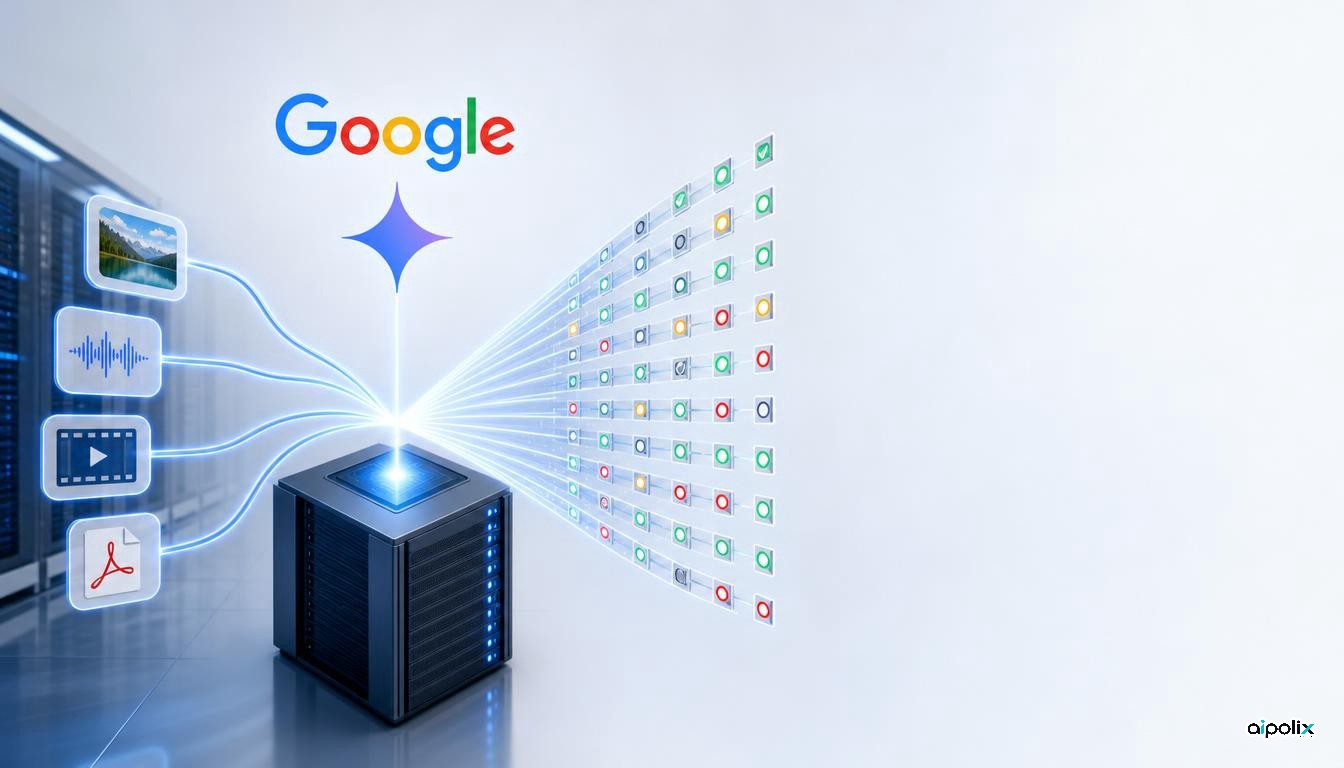
Google introduced the Gemini Decisions API on November 11, 2026, a new endpoint in the Gemini API in Google AI Studio built for fast, closed-set decisions. It runs on a new model, Gemini Decision 1 (gemini-decision-1). The announcement is bylined by Min Choi, a product manager at Google DeepMind, and Felix Yu, a principal scientist there.
The idea is to replace generated text with a score. Instead of writing an answer token by token, Gemini Decision 1 rates the candidate options in a single forward pass and returns probabilities and confidence values. Google says end-to-end latency is 150 to 250 milliseconds, of which 50 to 100 milliseconds is model compute, and that it stays nearly flat from one to 100 questions per request. One multimodal input of up to 256K tokens, mixing text, images, audio, video and PDFs, can be paired with up to 1,000 independent questions.
Questions come in three types. In Google's post they are named noul for yes/no conditions, choice for selecting among 2 to 255 options, and score for grading against an ordered rubric that starts at zero. Every answer includes a confidence score between 0 and 1, so application code can send ambiguous cases to a fallback model or a human reviewer. The input field reuses the Content block format of the Interactions API, and the post shows a Python example that checks a photo of a breakroom counter against all three question types in one call to client.decisions.create.
Pricing is $0.10 per million input tokens with no charge for output tokens. The shared input is billed once per request however many questions are asked, and each question adds only the tokens of its own instruction and criteria. Google lists no thinking-token charges or separate audio transcription and OCR fees, and says an API no-cost tier is available in Google AI Studio for prototyping. On a shared benchmark suite, Google states, the Decisions API is nearly five times cheaper than Gemini 3.5 Flash-Lite used through the Interactions API, and Gemini Decision 1 leads the suite, which covers agent routing, reasoning, ranking and multimodal understanding, with the lowest calibration error.
Google describes four internal uses. Gemini Notebook uses the endpoint as a real-time router that sends each query to a model tier and thinking level, with up to 40 percent lower latency on everyday queries. A rapid canvas experiment in Stitch uses it to generate playable wireframes in seconds and apply voice or touch edits almost instantly. CC from Google Labs picks an emoji reaction from a palette of more than 200 options, and Google Search uses it as a safety layer that detects adversarial behavior and content aimed at MCP tools.
For outside developers, the model is reachable through Google AI Studio, with Python, JavaScript and REST guides and three demo apps named Doorstep Parcels, Speed Sketch and Find the Zoo Keeper. Google says integrations are rolling out across OpenRouter, LangChain, Vercel, LiteLLM, Pydantic AI, Pipecat, LiveKit and OpenCode alongside the google-genai SDKs, with support in Gemini in Google Cloud coming soon.
The benchmark results, the cost comparison and the latency figures are Google's own and the underlying suite was not available for checking. The endpoint is also limited to closed-set questions, so it replaces classifiers and routers rather than open-ended generation.