
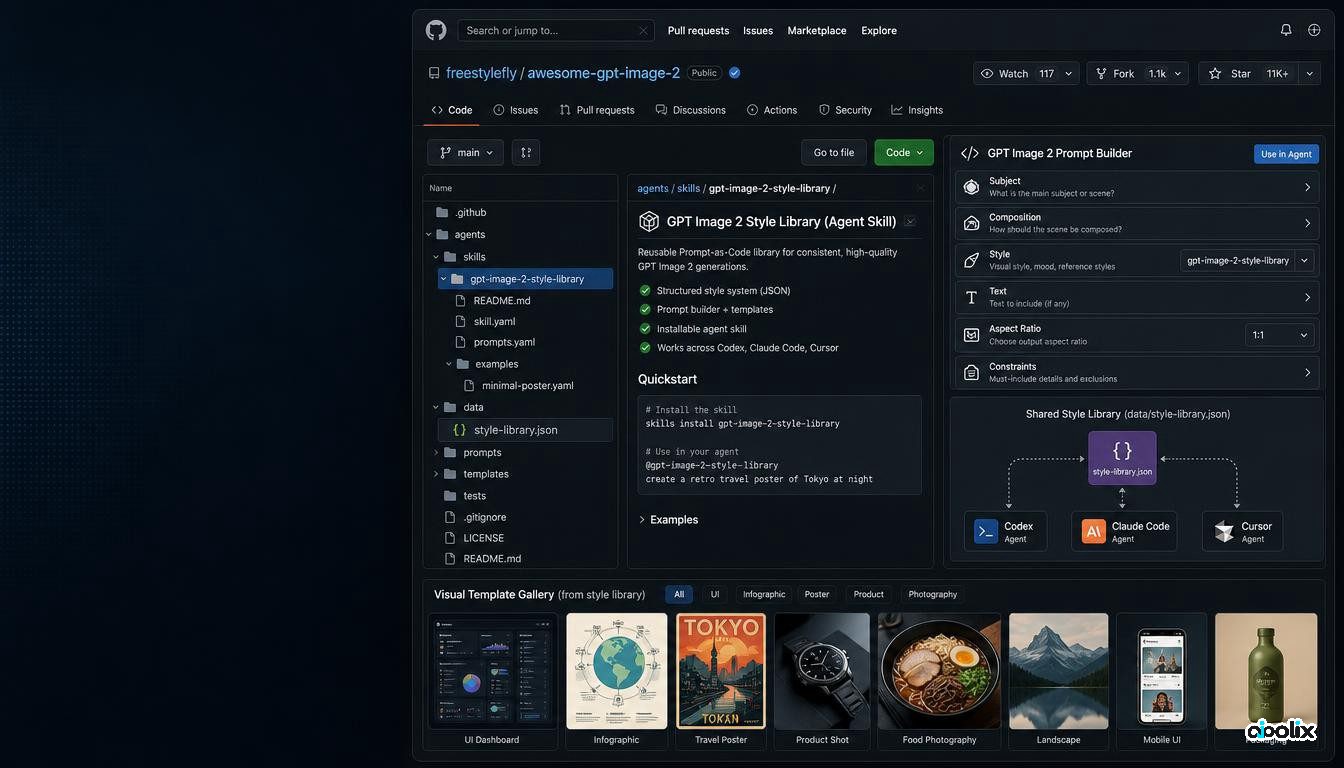
An open-source project built around OpenAI's GPT Image 2 is gaining traction by treating image prompting less like a collection of clever phrases and more like reusable software infrastructure. The awesome-gpt-image-2 repository now presents itself as a Prompt-as-Code system, combining hundreds of example cases, structured template categories, a generated style library and an installable agent skill. That combination is more consequential for developers than the raw size of the gallery, because it gives coding agents and automation workflows a repeatable way to select and assemble image prompts.
The adoption signal is substantial for a project that was first seen only a few months ago. A third-party repository tracker recorded 11,447 GitHub stars and 1,306 forks on August 20, 2026, while the skills.sh listing reports roughly 11.3K repository stars and about 1.2K installs of the GPT-Image-2 Style Library skill. Those figures are snapshots rather than immutable counters, and different trackers can lag GitHub by different amounts, but together they show that the project has moved well beyond a small experimental prompt collection.
The repository itself has also expanded. At the time of review, its README described more than 500 cases and exposed a browsable gallery of 520 cases spread across interface design, charts and infographics, posters, e-commerce, branding, architecture, photography, illustration, characters, storytelling, historical themes, publishing and other use cases. GitHub's repository page also showed 154 commits. The maintainers describe the cases as "reverse-engineered" and the templates as "industrial," but those descriptions should be read as project claims rather than independently validated quality guarantees.
The more important architectural change is the Agent Skill. The repository's skill definition instructs an agent to classify a user's intended output, match it against template categories, visual style tags, scene tags and nearby examples, then construct a final prompt with explicit sections for subject, composition, visual style, text requirements, aspect ratio and negative constraints. It can be installed into workflows for Claude Code, Codex, Cursor and other tools that support the emerging skills format. The repository also provides npm and GitHub Packages distribution paths, which makes the library usable as a component rather than only as documentation.
That matters because image prompting has a consistency problem. A one-off prompt can work well in an interactive session and still be difficult to reproduce in a batch pipeline, a content system or an agent that has to choose among many visual tasks. Awesome-gpt-image-2 tries to turn tacit prompt-writing habits into explicit structure. Instead of asking an agent to improvise every detail, the library gives it named categories, reusable templates, style tags, scene tags, known pitfalls and example references that can be selected systematically.
The timing also reflects a broader shift in the image-generation stack. OpenAI's GPT Image 2 model documentation describes the model as its current state-of-the-art image generation system, with support for both generation and editing, flexible image sizes and high-fidelity image inputs. The model snapshot dates to April 21, 2026. As model capability improves, the bottleneck for many production teams moves away from simply producing an acceptable image and toward controlling layout, text, consistency, format and repeatability across many images. Structured prompt libraries are one response to that operational problem.
For engineering teams, the useful part is not the promise that a template will always produce a better image. There is no independent benchmark in the repository showing that its templates consistently outperform carefully written custom prompts, and the project does not provide a controlled evaluation across models, tasks or image-quality metrics. The stronger claim is narrower: the project makes prompt construction more inspectable and reusable. A team can version a template, review its constraints, reuse it across jobs and expose the same style data to a website and an agent workflow.
The shared data model is particularly relevant. The repository says the Agent Skill's generated reference is built from the same data/style-library.json used by the website. That reduces the risk that the human-facing gallery and the agent-facing workflow drift into separate taxonomies. In practical terms, a style or template added to the underlying library can be regenerated into the agent reference instead of being copied manually into a second prompt catalog.
There are also reasons to treat the project cautiously. The README carries multiple commercial sponsors and promotes a paid community, so it is not a neutral benchmark or research dataset. The repository also acknowledges that many cases were inspired by publicly accessible community sources and warns that third-party content may have separate licensing constraints. Teams considering commercial reuse still need to inspect the provenance and licensing of individual examples rather than assuming the repository's MIT license automatically covers every referenced asset.
The project's popularity nevertheless points to a real developer need. Image generation is increasingly being inserted into coding agents, content automation systems and product pipelines, yet prompt knowledge often remains trapped in ad hoc documents or individual operators' habits. A library that turns those patterns into machine-readable categories and agent instructions can function as a lightweight control layer between a high-level creative request and a model-specific image prompt.
For AI practitioners, the takeaway is not that one repository has solved production image prompting. It has not. The more important signal is that prompt engineering for multimodal systems is beginning to acquire the same software practices that appeared earlier around text prompts: versioned assets, reusable schemas, package distribution and agent-accessible skills. Awesome-gpt-image-2's rapid adoption suggests developers see value in moving image prompting in that direction, even while the quality claims still need independent testing.