
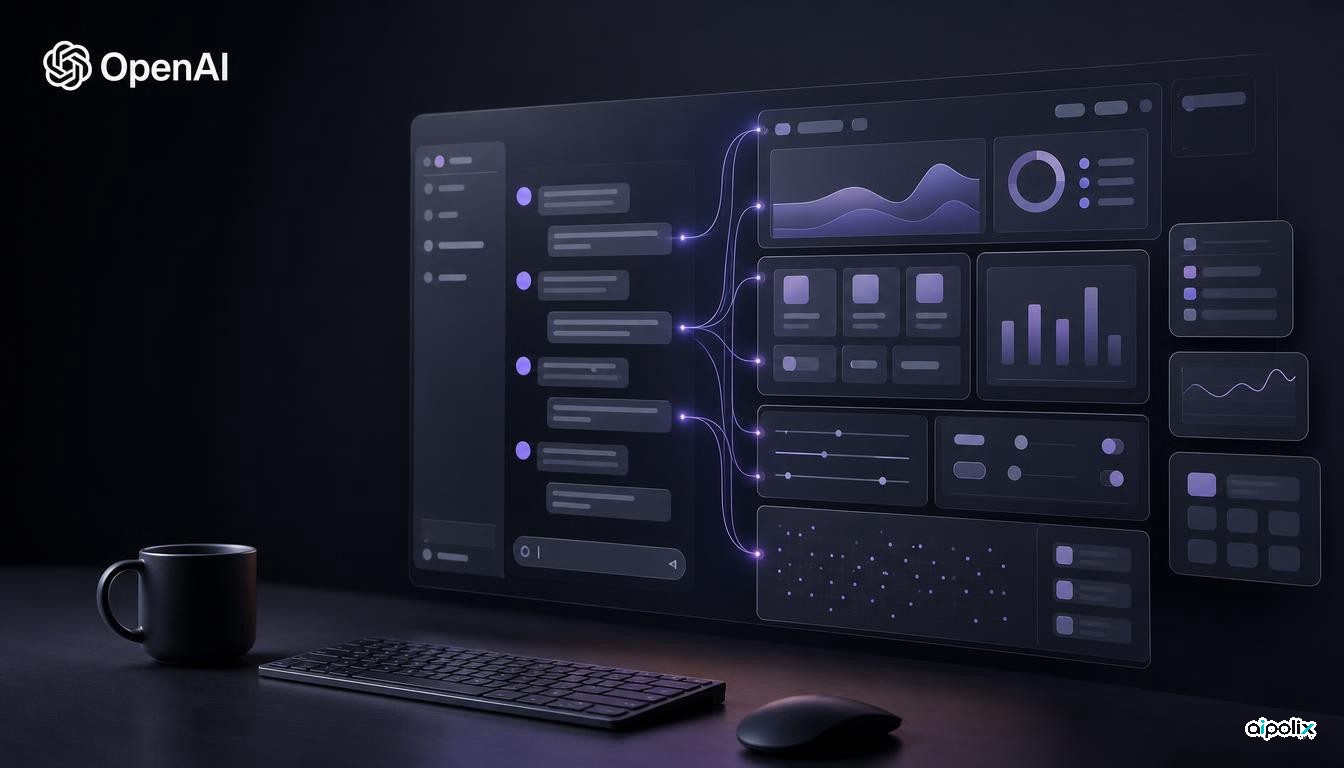
OpenAI has begun rolling out GPT-6 in ChatGPT together with a new response system called Intelligent UI, shifting some answers from static text into interfaces that users can interact with directly. The feature can generate response-specific elements such as buttons, forms, charts and other controls, so a conversation can become a lightweight working surface rather than only a sequence of messages. OpenAI says the interface is assembled while the answer is being produced, allowing visible components to appear progressively instead of waiting for a complete application-style render.
The company describes Intelligent UI as a native, streamable component system paired with a compiler that decides which interface elements fit the current answer. That approach matters because the interface is not a fixed template attached to a narrow task. A planning request could produce structured controls, a comparison could become an interactive chart, and a data-gathering flow could expose form elements. The product therefore blurs the boundary between conversational output and small task-specific applications, while keeping the generated experience inside ChatGPT.
The launch is tied to GPT-6 availability in ChatGPT. OpenAI says the rollout starts globally for Plus, Pro, Business and Enterprise users on October 7, with Free and Go following on October 8. Enterprise availability can still depend on administrator settings. The announcement also distinguishes the consumer ChatGPT rollout from other OpenAI surfaces: Work and Codex are not described as moving to the same model configuration as part of this release.
For users, the practical change is less about a single new widget and more about how answers can be acted on. A static recommendation normally requires the user to translate prose into the next set of clicks or entries. An answer that includes purpose-built controls can compress that handoff, especially for workflows involving choices, structured information or visual exploration. For developers and product teams, the move is another sign that general-purpose assistants are becoming runtime environments for generated interaction patterns rather than just text generators.
OpenAI also makes performance and responsiveness claims for GPT-6 in the announcement, but those claims are based on the company's own evaluations and should be treated as vendor-reported until broader independent testing is available. The more directly verifiable news is the product rollout itself, the supported interface primitives, and the stated availability schedule.
The open question is how reliably generated interfaces will behave across messy real-world requests. Dynamically choosing controls introduces a new quality dimension: an answer can be factually correct yet still present an awkward or misleading interaction. Adoption will therefore depend not only on model intelligence but also on consistency, accessibility and how safely the interface constrains actions. Intelligent UI is a significant expansion of the ChatGPT response format, but its long-term value will be determined by whether these generated surfaces remain dependable across varied tasks.